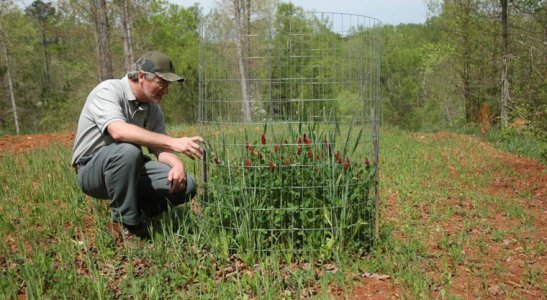
Good morning gentlemen. I'm off to plant chestnuts I just received from Chestnut hill but before I go I'll offer a few facts in response to some of the dialogue here.
First the. NDA article by Kip Adams; He offers the typical knee jerk political response with no facts. Let's look at the state of Texas where perhaps more people feed than anywhere else and deer mgt. is a religion. Countless thousands of people feed countless tons of feed year round both in high fence ranches and low fence. Historically to date 1) There are no reported cases of bovine tuberculosis in whitetail deer 2) There are no historical cases of bovine brucellosis reported in whitetail deer.. I didn't check mange but Ive never seen or heard of it on any places I've ever been. The same results are true for any property I have ever been on. The facts don't line up with his position and he leaves the benefits out
A brief deviation to discuss QDMA or the NDA. Back when they decided to kill the forum feature I had a lengthy debate [ argument ] with Brian Murphy about content QDMA puts out. I challenged him to stop the hypocrisy and take more political risk by discussing things that weren't readily accepted by some in the hunting community. Ex. The highest award presented by QDMA is the Al Brothers award. The first high fence I ever saw back in the 70's was built by Al Brothers on a ranch he heavily supplementally fed. He was one of the pioneers in game fencing and supplemental feeding to benefit deer. Yet QDMA was unwilling to acknowledge that aspect of Al's work much less present the values Ex. They have given their highest award to several of the biologist that literally created the enclosed deer breeder programs that have spread throughout the country. Yet they never discussed the factual pros /cons and realities of the deer breeder business { BTW I'm not a fan } I could go on. My " opinion " is they stay with politically safe generic content. I still review their food plots stuff though.
Steve Demarais. He states that deer are 3x more likely to visit a feeder than some other spot somewhere else therefore " concludes " it more likely spreads CWD . Pretty loose scientific hypothesis without a lot of back up don't you think? Let's look at some of his work. First pull up the MSU websight on him and you will see a pic of him in a breeder pen with feeders and heavily fenced. I know for a fact they have shipped deer from that pen all over the country...kinda contrary to the current CWD mantra right? Beyond that he has a significant body of research in larger study areas [ Faith Ranch for one } that heavily relied on supplemental feeding. I like much of Steve's work and think he is one of the good guys but his statement does not correlate with the wealth of factual experience disputing it. But everyone is trying to postulate and take the safe road on the CWD issue.
Now a caveat ....We should probably start a different thread for CWD. For me it is hard to separate fact from hysteria, false information, political agenda and reality. Nonetheless could be worthy discussions as there are some very interesting things going on in that world. Breeders have isolated deer that appear to be CWD resistant and are trying to identify the gene involved . Feed manufacturers are experimenting with ingredients copper being one that appear to help increase resistance to CWD. Lots to learn here but wouldn't it be fascinating if the deer breeding industry helped solve the CWD problem by populating resistant deer around the country while we all could feed deer a supplement that increased there resistance and improved there health.
I want to revisit feeders knee deep in mud feces and urine but need to move on. That is an incredibly unnatural occurrence As a general rule most animals don't crap or piss where they eat. I've been in numerous 2 acre deer pens with 15-20 deer in them and they don't eliminate anywhere near the feeder. Saliva--yep but piss and crap no. Thats my experience. But we can dig deeper into this concern later is useful.
CWD resistance? Do you have any links to research papers or scientific data? CWD is a prion and I think resistance to prion diseases is not easy. CJD is the human version of this type of prion disease and there is no cure and no treatment.
Here is what I found online (for what it is worth):


+5
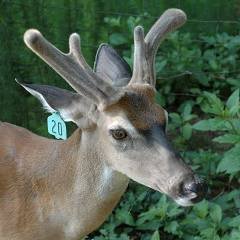
Chronic Wasting Disease (CWD) resistant deer are typically white-tailed deer with specific genetic markers (often referred to as the 96S allele) that, while not completely immune, allow them to live longer with, or slower succumb to, the fatal disease. These deer are primarily identified through genetic testing in captive breeding programs.
Key Facts on CWD Resistance:
- No True Immunity: No deer species is completely immune to CWD, and "resistant" deer can still contract and die from the disease.
- Slower Progression: Deer with specific genes (e.g., 96S, 96SS) experience a longer incubation period before showing clinical signs.
- Genetic Testing: Breeders are using DNA testing to identify and breed deer with these genetic traits.
- Concerns on Spread: While these deer live longer, they still carry and shed the infectious prion, potentially increasing the spread of CWD to other, more susceptible deer.
- Limited Impact in Wild: These resistant genes are currently rare in wild populations, and their effectiveness in controlling CWD in wild, free-ranging herds is still debated.
- Impact of Disease: CWD is 100% fatal and has caused up to 20% of some populations to die in endemic areas.
Breeding for resistance is considered a potential strategy to reduce CWD prevalence in captive herds, but its viability for managing the disease in wild, free-ranging populations remains under investigation.
Here is info on CJD:
6

Creutzfeldt-Jakob disease (CJD) is not curable and is considered 100% fatal, with most patients passing away within one year of symptom onset. There is no treatment to stop or slow the rapid progression of this brain disease. Current management focuses entirely on supportive care, comfort measures, and managing symptoms, such as using medication for pain and muscle jerks.
Key Aspects of CJD Treatment and Management:
- No Cure: No treatment exists to reverse or slow the progression of CJD.
- Supportive Care: The primary goal is to alleviate pain, reduce anxiety, and improve comfort.
- Symptom Management: Medications like clonazepam or sodium valproate may be used for muscle jerks (myoclonus).
- Experimental Research: While most treatments have failed to show benefit, researchers are investigating new approaches, such as antibodies (e.g., PRN100) that aim to stop prions from damaging the brain.
Because CJD is rapidly progressive, healthcare providers focus on palliative care to help patients and families manage the disease's symptoms.