• If you are posting pictures, and they aren't posting in the correct orientation, please flush your browser cache and try again.

    Edge
    Safari/iOS
    Chrome

Sale on 41% glyphosate at Menards

Yep. 2.5 gallons of surfactant last forever. I never buy the gly with it already in. Cheapest I can find.

 
^^^ co-ops by me don't even bother to stock the non-surfactant small quantity jugs of gly. Maybe they sell that way in 30 gal or 55 gal barrels for farmer types but for the 1 gal and 2.5 gal jugs maybe why carry extra inventory if Joe public wants convenience for a few bucks more. Perhaps online sales has more choices and of course related shipping cost too.

Not gonna spend another $10 in gas driving to some other locations to find the "cheaper" option.
 
Thanks for posting this....I went to Menards and purchased several jugs today! Rural King offers it at this price regularly, but we don't have any near us. For our area, this is a great price.
 
Nice deal. The jug I am on was $89 last year or two.

surfactant should be used. IF you have hard water, AMS is more important. I probably got 2 limetime supply of that with a 2.5 jug. Some years only do around the apple trees and a 1/2 acre plot. Did 3 acres last year. Camp's creek water is a pH of 4.5-5, so no need. When I did add AMS to that creek water, the jet screens wuld plug up with orange slime. Tannins from forest decay is my guess.
 
BTW, according to the manufacturer. "Compare-N-Save 41% Glyphosate concentrate contains a built-in surfactant. It is formulated as a "plus surfactant" product, meaning you do not need to add a separate surfactant for standard weed control applications. I confirmed this on the jugs I purchased.
 
AMS stands for ammonium sulfate. When using spray-grade AMS, it is typically added to the water before the herbicide. Once in the tank, AMS dissociates into ammonium and sulfate ions. The sulfate portion helps tie up hard-water cations such as calcium, magnesium, iron, and other positively charged ions that may be present in the water.

If AMS is not used, those hard-water ions can bind with herbicides like glyphosate and reduce their effectiveness. This is especially important with glyphosate because it is very prone to antagonism from hard water.

This should not be confused with a surfactant. AMS is mainly used for water conditioning and to help improve herbicide performance in hard water. A surfactant, on the other hand, helps reduce surface tension so the spray droplet spreads more evenly across the leaf surface. Many agricultural surfactants are also designed to improve spreading, sticking, wetting, and sometimes penetration through different leaf surfaces, especially waxy leaves.

The Dawn dish soap analogy makes sense to a point because dish soap can reduce surface tension, but it is usually not as effective or consistent as a proper agricultural surfactant. Ag surfactants are designed help beyond just surface tension reduction.

A common spray order would be: fill the tank with water, add AMS and agitate, then add glyphosate and the proper surfactant if not a blended product.

I hope this helps.
 
AMS stands for ammonium sulfate. When using spray-grade AMS, it is typically added to the water before the herbicide. Once in the tank, AMS dissociates into ammonium and sulfate ions. The sulfate portion helps tie up hard-water cations such as calcium, magnesium, iron, and other positively charged ions that may be present in the water.

If AMS is not used, those hard-water ions can bind with herbicides like glyphosate and reduce their effectiveness. This is especially important with glyphosate because it is very prone to antagonism from hard water.

This should not be confused with a surfactant. AMS is mainly used for water conditioning and to help improve herbicide performance in hard water. A surfactant, on the other hand, helps reduce surface tension so the spray droplet spreads more evenly across the leaf surface. Many agricultural surfactants are also designed to improve spreading, sticking, wetting, and sometimes penetration through different leaf surfaces, especially waxy leaves.

The Dawn dish soap analogy makes sense to a point because dish soap can reduce surface tension, but it is usually not as effective or consistent as a proper agricultural surfactant. Ag surfactants are designed help beyond just surface tension reduction.

A common spray order would be: fill the tank with water, add AMS and agitate, then add glyphosate and the proper surfactant if not a blended product.

I hope this helps.
Where do you buy AMS?
Everything I find is some form of fertilizer. Like 21-0-0 or 21-0-0-24S
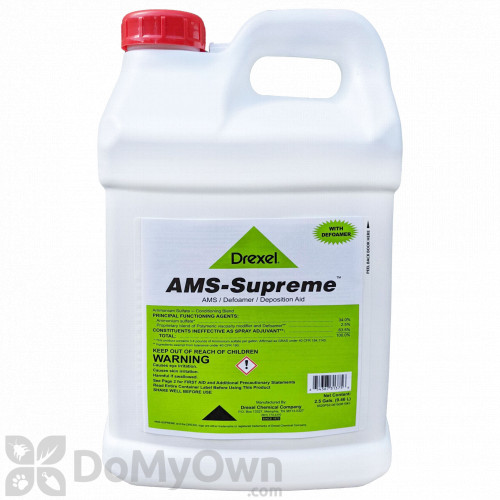
 
Where do you buy AMS?
Everything I find is some form of fertilizer. Like 21-0-0 or 21-0-0-24S
Rural king has it - in a liquid and a granular. Coops often have it. Just ask for it to be”spray grade”
 
Will the bottle give me some guideline on how much to use?
 
Will the bottle give me some guideline on how much to use?
Yes. The is also a great PDF that is available online from the product specifications. 41% glyphosate is pretty much the “norm” for habitat users, so feel free to post your questions as well.

Product Label
 
Yes. The is also a great PDF that is available online from the product specifications. 41% glyphosate is pretty much the “norm” for habitat users, so feel free to post your questions as well.

Product Label
Got that label. I meant how much AMS to use.
 
Got that label. I meant how much AMS to use.
Depends on the product you select. Most are figured per 100 gallons of water but almost all of the ones I've used have different rate recommendations.
 
You can also use Citric Acid as well for a water conditioner. I have used it and don't see any difference in it and other products.
 
IVe seen a few AG papers comparing weeds sprayed with moderate and low doses of gly. One with ams one without. 32oz/acre without ams ldid not kill as good as 16oz/acre gly with AMS.

I used pool test strips on my home's well water to see how much hardness and pH i had. Just did it now. I had 150ppm calcium hardness, pH of 7.5 or so, and alkalinity is high. Your hardness will vary depending on water table / time of year.

My drexel AMS supreme didnt have the label left on it. I wrote 28 ounces per 15 gallons. Not sure if that was suggested, or I calculated / pH testes the hardness and added until the pH was 6 or so. Could be many things other than H20 in there..... Calcium carbonate is an off white stain. Magnesium sulfate is more yellowish. Pool test strips check total hardness and rate it in calcium hardness. 150ppm is not very hard water.

This is even more important if your gly water mix sits around. I keep a 1 gallon sprayer filled all season for my apple tree cages. The longer the gly sit round calcium and magnesium ions untreated, the weaker it gets. I add 2 ounces per gallon.

More than needed is fine, like hey say its fertilizer. Not all liquid nitrgoen fertilizers are ammoium sulfate. I just keep it to roughly just enough because I want to save some money.

MY brother in law has a 350 head dairy farm and manages another farm as well as close to 5000 acre AG services. He mixes enough until he gets a pH in the 5's when nuking a fallow field. He goes in the mid 6's when using on roundup ready crops. His small fleet of john deere sprayers make my ATV sprayer look like a kids toy......


I use a 5 gallon paint mixer paddle on my electric drill to help mix.

As said before I do not use at camp when using the creek water. I used to bring water from home, but now use a 12v bilge pump with a strainer to fill the tanks. Gets the little bits of whatever out of the creek water. And since the creek water is devoid of calcium and very acidic like in the 5's, AMS clogs my strainers in the nozzles. IT makes an orange sludge and I dont use it there. Sandy soil spruce n birch forest. Coastal water from sandy sources is also very low in hardness.

Ammonia sulfate could be hard to get this year. ITs made from petrochemicals and is a byproduct of nylon production. Alot of plastics come from that region.
 
Last edited:
Surfactant lowers the surface tension of water. It makes the water (and herbicide with it) flatten out on the waxy leaves instead of rolling off the leaves like the waxy surface is repelling it.

image is swiped via google, showing what a surfactant does. You'll find coments like "a surfactant makes water wetter", which sounds silly, but is sorta true. Without a surfactant, more of your herbicide will roll off the leaves and fall to the ground.

Using dish soap is fine. The stuff bottled as surfactant is just cheaper, if you need a lot of it.

View attachment 91877
I had used dishsoap for years and it works often. Surfactant works better....and products like Turbo make it work REALLY well.

While this post was on Gly- anyone who has struggled with Cleth or Imox, the dishsoap is the weak spot
 
The idea of testing the solution to get an ideal ph is next level.

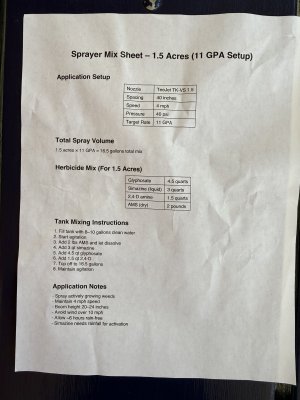
This is my worksheet for a recent switchgrass prep application. It was the first time I used this sprayer and I don’t like these spray tips. Too much drift and mist, I couldn’t turn down the PSI because I wasn’t getting enough water per acre. I don’t have time to figure it all out right now but I want more water per acre and bigger droplets. Might involve changing tip spacing. Anyway, this is my worksheet for this application. I am around a pound and a half dry AMS per acre.

Local FS was out of liquid AMS. I don’t mind mixing dry but you cant just chuck it in there. Needs agitation so tank partially filled and pump running. A bag of AMS lasts me a long time. I am storing it in a tall (7 gallon?) bucket with a tight lid because it will clump up over time. Assume thats due to moisture. If you just throw an open bag in the corner it clumps and you end up with dead bugs and crud that your sprayer won’t like.

Feel free to critique my sprayer worksheet- I’m trying to do this accurately and safely.


IMG_1606.jpeg
 
Last edited:
The idea of testing the solution to get an ideal ph is next level.

This is my worksheet for a recent switchgrass prep application. It was the first time I used this sprayer and I don’t like these spray tips. Too much drift and mist, I couldn’t turn down the PSI because I wasn’t getting enough water per acre. I don’t have time to figure it all out right now but I want more water per acre and bigger droplets. Might involve changing tip spacing. Anyway, this is my worksheet for this application. I am around a pound and a half dry AMS per acre.

Local FS was out of liquid AMS. I don’t mind mixing dry but you cant just chuck it in there. Needs agitation so tank partially filled and pump running. A bag of AMS lasts me a long time. I am storing it in a tall (7 gallon?) bucket with a tight lid because it will clump up over time. Assume thats due to moisture. If you just throw an open bag in the corner it clumps and you end up with dead bugs and crud that your sprayer won’t like.

Feel free to critique my sprayer worksheet- I’m trying to do this accurately and safely.


View attachment 91979
That's an incredibly high rate of gly. What's the 2,4D for, do you have gly resistant weeds? 2,4D on emerging switchgrass can be very detrimental.

Regarding the sprayer nozzles, pressure, etc...what kind of sprayer is it? Were they the factory nozzles? Sometimes a heavy (thick) chemical like simazine can cause the sprayer to act differently than normal, something worth considering.
 
It is a very high rate- 3 quarts per acre. I usually go no higher than 2 quarts and usually 1.5 is just fine but I have some broad leaf stuff that I have trouble getting killed. I think I got that mix from the Switchgrass For Habitat fb site? I try to follow the Roger Sampson advice. He has a two week plantback on this application mix due to the 2-4d. Also this patch will not get any more gly this year. That damn seed is so expensive and I’m really trying to get a good stand early rather than waiting 3 years.

I think it’s good to point out that this is a very high rate! Gly is very effective on grasses at a much lower rate and I normally don’t use a rate that high so don’t use this as an example of what to do! The exception may be what I am trying to zap- reed canary grass. I have a hard time killing it.

That simazine is a bear. First time spraying it. It is thick looking- that very well may be why I got so much drift. I don’t think you would want to leave that in the tank without agitation. I bet you are right about that might be why I wasn’t happy with the tips.

Sprayer is a new to me Demco. I called over there before spraying to confirm exactly what tips I had. Talked to a cat that knew exactly what I needed to know and answered some other questions I had. Also- my old sprayer id a Fimco. It isn’t in the same room with this Demco. The Demco has a sump in the bottom that makes cleaning it out so much easier and the agitation is set up much better.
 
Last edited:
Back
Top