• If you are posting pictures, and they aren't posting in the correct orientation, please flush your browser cache and try again.

    Edge
    Safari/iOS
    Chrome

Sale on 41% glyphosate at Menards

Yep. 2.5 gallons of surfactant last forever. I never buy the gly with it already in. Cheapest I can find.
 
^^^ co-ops by me don't even bother to stock the non-surfactant small quantity jugs of gly. Maybe they sell that way in 30 gal or 55 gal barrels for farmer types but for the 1 gal and 2.5 gal jugs maybe why carry extra inventory if Joe public wants convenience for a few bucks more. Perhaps online sales has more choices and of course related shipping cost too.

Not gonna spend another $10 in gas driving to some other locations to find the "cheaper" option.
 
Thanks for posting this....I went to Menards and purchased several jugs today! Rural King offers it at this price regularly, but we don't have any near us. For our area, this is a great price.
 
Nice deal. The jug I am on was $89 last year or two.

surfactant should be used. IF you have hard water, AMS is more important. I probably got 2 limetime supply of that with a 2.5 jug. Some years only do around the apple trees and a 1/2 acre plot. Did 3 acres last year. Camp's creek water is a pH of 4.5-5, so no need. When I did add AMS to that creek water, the jet screens wuld plug up with orange slime. Tannins from forest decay is my guess.
 
BTW, according to the manufacturer. "Compare-N-Save 41% Glyphosate concentrate contains a built-in surfactant. It is formulated as a "plus surfactant" product, meaning you do not need to add a separate surfactant for standard weed control applications. I confirmed this on the jugs I purchased.
 
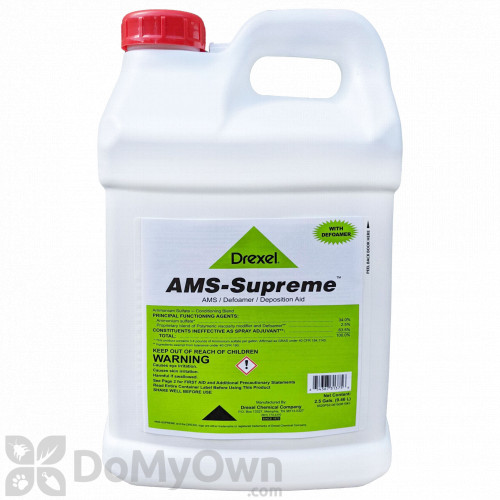
AMS stands for ammonium sulfate. When using spray-grade AMS, it is typically added to the water before the herbicide. Once in the tank, AMS dissociates into ammonium and sulfate ions. The sulfate portion helps tie up hard-water cations such as calcium, magnesium, iron, and other positively charged ions that may be present in the water.

If AMS is not used, those hard-water ions can bind with herbicides like glyphosate and reduce their effectiveness. This is especially important with glyphosate because it is very prone to antagonism from hard water.

This should not be confused with a surfactant. AMS is mainly used for water conditioning and to help improve herbicide performance in hard water. A surfactant, on the other hand, helps reduce surface tension so the spray droplet spreads more evenly across the leaf surface. Many agricultural surfactants are also designed to improve spreading, sticking, wetting, and sometimes penetration through different leaf surfaces, especially waxy leaves.

The Dawn dish soap analogy makes sense to a point because dish soap can reduce surface tension, but it is usually not as effective or consistent as a proper agricultural surfactant. Ag surfactants are designed help beyond just surface tension reduction.

A common spray order would be: fill the tank with water, add AMS and agitate, then add glyphosate and the proper surfactant if not a blended product.

I hope this helps.

 
AMS stands for ammonium sulfate. When using spray-grade AMS, it is typically added to the water before the herbicide. Once in the tank, AMS dissociates into ammonium and sulfate ions. The sulfate portion helps tie up hard-water cations such as calcium, magnesium, iron, and other positively charged ions that may be present in the water.

If AMS is not used, those hard-water ions can bind with herbicides like glyphosate and reduce their effectiveness. This is especially important with glyphosate because it is very prone to antagonism from hard water.

This should not be confused with a surfactant. AMS is mainly used for water conditioning and to help improve herbicide performance in hard water. A surfactant, on the other hand, helps reduce surface tension so the spray droplet spreads more evenly across the leaf surface. Many agricultural surfactants are also designed to improve spreading, sticking, wetting, and sometimes penetration through different leaf surfaces, especially waxy leaves.

The Dawn dish soap analogy makes sense to a point because dish soap can reduce surface tension, but it is usually not as effective or consistent as a proper agricultural surfactant. Ag surfactants are designed help beyond just surface tension reduction.

A common spray order would be: fill the tank with water, add AMS and agitate, then add glyphosate and the proper surfactant if not a blended product.

I hope this helps.
Where do you buy AMS?
Everything I find is some form of fertilizer. Like 21-0-0 or 21-0-0-24S
 
Where do you buy AMS?
Everything I find is some form of fertilizer. Like 21-0-0 or 21-0-0-24S
Rural king has it - in a liquid and a granular. Coops often have it. Just ask for it to be”spray grade”
 
Will the bottle give me some guideline on how much to use?
 
Back
Top