omicron1792
5 year old buck +
Yep. 2.5 gallons of surfactant last forever. I never buy the gly with it already in. Cheapest I can find.



Where do you buy AMS?AMS stands for ammonium sulfate. When using spray-grade AMS, it is typically added to the water before the herbicide. Once in the tank, AMS dissociates into ammonium and sulfate ions. The sulfate portion helps tie up hard-water cations such as calcium, magnesium, iron, and other positively charged ions that may be present in the water.
If AMS is not used, those hard-water ions can bind with herbicides like glyphosate and reduce their effectiveness. This is especially important with glyphosate because it is very prone to antagonism from hard water.
This should not be confused with a surfactant. AMS is mainly used for water conditioning and to help improve herbicide performance in hard water. A surfactant, on the other hand, helps reduce surface tension so the spray droplet spreads more evenly across the leaf surface. Many agricultural surfactants are also designed to improve spreading, sticking, wetting, and sometimes penetration through different leaf surfaces, especially waxy leaves.
The Dawn dish soap analogy makes sense to a point because dish soap can reduce surface tension, but it is usually not as effective or consistent as a proper agricultural surfactant. Ag surfactants are designed help beyond just surface tension reduction.
A common spray order would be: fill the tank with water, add AMS and agitate, then add glyphosate and the proper surfactant if not a blended product.
I hope this helps.
Rural king has it - in a liquid and a granular. Coops often have it. Just ask for it to be”spray grade”Where do you buy AMS?
Everything I find is some form of fertilizer. Like 21-0-0 or 21-0-0-24S
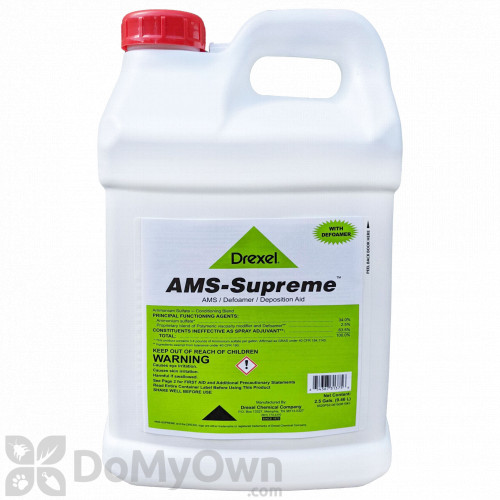
Yes. The is also a great PDF that is available online from the product specifications. 41% glyphosate is pretty much the “norm” for habitat users, so feel free to post your questions as well.Will the bottle give me some guideline on how much to use?
Got that label. I meant how much AMS to use.Yes. The is also a great PDF that is available online from the product specifications. 41% glyphosate is pretty much the “norm” for habitat users, so feel free to post your questions as well.
Product Label

Depends on the product you select. Most are figured per 100 gallons of water but almost all of the ones I've used have different rate recommendations.Got that label. I meant how much AMS to use.

I had used dishsoap for years and it works often. Surfactant works better....and products like Turbo make it work REALLY well.Surfactant lowers the surface tension of water. It makes the water (and herbicide with it) flatten out on the waxy leaves instead of rolling off the leaves like the waxy surface is repelling it.
image is swiped via google, showing what a surfactant does. You'll find coments like "a surfactant makes water wetter", which sounds silly, but is sorta true. Without a surfactant, more of your herbicide will roll off the leaves and fall to the ground.
Using dish soap is fine. The stuff bottled as surfactant is just cheaper, if you need a lot of it.
View attachment 91877

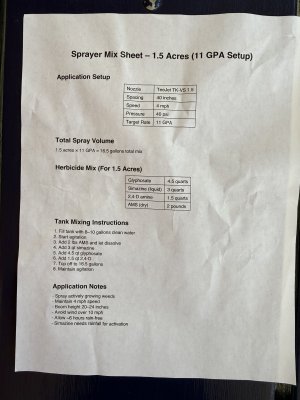
That's an incredibly high rate of gly. What's the 2,4D for, do you have gly resistant weeds? 2,4D on emerging switchgrass can be very detrimental.The idea of testing the solution to get an ideal ph is next level.
This is my worksheet for a recent switchgrass prep application. It was the first time I used this sprayer and I don’t like these spray tips. Too much drift and mist, I couldn’t turn down the PSI because I wasn’t getting enough water per acre. I don’t have time to figure it all out right now but I want more water per acre and bigger droplets. Might involve changing tip spacing. Anyway, this is my worksheet for this application. I am around a pound and a half dry AMS per acre.
Local FS was out of liquid AMS. I don’t mind mixing dry but you cant just chuck it in there. Needs agitation so tank partially filled and pump running. A bag of AMS lasts me a long time. I am storing it in a tall (7 gallon?) bucket with a tight lid because it will clump up over time. Assume thats due to moisture. If you just throw an open bag in the corner it clumps and you end up with dead bugs and crud that your sprayer won’t like.
Feel free to critique my sprayer worksheet- I’m trying to do this accurately and safely.
View attachment 91979


