• If you are posting pictures, and they aren't posting in the correct orientation, please flush your browser cache and try again.

    Edge
    Safari/iOS
    Chrome

CWD conversations that are worth the time to watch

New study results published:


"Abstract
Chronic wasting disease (CWD) is a fatal transmissible spongiform encephalopathy affecting cervids worldwide. CWD was first detected in Arkansas in 2015 and as of August 2025 has been detected in 24 counties across the state. Within the Tier 1 CWD management zone of northern Arkansas, average apparent CWD prevalence exceeded 25% at the onset of our study in 2021. We tested the hypothesis that high prevalence of CWD negatively affects white-tailed deer population viability. We collected data from 243 camera traps and deployed GPS-collars on 131 adult deer to monitor population dynamics. Using spatial mark-resight models, we estimated density of adult deer from 2021 to 2024 at three sites across a presumed CWD gradient to assess the impacts of high CWD prevalence on deer abundance. Deer densities declined at all three study sites, at an average 17% (95% CI: 8% - 24%) decline per year. Male densities declined by an average 23% (95% CI: 5% - 31%) per year compared to 15% (95% CI: 2% - 23%) yearly declines for females. These findings suggest that CWD can negatively impact deer populations through direct reductions in density, but additional research is needed to determine if additional factors contributed to these declines. Furthermore, our findings suggest the populations we studied are not sustainable under current harvest regulations."

In the podcast I watched on that study, if I remember correctly, the researchers recommended increasing the doe population by 24% each year. Hunting with relaxed harvest restrictions was allowed during the study so with cwd and hunters, it about wiped the deer out. I think they said the deer population dropped to 1.5 dpsm. Our G&F did indicate a willingness to reduce doe harvest
 
That’s the first time I personally have read or heard any official statement that harvesting less deer might actually be a good idea.

But it’s just a consideration they haven’t implemented it yet.

The Arkansas CWD website still says they are offering bonus tags to kill more deer.
  • Within the CWD Management Zone, the seasonal bag limit has been increased or adjusted.
  • Landowners within the CWD Management Zone may apply for additional deer tags to harvest bonus deer. These deer must be submitted for CWD testing. Landowners should contact their local private lands biologist to receive these tags.
 
That’s the first time I personally have read or heard any official statement that harvesting less deer might actually be a good idea.

But it’s just a consideration they haven’t implemented it yet.

The Arkansas CWD website still says they are offering bonus tags to kill more deer.
  • Within the CWD Management Zone, the seasonal bag limit has been increased or adjusted.
  • Landowners within the CWD Management Zone may apply for additional deer tags to harvest bonus deer. These deer must be submitted for CWD testing. Landowners should contact their local private lands biologist to receive these tags.

I think if anything new happens, it will be fall of 2026. It will be interesting to see if they reverse any of their relaxed cwd restrictions now implemented, and secondly, if they do, will it just be in the study area or encompass a larger area. I honestly dont have much faith in them doing something positive
 
One excerpt I found interesting in this new published study was this about an area that had no hunting. There was a population decline even without shooting them.

"To the best of our knowledge, no previous published studies have estimated deer densities in the Arkansas northern CWD management zone, with the exception of a long-term monitoring effort for an un-hunted deer population at Arkansas Post National Memorial in Benton County, Arkansas [36]. CWD was first detected in Benton County in 2018, but average sample prevalence was below 2% at the time of our study [28]. Mean deer densities at the Arkansas Post National Memorial declined from around 90 deer per square kilometer in 2020–55 deer per square kilometer in 2024, but the cause of these declines is unknown [36]. However, the high deer densities within the park are likely unrepresentative of the average deer population across the region, especially in comparison to public lands with high harvest pressure."
 
A population decline in that area is not surprising if their initial reporting is the real number. Not sure if they like to sound scientific by using metric or want to cloud the fact most folks won't realize that 90 deer per sq km equates to 233 deer per sq mile!

No way that is sustainable long term on any piece of ground unless some supplements are happening. The habitat would just be decimated

Edit to add: the comments at the end are almost laughable. Likely unrepresented for lands where hunting is allowed. No chit Sherlock. 233 deer per sq mile on public land as possible anywhere.....ah no
 
Last edited:
A population decline in that area is not surprising if their initial reporting is the real number. Not sure if they like to sound scientific by using metric or want to cloud the fact most folks won't realize that 90 deer per sq km equates to 233 deer per sq mile!

No way that is sustainable long term on any piece of ground unless some supplements are happening. The habitat would just be decimated

Edit to add: the comments at the end are almost laughable. Likely unrepresented for lands where hunting is allowed. No chit Sherlock. 233 deer per sq mile on public land as possible anywhere.....ah no
You are right. But, that wasn't the population size in the overall study area. That was an unhunted population. They were just using it as a comparison of what an unhunted population in that area looked like. Population busts in areas due to overpopulation have been well documented. They go over carrying capacity, are decimated, then rebound. That area was just a side note, not what the study was focused on.

Metric measurements are required for these published studies.
 
The question that needs to be answered about Arkansas is: Why is CWD reducing herds there, and no place else?

It’s an important question. Is it a different disease there, or entirely something different killing the deer? It’s important because if it’s not properly answered, the failed theory of killing all the deer to save the deer will continue.

I would be asking if the state is feeding sterilizer chow to the deer if no other theory comes to light.


Sent from my iPhone using Tapatalk
I have read a few things about different strains of cwd. True or not, heck if I know.

Certain soils also hold the prion.
 
You are right. But, that wasn't the population size in the overall study area. That was an unhunted population. They were just using it as a comparison of what an unhunted population in that area looked like. Population busts in areas due to overpopulation have been well documented. They go over carrying capacity, are decimated, then rebound. That area was just a side note, not what the study was focused on.

Metric measurements are required for these published studies.
You commented that you found that excerpt interesting. I commented that cwd area or not I can predict that particular area is gonna see those high populations reduced over time. Don't see the value in including it to be honest. Find some other unhunted property that had long term sustainable numbers of deer to begin with and CWD and showed declines. Can't find any others? Too bad. Don't make dumb statements " the cause of these declines is unknown". They should have skipped the side note.

Not saying the other CWD report stuff is invalid but because the authors went there they lose some credibility with me.

Now maybe if they overlaid EHD data with their CWD data that would make their study more interesting. More complex interactions.....sure.
 
Are there not any CWD
A population decline in that area is not surprising if their initial reporting is the real number. Not sure if they like to sound scientific by using metric or want to cloud the fact most folks won't realize that 90 deer per sq km equates to 233 deer per sq mile!

No way that is sustainable long term on any piece of ground unless some supplements are happening. The habitat would just be decimated

Edit to add: the comments at the end are almost laughable. Likely unrepresented for lands where hunting is allowed. No chit Sherlock. 233 deer per sq mile on public land as possible anywhere.....ah no
Metric is the standard unit in peer-reviewed literature.
 
You commented that you found that excerpt interesting. I commented that cwd area or not I can predict that particular area is gonna see those high populations reduced over time. Don't see the value in including it to be honest. Find some other unhunted property that had long term sustainable numbers of deer to begin with and CWD and showed declines. Can't find any others? Too bad. Don't make dumb statements " the cause of these declines is unknown". They should have skipped the side note.

Not saying the other CWD report stuff is invalid but because the authors went there they lose some credibility with me.

Now maybe if they overlaid EHD data with their CWD data that would make their study more interesting. More complex interactions.....sure.
The side note is relevant for exactly the reasons Bill has been pointing out - not including the effect of hunting on lowering deer numbers is not telling the whole picture. If it wasn't relevant the Reviewers or the Editor for the Journal would have asked them not to include it. The reviewing process for peer-reviewed research tends to try and cut out fluff by default and is very intentional what is included or not. Progress in science often happens because of these minor observations and it would be a huge disservice if they were left out, even if all they are is a seemingly partially relevant observation.
 
Is anyone aware of any research that tracked deer herd reductions in captive or fenced deer herds as a result of CWD?
I have read a few things about different strains of cwd. True or not, heck if I know.

Certain soils also hold the prion.
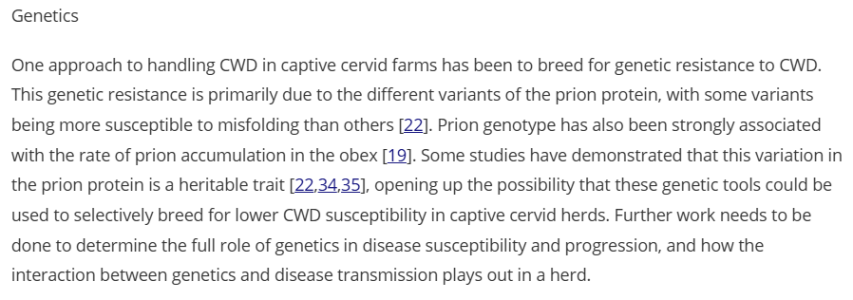
The screenshot below is from a review paper on captive deer herds and transmission of CWD. It looks like there are different variants to the prions that cause CWD:

1768159983367.png

At least within the animals themselves, there might also be genetic susceptibility differences.
 
Related to Bill's and others comments about what CWD mortality would look like without hunting pressure, I have been trying to dig into the literature. Most of this research has taken place in captive deer herds. The problem with these studies is that captive deer have something like 20 times the transmission rates of CWD than wild herds, so it isn't an apples to apples comparison. They also don't typically report mortality from CWD as they are more focused on other factors like transmission based on deer age or where and how the transmission takes place.

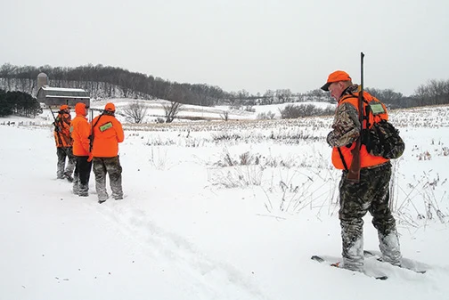
Currently, the best study with wild deer that I can find is from SW Wisconsin. They radio collared deer and tracked them overtime. Survivability plummeted after the deer contracted CWD:
1768161198599.png
This included hunting (34% of mortalities) and if you follow the links to the study data, most of the deer that died were suspected of dying from starvation. If you want to read more about it, go to the necropsy section.
 
Back
Top