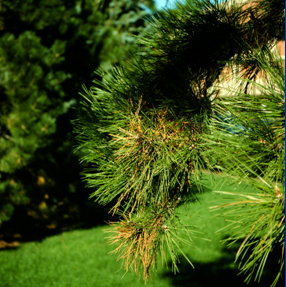
White pine is more resistant to Diplodia, there hasn't been confirmed that it will carry diplodia at the same extent as Norway, its been found on it, just not studied enough.
Diplodia shoot blight and canker is one of the most common fungal diseases of Austrian pine in Wisconsin, and can also affect other pines as well as other conifers including cedars, cypresses, firs, junipers and spruces. Learn more here.

hort.extension.wisc.edu
Diplodia is the largest issue with Norway (red) Pine stands and plantations here in MN. If your in MN and are up to date with what the DNR is doing, reporting, staying informed, why there has been a huge debate between the Forestry and Wildlife/Eco divisions on the history of Norway Pine and management on pine stands. One side (forestry) is more of a one-age, comes in after a disturbance and once it dies out, it is replaced by longer lived species. Or in a modern, we replant, and repeat the plantation cycle. The other side is that it was uneven-aged, however all the stands on WMA lands or Parks...have been showing diplodia in them based on that mgmt approach.
So do you manage the pine for economic goals, or manage it for historical natural goals. That is what it comes down to, and diplodia is one of the major hurdles in that debate.
It came over in the 1700s-1800s, it is now part of the ecosystem and there isn't a way to get rid of it. In plantations that get affected, they have to fumigate the beds and whole of costs are associated with sterialization. Diplodia for the most part is on the mature trees, and when it rains the spores fall down onto saplings. Usually any fungus present in the ecosystem, the wetter a spring, summer, fall is the more issues you will have.
For quite a few years, probably 2014-2022/3 there was issues with diplodia in the nursery stock. This was why, when you ordered Pine from the MNDNR in recent years you got PLT containerized stock (plugs). WAY BETTER!! Sure more expensive, but the problem with bare root, outside of planting it correctly, which people sometimes J-root it or plant it at wrong depth, the seed bed of those bare root had diplodia spores in it as well as on the saplings. I would plant plugs any time, more success, better genetics, just better overall health. Especially if your looking at this being an investment long term, with some wildlife benefits.
A good strategy if planting Norway Pine near already estblished stands/mature pine. you want to have a distance, or if letting natural regeneration happen, a distance of 1.5x the tree height (canopy) of the mature pine. You go further in distance, you can also expand on this and plant a barrier species such as spruce, tamarack, white pine (to a lesser degree), balsam fir, hemlock, cedar, something to stop the spores from raining down on the saplings.
I would also be on the look out in the SE/E portion of MN and if your in WI, MI, Iowa, and Illinois for Heterobasidium Root Disease. Once it is in a stand, though still minimal across the state (WI) it effectively neutralizes any conifer establishment. I think there is only a couple stands in MN that have it. But this is very limited, and obviously private landowner awareness is huge especially if your in the areas impacted by a disease or pest you need to be on the lookout so you can prevent and mitigate sooner than later.