• If you are posting pictures, and they aren't posting in the correct orientation, please flush your browser cache and try again.

    Edge
    Safari/iOS
    Chrome

Winning the battle to establish conifers

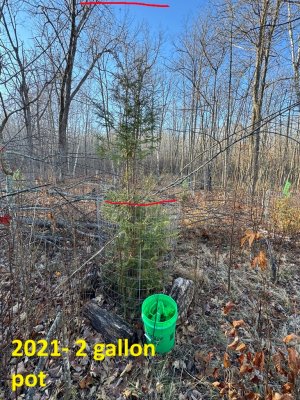
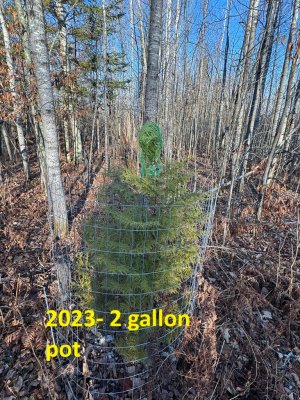
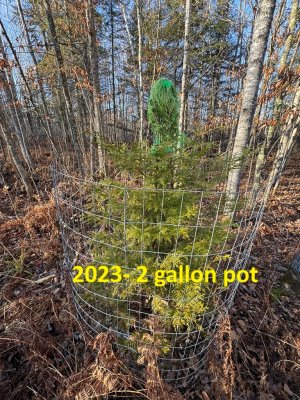
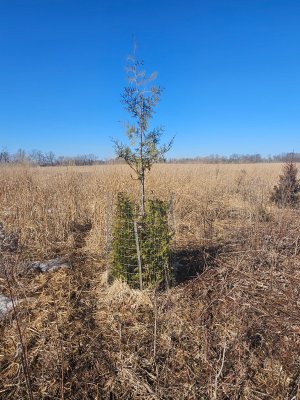
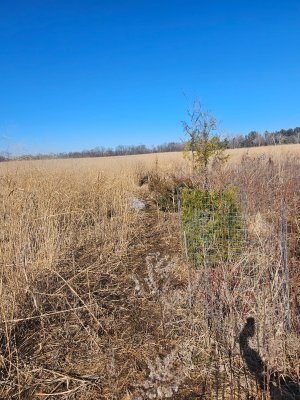
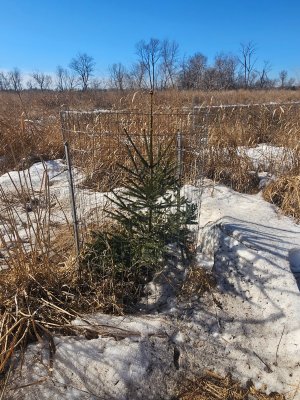
I see the exact same thing as you. It takes a good 4-5 years for spruce to really get going at my place. Spruce tend to really struggle in the early years. The clay is sticky and heavy. The white pines have no problem at all. They go like hell from day 1. A weed mat to smoother the competition is mandatory for my spruce.


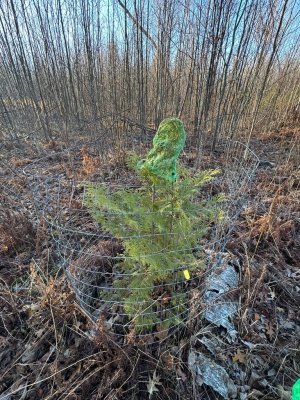
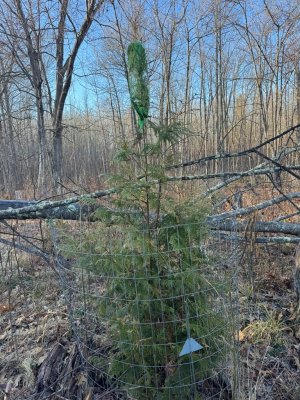
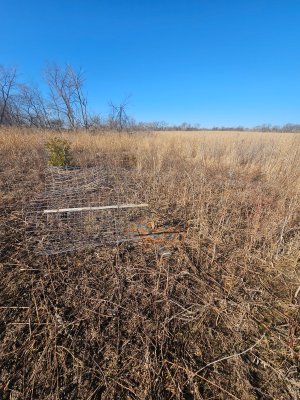
I have over 100 white cedars that I have planted and caged. They do really well against the clay.


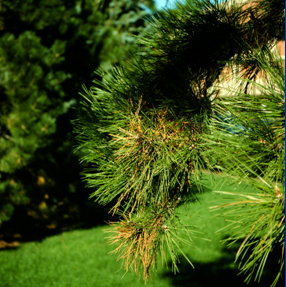
Red pine cant hardly make it on my land. I bet half the ones I have planted have died. The clay is too much for them. I have a few dozen Austrian pines. They grow decent, but I just might be too far north for them. They had severe winter burn last year. Couple dozen Scotch pine look pretty good.


Clear winners for me are white pine and white cedar. Norway and white spruce seem to get going strong after 5 years. Planting bigger trees helps them get going a lot quicker.
 
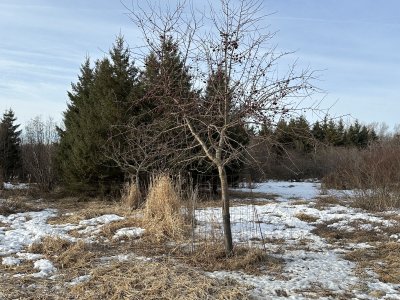
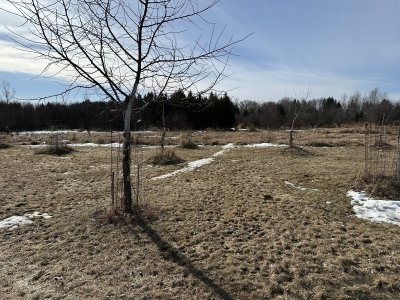
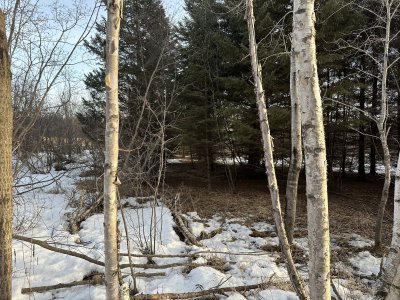
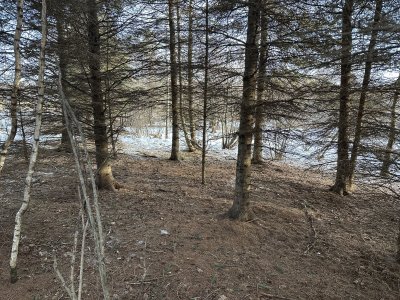
Those cover pics show some REALLY excellent cover, Buck! Trails are plainly visible. You have to love that "herd of cattle" experience. No wonder the deer are camping in that stuff. Your list of things planted there, point to the advantage of diversity in our habitats. Planting more varieties of trees & shrubs & grasses is the best route to take, IMO. (Using plants suited to each individual locality).

Thanks for posting those super pics!
 
From experience with planting crews in Northern and central MN. For any large plantings it is best to have a plan and look into site prep, whether it be chemical, or mechanical, or a mix of both.

In general if we were to plant after a harvest, and it was Red pine, and we have decent deer numbers. We harvest first. The slash is piled and burned that winter following harvest. Wait 1-2 years for the site to “season” or “express itself”. Meaning if there was aspen, ash, brush, or just grass it gets a year or two to grow.

We than come in and do a chemical spray via helicopter (could use drone sprayer, larger ag sprayer) and use a mixture of Garlon 4 or Reach/Oust of that nature. If mechanical is needed it is done in place of chemical or afterwards to break up the soil and expose mineral. Most pines and oaks need to have that mineral soil layer exposed. These can be large harrows or discs on the back of a skidder. The purpose of the mechanical is to not just break up the soil and expose the mineral soil and even create rows to plant trees on the berms, but if done at the correct depth you can cut cut the shallow roots of say aspen and drastically kill off the clone.

I agree with many people who have found that larger plugs work the best. You want to get at least 3-0 saplings. That is what the DNR uses for its plantings. They have been slow on utilizing plugs and for many years it was bare root coming from the state nursery. However the quality of containerized(plugs) vs bare root was huge. Plus for many years there was diplodia in the Baudura nursery. And don’t be planting any pine near already established canopy pine…cause guess what, you’ll get diplodia.

For smaller plantings. If you can transplant and have good survivability you should reap benefits. Always bud cap and remember to bud cap every spring and every fall. Many people forget and just bud cap once and leave and forget. You have to be on it until it is past the deer browsing height.

If you have a stewardship plan there should be good guidelines about planting, how and when, as well as soil maps and a good soil core analysis of what you have in the areas planned to planted…should be.
 
And don’t be planting any pine near already established canopy pine…cause guess what, you’ll get diplodia.
Just a question, not doubting what you're saying here. We have lots of white pine at camp, that throw off seed and hatch many seedlings. How do they not get diplodia when they hatch at the edge of big white pine patches? Or were you just referring to nursey stock seedlings? (I never heard of diplodia - so I'm learning here!)
 
Just a question, not doubting what you're saying here. We have lots of white pine at camp, that throw off seed and hatch many seedlings. How do they not get diplodia when they hatch at the edge of big white pine patches? Or were you just referring to nursey stock seedlings? (I never heard of diplodia - so I'm learning here!)
White pine is more resistant to Diplodia, there hasn't been confirmed that it will carry diplodia at the same extent as Norway, its been found on it, just not studied enough.

Diplodia is the largest issue with Norway (red) Pine stands and plantations here in MN. If your in MN and are up to date with what the DNR is doing, reporting, staying informed, why there has been a huge debate between the Forestry and Wildlife/Eco divisions on the history of Norway Pine and management on pine stands. One side (forestry) is more of a one-age, comes in after a disturbance and once it dies out, it is replaced by longer lived species. Or in a modern, we replant, and repeat the plantation cycle. The other side is that it was uneven-aged, however all the stands on WMA lands or Parks...have been showing diplodia in them based on that mgmt approach.

So do you manage the pine for economic goals, or manage it for historical natural goals. That is what it comes down to, and diplodia is one of the major hurdles in that debate.

It came over in the 1700s-1800s, it is now part of the ecosystem and there isn't a way to get rid of it. In plantations that get affected, they have to fumigate the beds and whole of costs are associated with sterialization. Diplodia for the most part is on the mature trees, and when it rains the spores fall down onto saplings. Usually any fungus present in the ecosystem, the wetter a spring, summer, fall is the more issues you will have.

For quite a few years, probably 2014-2022/3 there was issues with diplodia in the nursery stock. This was why, when you ordered Pine from the MNDNR in recent years you got PLT containerized stock (plugs). WAY BETTER!! Sure more expensive, but the problem with bare root, outside of planting it correctly, which people sometimes J-root it or plant it at wrong depth, the seed bed of those bare root had diplodia spores in it as well as on the saplings. I would plant plugs any time, more success, better genetics, just better overall health. Especially if your looking at this being an investment long term, with some wildlife benefits.

A good strategy if planting Norway Pine near already estblished stands/mature pine. you want to have a distance, or if letting natural regeneration happen, a distance of 1.5x the tree height (canopy) of the mature pine. You go further in distance, you can also expand on this and plant a barrier species such as spruce, tamarack, white pine (to a lesser degree), balsam fir, hemlock, cedar, something to stop the spores from raining down on the saplings.

I would also be on the look out in the SE/E portion of MN and if your in WI, MI, Iowa, and Illinois for Heterobasidium Root Disease. Once it is in a stand, though still minimal across the state (WI) it effectively neutralizes any conifer establishment. I think there is only a couple stands in MN that have it. But this is very limited, and obviously private landowner awareness is huge especially if your in the areas impacted by a disease or pest you need to be on the lookout so you can prevent and mitigate sooner than later.
 
This picture pretty much sums up why I like white pine. A true monarch that towers over the rest of the forest.


View attachment 32817
I can always identify White Pine from long distance as it looks like it is holding its branches up to the sky, almost like a person praising God. Why in WI we have Cathedral Pines (40 acres), it truly is an awe inspiring species. I've only been in a couple told-growth stands (pre-1880s-1900) cutover, and even then they were young trees when the giants were taken. I can only imagine a super canopy of white pine (400-600 years old, 10+ diameters) with a hemlock and cedar canopy under it would have looked like. The Midwests version of the Redwoods out west maybe.
 
White pine is more resistant to Diplodia, there hasn't been confirmed that it will carry diplodia at the same extent as Norway, its been found on it, just not studied enough.

Diplodia is the largest issue with Norway (red) Pine stands and plantations here in MN. If your in MN and are up to date with what the DNR is doing, reporting, staying informed, why there has been a huge debate between the Forestry and Wildlife/Eco divisions on the history of Norway Pine and management on pine stands. One side (forestry) is more of a one-age, comes in after a disturbance and once it dies out, it is replaced by longer lived species. Or in a modern, we replant, and repeat the plantation cycle. The other side is that it was uneven-aged, however all the stands on WMA lands or Parks...have been showing diplodia in them based on that mgmt approach.

So do you manage the pine for economic goals, or manage it for historical natural goals. That is what it comes down to, and diplodia is one of the major hurdles in that debate.

It came over in the 1700s-1800s, it is now part of the ecosystem and there isn't a way to get rid of it. In plantations that get affected, they have to fumigate the beds and whole of costs are associated with sterialization. Diplodia for the most part is on the mature trees, and when it rains the spores fall down onto saplings. Usually any fungus present in the ecosystem, the wetter a spring, summer, fall is the more issues you will have.

For quite a few years, probably 2014-2022/3 there was issues with diplodia in the nursery stock. This was why, when you ordered Pine from the MNDNR in recent years you got PLT containerized stock (plugs). WAY BETTER!! Sure more expensive, but the problem with bare root, outside of planting it correctly, which people sometimes J-root it or plant it at wrong depth, the seed bed of those bare root had diplodia spores in it as well as on the saplings. I would plant plugs any time, more success, better genetics, just better overall health. Especially if your looking at this being an investment long term, with some wildlife benefits.

A good strategy if planting Norway Pine near already estblished stands/mature pine. you want to have a distance, or if letting natural regeneration happen, a distance of 1.5x the tree height (canopy) of the mature pine. You go further in distance, you can also expand on this and plant a barrier species such as spruce, tamarack, white pine (to a lesser degree), balsam fir, hemlock, cedar, something to stop the spores from raining down on the saplings.

I would also be on the look out in the SE/E portion of MN and if your in WI, MI, Iowa, and Illinois for Heterobasidium Root Disease. Once it is in a stand, though still minimal across the state (WI) it effectively neutralizes any conifer establishment. I think there is only a couple stands in MN that have it. But this is very limited, and obviously private landowner awareness is huge especially if your in the areas impacted by a disease or pest you need to be on the lookout so you can prevent and mitigate sooner than later.
I'm in Pa. Camp is in the North-Central mountains. White pine is the dominant native pine here. We have stands of pitch pine in various places too - but not nearly as common as white pine. We sprout WP like weeds here - in fact, if we didn't pull out many of the seedlings, we'd be overrun by them. Canadian hemlock (State tree of Pa.) is our other native evergreen here, and deer love them. Wooly adelgids are the biggest problem with hemlocks here, and in many other places as well. They're wiping out mature hemlock stands. Major losses of hemlocks. They only started to be a problem in the last 15-20 years - not before. Gotta love international trade with all the imported diseases and insect pests it brings us - spotted lantern fly, gypsy moths, European thrips, Dutch elm disease, chestnut blight, etc.

We don't even mess with red pine here. No value - not a good habitat tree.
 
Last edited:
I'm in Pa. Camp is in the North-Central mountains. White pine is the dominant native pine here. We have stands of pitch pine in various places too - but not nearly as common as white pine. We sprout WP like weeds here - in fact, if we didn't pull out many of the seedlings, we'd be overrun by them. Canadian hemlock (State tree of Pa.) is our other native evergreen here, and deer love them. Wooly adelgids are the biggest problem with hemlocks here, and in many other places as well. They're wiping out mature hemlock stands. Major losses of hemlocks. Gotta love international trade with all the imported diseases and insect pests it brings us.

We don't even mess with red pine here. No value - not a good habitat tree.
Yeah in your area the white pine is a timber species. As well as the spruce when get into Vermont and Maine I believe is a huge timber source. I think it was Vermont that had a collapse back in the 70s maybe 80s of the spruce, we are talking beautiful timber grade. Its rebounded with better management mostly group, single tree selection, instead of full on clear cuts.

Hence why there is a lot of timber frame builders out there, they mostly use white pine, hemlock, and oak. With white pine and oak being superior, hemlock more so decorative than structural but it can do well for some applications.

Red Pine plantations don't have much value. They are for the most part a timber investment. Not as fast as the 25-30 year rotation ages like loblolly and yellow pine down in the south (Georgia, Arkansas, Lousianna, Alabama, Florida) but a good one for the midwest. I think PA actually is a pretty decent region for Walnuts, at least the southern portion of midwest is for sure.

Seen any American Chestnuts, if you find a big one that isn't taken out by Chestnut Blight definitely spread those genetics! Great food source, sad it was the east coast equivalent giant to the redwoods besides the white pine!
 
I can always identify White Pine from long distance as it looks like it is holding its branches up to the sky, almost like a person praising God. Why in WI we have Cathedral Pines (40 acres), it truly is an awe inspiring species. I've only been in a couple told-growth stands (pre-1880s-1900) cutover, and even then they were young trees when the giants were taken. I can only imagine a super canopy of white pine (400-600 years old, 10+ diameters) with a hemlock and cedar canopy under it would have looked like. The Midwests version of the Redwoods out west maybe.


Welcome aboard. Sounds like people here could gain a lot of knowledge from you.


Would it be fair to say that you don't think its a good idea for people to plant trees from out of our area?? In north central MN I have planted some of the following:

ALL DEAD already ( I planted about 10 of these each to see if they could make it. zone 4 trees in zone 3:
1. Grand Fir
2. Western White Pine
3. Frasier fir
4. Western Hemlock


They were no match for our cold weather.


Planted and doing OK and not native:
1. Austrian pine (couple dozen)
2. Meyer spruce (couple dozen)
3. Black hills Spruce (couple dozen)
4, Scotch pine (around 15)
5. Canadian Hemlock (dozen)


I am watching LOTS of balsam fir die across our area. Seems like plenty of Tamaracks are dead. Last year up in the BWCA I saw copious amounts of dead jack pine and dead balsam. Newly dead from the year before.


I sought to diversify my plantings away from just a couple species and not go all in with one or two. I plant mainly white pine, white cedar, norway spruce, white spruce, meyer spruce and black hills spruce. A few tamaracks on the side. I have given up on the more exotic western conifers. I just dont want to see all my hard work die a couple years down the road so I thought some diversity would be good.
 
I'm in Lake of the Woods, so that's zone 3 I believe. Yeah this northern portion of MN and ND are a little odd, the freeze thaw cycles along with the harsh winds can be pretty gnarly on most trees, I mean look what happened to Bemidji and Cass Lake area this summer with the shear winds/tornado. I haven't experienced the really early frost or late frost up here that other folks have in the past, we are talking frost in June and frost in August. A little abnormal, but definitely detrimental to a lot of plants, just talk to anyone who has an outdoor garden all the strategy that is involved to grow certain plants in these northern climates. I can only imagine what it is like in northern Ontario or Manitoba for folks.

Last time I saw Grand Fir I was in Colorado, near Winter Park at the elevation relative to Minnesota of 8,000-11,000 feet. Above the aspen that's for sure, and on very poor soil, very little organic matter and bedrock.

I don't know much about Austrian pine, Meyer spruce, or Canadian hemlock. They just aren't common on most properties and what I've seen in the natural woods, to be honest. Black hills spruce is a subspecies of white spruce, just smaller. Pretty hardy, I've heard from folks in the DNR and landowners I'm working with in the NW MN that it is working pretty good as a windbreak tree. Probably could do a mixture of both to satisfy a windbreak along with Norway spruce. Again all three of those are pretty hardy, provide a lot of cover, and are for the most in the lake states pretty resistant to pests.


Now to Scotch Pine... Here is just a list of the issues with it:

The pine root collar weevil (Hylobius radicis) is a major cause of tree death in young plantations in the Lake States. The weevil girdles the tree at the base, killing it within 3 to 4 years. The damage is especially severe on dry sandy soils. The fast-growing central European trees are particularly susceptible (26). In Michigan, on low quality sites, mortality frequently reaches 70 to 80 percent.

The pine root tip weevil (Hylobius rhizophagus) causes serious damage in Michigan on Scotch pine Christmas trees grown from stump culture. These trees result from leaving the lower limbs on cut trees to grow into a second tree crop. The pine root tip weevil larvae feed on the roots and root tips, resulting in reduced height growth and flagged shoots, and eventual death. In some cases the pine root tip weevil and the pine root collar weevil attack some Scotch pine stands simultaneously, causing more mortality than expected from either insect alone (7).

The European pine sawfly (Neodiprion sertifer) causes moderate damage in Christmas trees and ornamental plantings. Heavy defoliation reduces growth from 10 to 20 percent. The fast-growing Scotch pine variety uralensis shows some resistance to this insect while the slow-growing variety iberica is most susceptible (27).

If Scotch pine is pruned in midsummer, the Zimmerman pine moth may be attracted to the fresh pitch. The larvae feed in the cambial region, causing masses of coagulated pitch and frass to collect. Feeding by several larvae at the same whorl may kill the tree top or the entire tree. Partially girdled stems frequently break at the weakened area during storms (28).

The white pine weevil (Pissodes strobi) burrows into terminal shoots and kills them. This insect is very damaging to trees on light soils but causes only minor damage on better sites (28). The eastern pine shoot borer (Eucosma gloriola) also burrows in the pith of new growth. In Michigan plantations, this insect is universal but causes only minor damage.

The pine spittlebug (Aphrophora parallela) is a serious pest in many Scotch pine Christmas tree plantations. Heavy infestations of spittlebugs may cause twig, branch, and tree mortality. In one 19-year-old Scotch pine plantation in southern Michigan, the pine spittlebug has apparently acted as the vector for the fungus disease Sphaeropsis sapinea; mortality is now 25 percent and is continuing.

Lophodermium needlecast caused by the fungus Lophodermium seditiosum is the most serious disease of Scotch pine Christmas tree plantations. The major loss is due to premature defoliation resulting in unsalable Christmas trees. In general, the longer needle provenances are resistant to this disease. The problem is minor in forest stands (8).

Scotch pine is also a host for brown spot needle disease of southern pines (Scirrhia acicola). This disease, like Lophodermium, causes premature defoliation and is primarily limited to Christmas tree plantations. The long needle provenances are also more resistant to this disease (16).

Western gall rust (Endocronartium harknessii) is common on Scotch pine in the Lake States and the Northeast. Individual trees may have several hundred galls. In most cases damage is limited to branch mortality and growth loss.

As described earlier, Scotch pine is susceptible to scleroderris canker. This disease is present in many areas in Europe, and as a result, certain Scotch pine provenances show some resistance. Scotch pine is more resistant to scleroderris canker than red pine, and in some areas, red pines have been eliminated from the stand while Scotch pines are still alive. Scleroderris canker can be spread on cut Scotch pine Christmas trees. Therefore, State quarantines have been established to prevent the movement of this disease into noninfected areas (15).

REFERENCE: https://research.fs.usda.gov/silvics/scotch-pine

So you can see why I push for native plants, because you are playing with fire in terms of getting the most bang for your buck in the long run. Sure it may do good in the first few years, but just like Ash and Emerald Ash Borer, or Sudden Oak Death, no one wants to come to their property and over the course of a year or even 6 months and see an entire chunk die off. And the damage growing.

That is why I push folks and why I joined, because I think a lot of the businesses and organizations that push wildlife habitat management or even land agents that sell properties there is a lot of misinformation that is pushed out there and to be honest, not all, but there are bad apples that are just looking out for their bottom line. Id rather be a partner with someone and help them over the course of 10-20 years, let's say, and for the most part, a forester as should wildlife biologist, be a person that is informing you.

If you got a pocket that is working even for a non-native you might have lucked out and just have it in the right microclimate that works. Other trees could be blocking the harsh winds, ash trees are huge hydrology pumps for water tables and so affect the surrounding area, same with pine and walnut that change the pH levels and introduce jugulars into the soils to limit other plant growth and diversity.

I mean I've seem ponderosa and sequoia grown in MN...was it like out west, no. It can be done, the question is should it be done.

So to keep wrap up this large post...do your research, use native as much as possible. And if your worried about not enough diversity I would look at trees that are just a little bit south of where you are, most DNRs, MNDNR has this, I have this, a ecological-climate adaptability sheet, basically looking at if the climate is getting warmer and drier, or colder and wetter as predicted in some areas what species are predicted to do better, all while being native.

 
Back
Top