• If you are posting pictures, and they aren't posting in the correct orientation, please flush your browser cache and try again.

    Edge
    Safari/iOS
    Chrome

Ohio Farm Tours

Vitalize EDU: How Nutrients Work Together in Your Soil

Bringing it all full circle.

Not all nutrients work independently.
They interact with each other in ways that can either improve or limit plant performance.

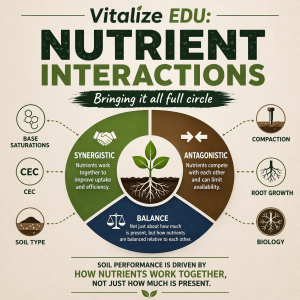
These interactions fall into three categories:

Synergistic
Some nutrients work together to improve uptake and efficiency.

Example: nitrogen and sulfur working together for protein production.

Antagonistic
Some nutrients compete with each other and can limit availability.

Example: excess potassium can limit magnesium uptake.

Balance
This is where everything comes together.
It is not just about how much of a nutrient is present, but how nutrients are balanced relative to each other.

This is why soil tests should not be viewed as individual numbers.

They should be evaluated as a system.

Even if levels are high, imbalance can still limit performance.

Even if levels are lower, balance and biology can improve efficiency.

This is where base saturations, CEC, soil type, compaction, and biology all connect.

Like all things, biology, root growth, and plant health flourish when the system is in balance or moving toward it.

Bottom line:
Soil performance is driven by how nutrients work together, not just how much is present.
FB882BAC-F0EB-4A2B-B273-418C8386C1D2.png
 
Quick field check tip-

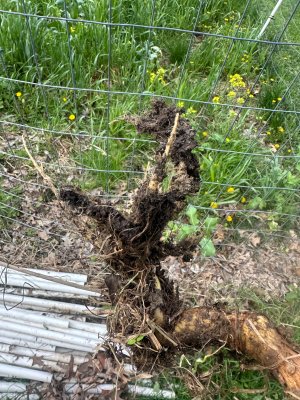
This brassica root, likely a forage type from our Carbon Load mix, shows how living roots can help create channels in the soil. You can also see soil clinging to the lateral roots, which is often called a rhizosheath.

That can be a sign of active root-soil interaction, influenced by root hairs, exudates, microbes, fungi, soil texture, and moisture. It is not a full measure of soil biology, but it is a useful field clue that aggregation and root-zone activity are taking place.
IMG_6058.jpeg
 
B47A1F7A-39C4-4FAC-B675-2EBAAC497EDB.png
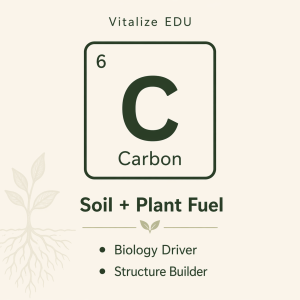
Vitalize EDU: What Carbon Is and How It Works in Your Soil

What is carbon?
It’s one of the most talked about terms in soil health, but often least defined.

Carbon (C) is the foundation of life.
It drives plant growth and soil function.
Carbon stability and cycling are major topics in soil science because they are complex, but critical to understanding how soils truly function.

Plants take in carbon dioxide (CO₂) and, through photosynthesis, convert it into sugars.
These are not just simple sugars, but carbon-based compounds built on carbon chains that form:

* Amino acids
* Proteins
* Plant structure

Healthy, actively growing plants capture more carbon and release more carbon compounds into the soil.

In the soil, carbon feeds biology.
Plants release carbon compounds through their roots, fueling microbes that help cycle nutrients.

As microbes process carbon, they produce compounds that help bind soil particles together into aggregates.

These aggregates improve soil structure by creating pore space for air and water movement.

Carbon also helps the soil hold water.
Organic carbon acts like a sponge, absorbing and slowly releasing moisture back to the plant.

Over time, roots and biology build a more structured, porous soil system.

When adding carbon to a system, the type matters.
Complex carbon breaks down more slowly and supports long-term soil structure.
Simpler carbon breaks down quickly and acts as a short-term fuel for biology.

For example:

* Complex carbon: humic substances, plant residues, compost
* Simple carbon: sugars such as molasses or plant root exudates

On a soil test, carbon does not show up directly.
Instead, we look at organic matter and biological activity.

Organic matter reflects a mix of carbon pools in the soil, including both more active carbon and more stable forms such as humus.
Active carbon represents the more readily available portion that helps fuel biology and day-to-day soil function.

Like all things, biology, root growth, and plant health flourish when the system is in balance or moving toward it.

Bottom line:
Carbon connects plant growth and soil function, driving structure, water holding, and nutrient availability.
 
E10201BE-8C52-4613-901A-BCEAEC5B9174.png
Vitalize EDU: What Soil Biological Additives Are and Aren’t Doing in Your Soil


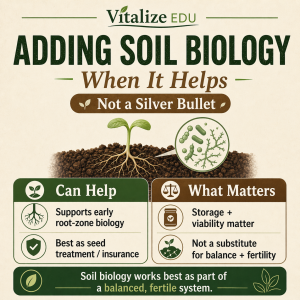
Soil biological additives can sound like an easy answer, especially in degraded soils. Sometimes they can help, but they are not always a major or consistent yield driver.

At Vitalize Seed, we like using them too, but we view them more like an insurance policy than a silver bullet.

What they can do:
  • Support early root-zone biology
  • Act as a lower-cost insurance policy, especially as seed treatments
  • Help stimulate biological activity when paired with a sound system

What they are not doing:
  • Fixing major nutrient deficiencies
  • Correcting poor balance
  • Overcoming bigger system limitations on their own
Form and storage matter.
Liquid biologicals can decline over time, and shelf life depends heavily on storage and handling.
Likewise, if biology is applied to seed too early, then sits on a shelf, in a bag, or is shipped long before planting, microbial survivability can decline.

That is why at Vitalize Seed, we store our seed coatings in opaque bags and recommend applying them right before planting whenever possible.
This helps protect viability and improves the chance of getting active microbes on or near the seed as it germinates.


What I’d watch for:

  • Vague ingredient disclosure
  • Claims that go further than the evidence shown
  • Lack of viability, use-rate, or survivability data

The higher the cost per acre, the higher the burden of proof should be on the supplier.

Bottom line:
Soil biological additives can support a good system, but they are not a substitute for balance, fertility, and sound management.

E10201BE-8C52-4613-901A-BCEAEC5B9174.png
 
Back
Top