
• If you are posting pictures, and they aren't posting in the correct orientation, please flush your browser cache and try again.

    Edge
    Safari/iOS
    Chrome

Ohio Farm Tours

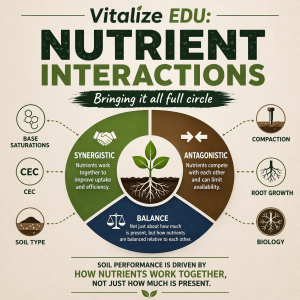
Vitalize EDU: How Nutrients Work Together in Your Soil

Bringing it all full circle.

Not all nutrients work independently.
They interact with each other in ways that can either improve or limit plant performance.

These interactions fall into three categories:

Synergistic
Some nutrients work together to improve uptake and efficiency.

Example: nitrogen and sulfur working together for protein production.

Antagonistic
Some nutrients compete with each other and can limit availability.

Example: excess potassium can limit magnesium uptake.

Balance
This is where everything comes together.
It is not just about how much of a nutrient is present, but how nutrients are balanced relative to each other.

This is why soil tests should not be viewed as individual numbers.

They should be evaluated as a system.

Even if levels are high, imbalance can still limit performance.

Even if levels are lower, balance and biology can improve efficiency.

This is where base saturations, CEC, soil type, compaction, and biology all connect.

Like all things, biology, root growth, and plant health flourish when the system is in balance or moving toward it.

Bottom line:
Soil performance is driven by how nutrients work together, not just how much is present.
FB882BAC-F0EB-4A2B-B273-418C8386C1D2.png
 
Quick field check tip-

This brassica root, likely a forage type from our Carbon Load mix, shows how living roots can help create channels in the soil. You can also see soil clinging to the lateral roots, which is often called a rhizosheath.

That can be a sign of active root-soil interaction, influenced by root hairs, exudates, microbes, fungi, soil texture, and moisture. It is not a full measure of soil biology, but it is a useful field clue that aggregation and root-zone activity are taking place.
IMG_6058.jpeg
 
B47A1F7A-39C4-4FAC-B675-2EBAAC497EDB.png
Vitalize EDU: What Carbon Is and How It Works in Your Soil

What is carbon?
It’s one of the most talked about terms in soil health, but often least defined.

Carbon (C) is the foundation of life.
It drives plant growth and soil function.
Carbon stability and cycling are major topics in soil science because they are complex, but critical to understanding how soils truly function.

Plants take in carbon dioxide (CO₂) and, through photosynthesis, convert it into sugars.
These are not just simple sugars, but carbon-based compounds built on carbon chains that form:

* Amino acids
* Proteins
* Plant structure

Healthy, actively growing plants capture more carbon and release more carbon compounds into the soil.

In the soil, carbon feeds biology.
Plants release carbon compounds through their roots, fueling microbes that help cycle nutrients.

As microbes process carbon, they produce compounds that help bind soil particles together into aggregates.

These aggregates improve soil structure by creating pore space for air and water movement.

Carbon also helps the soil hold water.
Organic carbon acts like a sponge, absorbing and slowly releasing moisture back to the plant.

Over time, roots and biology build a more structured, porous soil system.

When adding carbon to a system, the type matters.
Complex carbon breaks down more slowly and supports long-term soil structure.
Simpler carbon breaks down quickly and acts as a short-term fuel for biology.

For example:

* Complex carbon: humic substances, plant residues, compost
* Simple carbon: sugars such as molasses or plant root exudates

On a soil test, carbon does not show up directly.
Instead, we look at organic matter and biological activity.

Organic matter reflects a mix of carbon pools in the soil, including both more active carbon and more stable forms such as humus.
Active carbon represents the more readily available portion that helps fuel biology and day-to-day soil function.

Like all things, biology, root growth, and plant health flourish when the system is in balance or moving toward it.

Bottom line:
Carbon connects plant growth and soil function, driving structure, water holding, and nutrient availability.
 
E10201BE-8C52-4613-901A-BCEAEC5B9174.png
Vitalize EDU: What Soil Biological Additives Are and Aren’t Doing in Your Soil


Soil biological additives can sound like an easy answer, especially in degraded soils. Sometimes they can help, but they are not always a major or consistent yield driver.

At Vitalize Seed, we like using them too, but we view them more like an insurance policy than a silver bullet.

What they can do:
  • Support early root-zone biology
  • Act as a lower-cost insurance policy, especially as seed treatments
  • Help stimulate biological activity when paired with a sound system

What they are not doing:
  • Fixing major nutrient deficiencies
  • Correcting poor balance
  • Overcoming bigger system limitations on their own
Form and storage matter.
Liquid biologicals can decline over time, and shelf life depends heavily on storage and handling.
Likewise, if biology is applied to seed too early, then sits on a shelf, in a bag, or is shipped long before planting, microbial survivability can decline.

That is why at Vitalize Seed, we store our seed coatings in opaque bags and recommend applying them right before planting whenever possible.
This helps protect viability and improves the chance of getting active microbes on or near the seed as it germinates.


What I’d watch for:

  • Vague ingredient disclosure
  • Claims that go further than the evidence shown
  • Lack of viability, use-rate, or survivability data

The higher the cost per acre, the higher the burden of proof should be on the supplier.

Bottom line:
Soil biological additives can support a good system, but they are not a substitute for balance, fertility, and sound management.
 
Last edited:
Vitalize EDU: Live Biologicals vs. Biological Stimulants.

These are not the same thing.

Live biologicals contain living organisms, such as bacteria or fungi, that are applied to the soil, seed, or plant.

Biological stimulants are different.
They do not necessarily add live microbes.
Instead, they help stimulate the biology already present in the system.

Examples of biological stimulants can include:
  • Fish-based products
  • Molasses or simple sugars
  • More complex carbon sources
  • Certain nutrient sources, including nitrogen
Compost tea can be a lower-cost example of both a biological additive and a biological stimulant.
It may add living microbes, while also supplying soluble compounds that help stimulate the biology already present in the soil.

Live biologicals are trying to introduce biology.
Biological stimulants are trying to feed or activate biology.

Simple carbon sources tend to break down quickly and create a faster microbial response.
More complex carbon sources tend to break down more slowly and support longer-term cycling and soil building.

Nutrient additions can also stimulate biology.
For example, nitrogen can help speed residue breakdown when carbon is in excess and available nitrogen is limiting.

But too much stimulation without adequate carbon pools, residue, or balance can actually mine organic matter over time.

That is similar to what can happen with tillage.
If we overstimulate biology without building the system, we can burn through carbon instead of improving it.

Bottom line:
Live biologicals add organisms.

Biological stimulants feed or activate the system.
Both can have a place, but balance, carbon sources, and sound management determine whether they help or hurt.
793E047F-9750-4591-953A-1287F983B1D4.png
 
As a small business, reviews like this mean so much to us.

Our goal has always been simple: offer high-quality products, provide real information, set realistic expectations, and stand behind every order with unmatched customer service.

When we receive feedback like this, it means everything. It tells us that what we are doing is helping people get better results in the field, and that is exactly why we do what we do.

We cannot thank you all enough for the orders, the support, and for taking the time to leave these 5-star reviews. Your trust and feedback keep us going.

Thank you, and have a wonderful, blessed day.

IMG_6163.jpeg
 
Vitalize EDU: What Chelation Is and Isn’t Doing in Your Soil

Chelation is a term we hear often, but it is rarely explained clearly.

A simple way to think about chelation is like giving a nutrient a protective hug.

Many metal nutrients, like iron, zinc, manganese, and copper, can quickly bind to other things in the soil and become less available to the plant.

Chelation happens when a molecule, often an organic compound, binds to a metal nutrient and helps keep it more stable, soluble, or plant-available.

For example, iron may be present in the soil but not very available, especially in higher pH soils. A chelated iron product can help protect it from reacting too quickly and increase the chance of uptake.

But chelation is not always needed.

Healthy roots, microbes, organic acids, and root exudates can naturally help access nutrients already in the soil.

Foliar chelated micronutrients can be useful when:

* A deficiency needs corrected quickly
* Soil pH is limiting availability
* A nutrient is present but tied up
* The crop is under stress or demand is high

In soil, chelation helps protect nutrients from tying up too quickly and improves root-zone availability.

This is also why we buffer our Vitalize Micros with humics. Humics can help complex and support micronutrient availability, but placement, timing, moisture, roots, biology, and soil balance still matter.

Glyphosate is often discussed as a chelator because it can bind with certain metal ions. This is why AMS use and proper herbicide handling is critical to optimize the effectiveness.

Important note:
“Organic” in chemistry does not mean organic agriculture or natural. It simply means carbon-containing chemistry.

Bottom line:
Chelation is a way of binding and carrying nutrients or metals that changes their availability. It can be helpful, harmful, or neutral depending on the molecule, the nutrient, and the system.
1A812934-F52D-4262-8850-18C60338FF5B.png
 
290D2DFA-3081-4B40-9B13-9D481EB32E76.png
NitroBoost isn’t just about tonnage above ground. It’s about what happens below it.

Deep fibrous grasses.
Nitrogen-fixing legumes.
Taproots that break compaction.
Diverse root exudates feeding soil biology.

The result?
Better water infiltration.
More carbon cycling.
Improved drought resilience.
Healthier soils over time.

And highly attractive, diverse forage for wildlife throughout the growing season.

Diverse species. Diverse roots. Better soil.
 
Nitro Boost into Carbon Load.
Carbon Load back into Nitro Boost.

That cycle just makes sense.

Warm-season diversity feeds biomass, biology, nitrogen fixation, and deep rooting.
Cool-season diversity drives carbon cycling, nutrient scavenging, fall attraction, and soil armor.

Different species do different jobs:
• Clovers fix nitrogen
• Cereals build carbon and fibrous roots
• Brassicas break compaction
• Chicory mines deep nutrients
• Diverse roots feed soil biology year-round

This is bigger than just deer food.

It’s building healthier soil, better habitat, stronger forage, and a system that keeps improving over time.

91C3338A-765A-4547-9426-1A3213D72096.png
 
Just a great show - putting this here to save it.

I recently watched the Nat Geo Einstein documentary on Amazon Prime, and I found it incredibly thought-provoking. I highly recommend it.

Einstein’s genius is obvious. The math, the theory, the ability to rethink time, space, gravity, and the universe itself is almost impossible for most of us to fully comprehend.

But what struck me most was not just the academic brilliance. It was the moral weight these scientists carried.

Einstein, Planck, Heisenberg, Haber, and many others lived through a rapidly changing world. Many were born into a world of horse-drawn carriages. By the end of their lives, science had helped create chemical warfare, quantum mechanics, nuclear physics, and eventually atomic weapons.

Fritz Haber may be one of the clearest examples of this contradiction. The Haber-Bosch process helped pull nitrogen from the air and made modern fertilizer possible, feeding billions. Yet Haber also played a central role in the development and use of chemical warfare in World War I.

Einstein faced his own moral burden. While he did not build the atomic bomb, he signed the famous 1939 letter warning President Franklin D. Roosevelt that Nazi Germany might be pursuing nuclear weapons. That letter helped push the United States toward what became the Manhattan Project. Later, Einstein became one of the loudest voices warning humanity about the dangers of nuclear weapons.

What I find beautiful about this era of science is that, at its best, science and academia function when political bias is removed, and scientists are allowed to test, debate, criticize, and shape conclusions based on findings rather than ideology.

Philipp Lenard is an example of what happens when that breaks down. A Nobel Prize-winning physicist, he later aligned himself with Nazi ideology and dismissed great science and great scientists through the lens of political and racial bias.

Despite geopolitical chaos, economic collapse, rising nationalism, and two world wars, these scientists made some of the most staggering theoretical physics discoveries in history.

Heisenberg’s uncertainty principle reshaped our understanding of the quantum world. Einstein, while helping lay some of the groundwork for quantum theory, struggled with the idea that nature itself could be fundamentally uncertain. His famous objection that “God does not play dice with the universe” reflected his belief that there had to be a deeper order beneath what appeared to be randomness.

These were discussions about the nature of reality itself, led by brilliant minds standing on different sides of one of the most important scientific debates of their time. It was rigorous criticism, disagreement, deep respect for the work, and a shared passion for the question they were trying to answer.

The deeper lesson, at least to me, is that science is never completely separate from morality once it enters others’ hands.

Einstein’s brilliance was not only that he helped us understand the universe differently. It was that he seemed to understand the gravity, pun intended, of what human beings might do with that knowledge.
 
Any thoughts on waiting for average daily soil temp getting up to around 65 before planting summer mix?
 
Any thoughts on waiting for average daily soil temp getting up to around 65 before planting summer mix?
I plant when temps get 55 and rising. I’ve found once that occurs - they tend to stay and rise quickly. So that’s been my goal for years and it’s worked well.
 
Planted yesterday, got rain this morning and soil temp at 9a skyrocketed to 74. Had been hanging around 60
 
Back
Top