Buckhunter10
5 year old buck +
Vitalize EDU: How Nutrients Work Together in Your Soil
Bringing it all full circle.
Not all nutrients work independently.
They interact with each other in ways that can either improve or limit plant performance.
These interactions fall into three categories:
Synergistic
Some nutrients work together to improve uptake and efficiency.
Example: nitrogen and sulfur working together for protein production.
Antagonistic
Some nutrients compete with each other and can limit availability.
Example: excess potassium can limit magnesium uptake.
Balance
This is where everything comes together.
It is not just about how much of a nutrient is present, but how nutrients are balanced relative to each other.
This is why soil tests should not be viewed as individual numbers.
They should be evaluated as a system.
Even if levels are high, imbalance can still limit performance.
Even if levels are lower, balance and biology can improve efficiency.
This is where base saturations, CEC, soil type, compaction, and biology all connect.
Like all things, biology, root growth, and plant health flourish when the system is in balance or moving toward it.
Bottom line:
Soil performance is driven by how nutrients work together, not just how much is present.
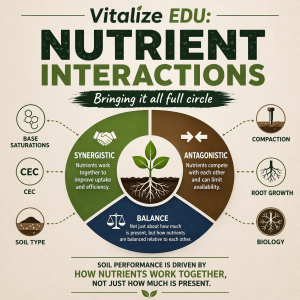
Bringing it all full circle.
Not all nutrients work independently.
They interact with each other in ways that can either improve or limit plant performance.
These interactions fall into three categories:
Synergistic
Some nutrients work together to improve uptake and efficiency.
Example: nitrogen and sulfur working together for protein production.
Antagonistic
Some nutrients compete with each other and can limit availability.
Example: excess potassium can limit magnesium uptake.
Balance
This is where everything comes together.
It is not just about how much of a nutrient is present, but how nutrients are balanced relative to each other.
This is why soil tests should not be viewed as individual numbers.
They should be evaluated as a system.
Even if levels are high, imbalance can still limit performance.
Even if levels are lower, balance and biology can improve efficiency.
This is where base saturations, CEC, soil type, compaction, and biology all connect.
Like all things, biology, root growth, and plant health flourish when the system is in balance or moving toward it.
Bottom line:
Soil performance is driven by how nutrients work together, not just how much is present.