Saw something on Utube. They have Chines Tar River knock off on Amazon that weighs 500LB. The guy said getting replacement parts was tuff. I got a good laugh.thanks so much! Absolutely slow and steady is key to any drill - imo. The biggest reason, imo, why these arms bend is because of the below. This is the gap. That metal ought to sit flush not have a gap. I forgot I also upgraded all the pins. Because of slop even some of those were warped.
Mostly. I’m just having fun trying upgrades and sharing with folks. It’s certainly custom now lol.
View attachment 91228

-
If you are posting pictures, and they aren't posting in the correct orientation, please flush your browser cache and try again.
Edge
Safari/iOS
Chrome
You are using an out of date browser. It may not display this or other websites correctly.
You should upgrade or use an alternative browser.
You should upgrade or use an alternative browser.
Ohio Farm Tours
- Thread starter Buckhunter10
- Start date

Buckhunter10
5 year old buck +
Saw something on Utube. They have Chines Tar River knock off on Amazon that weighs 500LB. The guy said getting replacement parts was tuff. I got a good laugh.
Oh geeze - ya that is a tough spot to be in for sure.
Buckhunter10
5 year old buck +
Buckhunter10
5 year old buck +
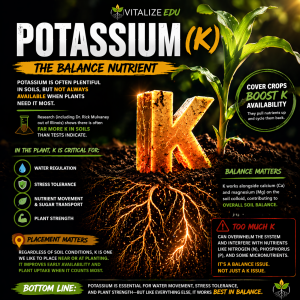
Vitalize EDU: What Potassium Is (and Isn’t) Doing in Your Soil
Potassium (K) is often abundant in soil, but not always available. Sounds similar to P doesn’t it? Let’s dive in!
Research, including work by Dr. Rick Mulvaney (University of Illinois), shows soils can hold far more K than standard tests indicate. The issue is availability, not just supply.
K can be:
• Tied up in minerals
• Held on the soil colloid
• Temporarily unavailable
pH plays a role.
In acidic soils, K availability can be reduced through interactions with iron and aluminum.
Cover crops help:
•Cycle K into plant-available forms
•Improve soil structure and porosity
•Access nutrients from areas roots couldn’t previously reach
In the plant, K supports:
•Water regulation
•Drought tolerance
•Nutrient and sugar movement
•Overall plant strength
K also plays a role in soil balance on the colloid alongside Ca and Mg.
I like placing K near or at planting to improve early uptake.
But balance matters.
Too much K can:
• Compete with Ca and Mg
• In extreme cases, interfere with other nutrients
Bottom line:
Potassium is critical, but availability and balance matter more than total levels.
Potassium (K) is often abundant in soil, but not always available. Sounds similar to P doesn’t it? Let’s dive in!
Research, including work by Dr. Rick Mulvaney (University of Illinois), shows soils can hold far more K than standard tests indicate. The issue is availability, not just supply.
K can be:
• Tied up in minerals
• Held on the soil colloid
• Temporarily unavailable
pH plays a role.
In acidic soils, K availability can be reduced through interactions with iron and aluminum.
Cover crops help:
•Cycle K into plant-available forms
•Improve soil structure and porosity
•Access nutrients from areas roots couldn’t previously reach
In the plant, K supports:
•Water regulation
•Drought tolerance
•Nutrient and sugar movement
•Overall plant strength
K also plays a role in soil balance on the colloid alongside Ca and Mg.
I like placing K near or at planting to improve early uptake.
But balance matters.
Too much K can:
• Compete with Ca and Mg
• In extreme cases, interfere with other nutrients
Bottom line:
Potassium is critical, but availability and balance matter more than total levels.
Buckhunter10
5 year old buck +
Yea I haven’t used synthetic fertilizers in many years- many fields haven’t seen organic fertilizers either. I do lime and think it’s well worth time and money to do so.I quit worrying about lime and fertilizer input in 2016. Been using LC rotation of brassica's and oats, rye, red clover. Beans and corn gets expensive.
I do work with a lot of farmers and such so I like to write to educate if/where I can on all things soils.
In many cases - one will find the growers are often better with less (or in your case none) in the right spot that blindly applying nutrients. The antagonisms can cause more issues when folks blanket apply.
I really appreciate you following and commenting!
Have a great day!
You keep a great post going. Dr Grant has great info on organic planting using a notill method building soil in poor area. I dont plant enough acres every year to justify a notill planter.Yea I haven’t used synthetic fertilizers in many years- many fields haven’t seen organic fertilizers either. I do lime and think it’s well worth time and money to do so.
I do work with a lot of farmers and such so I like to write to educate if/where I can on all things soils.
In many cases - one will find the growers are often better with less (or in your case none) in the right spot that blindly applying nutrients. The antagonisms can cause more issues when folks blanket apply.
I really appreciate you following and commenting!
Have a great day!
Buckhunter10
5 year old buck +
Thank you much, sir. Yeah, the no-till drill game is a tough one. Honestly, I was doing 10 acres x2 a year and still didnt get a not till, until I got up to 15 acres x2 a year with plans to expand. I still do a good bit via broadcast/spray/mow/etc.You keep a great post going. Dr Grant has great info on organic planting using a notill method building soil in poor area. I dont plant enough acres every year to justify a notill planter.
Buckhunter10
5 year old buck +
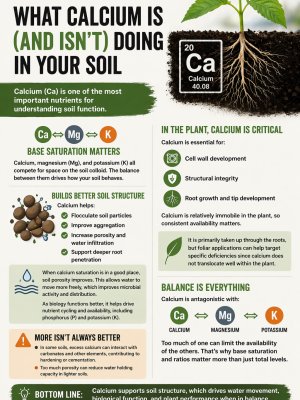
Vitalize EDU: What Calcium Is (and Isn’t) Doing in Your Soil
Calcium (Ca) is one of the most important nutrients for understanding soil function.
It’s not just about how much calcium you have.
It’s about how it sits on the soil colloid.
This is where base saturation comes in.
Calcium, magnesium (Mg), and potassium (K) all compete for space on the soil colloid.
The balance between them drives how your soil behaves.
Calcium plays a major role in soil structure.
It helps:
This allows water to move more freely, which improves microbial activity and distribution.
As biology functions better, it helps drive nutrient cycling and availability, including P and K.
But more is not always better.
In some soils, excess calcium can interact with carbonates and other elements, contributing to hardening or cementation.
Too much porosity can also reduce water holding capacity in lighter soils.
In the plant, calcium is critical for:
It is primarily taken up through the roots, but foliar applications can help target specific deficiencies since calcium does not translocate well within the plant.
Back to balance.
Calcium is antagonistic with:
That’s why base saturation and ratios matter more than just total levels.
Bottom line:
Calcium supports soil structure, which drives water movement, biological function, and plant performance when in balance.
Calcium (Ca) is one of the most important nutrients for understanding soil function.
It’s not just about how much calcium you have.
It’s about how it sits on the soil colloid.
This is where base saturation comes in.
Calcium, magnesium (Mg), and potassium (K) all compete for space on the soil colloid.
The balance between them drives how your soil behaves.
Calcium plays a major role in soil structure.
It helps:
- Flocculate soil particles
- Improve aggregation
- Increase porosity and water infiltration
- Support deeper root penetration
This allows water to move more freely, which improves microbial activity and distribution.
As biology functions better, it helps drive nutrient cycling and availability, including P and K.
But more is not always better.
In some soils, excess calcium can interact with carbonates and other elements, contributing to hardening or cementation.
Too much porosity can also reduce water holding capacity in lighter soils.
In the plant, calcium is critical for:
- Cell wall development
- Structural integrity
- Root growth and tip development
It is primarily taken up through the roots, but foliar applications can help target specific deficiencies since calcium does not translocate well within the plant.
Back to balance.
Calcium is antagonistic with:
- Magnesium (Mg)
- Potassium (K)
That’s why base saturation and ratios matter more than just total levels.
Bottom line:
Calcium supports soil structure, which drives water movement, biological function, and plant performance when in balance.
Buckhunter10
5 year old buck +
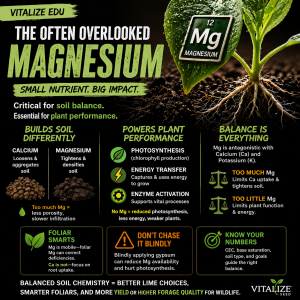
Vitalize EDU: What Magnesium Is (and Isn’t) Doing in Your Soil
Magnesium (Mg) is often overlooked, but it plays a critical role in both soil and plant function.
Like calcium, magnesium sits on the soil colloid.
It’s part of base saturation alongside:
Magnesium influences soil structure, but differently than calcium.
In the plant, magnesium is essential for:
No magnesium = reduced photosynthesis and plant energy.
This is where understanding CEC matters.
CEC helps define how nutrients like Ca, Mg, and K are held and balanced on the soil colloid.
Targets should align with your goals:
Magnesium is antagonistic with:
Too much Mg can limit Ca uptake and tighten soils.
Too little Mg can limit plant function.
This even applies to foliars.
Magnesium is mobile in the plant, so foliar applications can help correct deficiencies more systemically.
Calcium is not, so consistent root uptake is critical, with foliar Ca being more situational.
That’s why we don’t chase magnesium or calcium blindly.
I often hear, “I just apply gypsum, it’s great.”
But without understanding your base saturation, you could be reducing magnesium availability and impacting photosynthesis efficiency in the plant.
We look at:
Magnesium (Mg) is often overlooked, but it plays a critical role in both soil and plant function.
Like calcium, magnesium sits on the soil colloid.
It’s part of base saturation alongside:
- Calcium (Ca)
- Potassium (K)
Magnesium influences soil structure, but differently than calcium.
- Calcium helps loosen and aggregate soil
- Magnesium tends to create denser, tighter soil structure compared to calcium
- Reduce porosity
- Slow water infiltration
- Create heavier, tighter soils
In the plant, magnesium is essential for:
- Photosynthesis (chlorophyll production)
- Energy transfer
- Enzyme activation
No magnesium = reduced photosynthesis and plant energy.
This is where understanding CEC matters.
CEC helps define how nutrients like Ca, Mg, and K are held and balanced on the soil colloid.
Targets should align with your goals:
- Tillage vs. no-till
- Irrigated vs. non-irrigated
- Soil type and structure
Magnesium is antagonistic with:
- Calcium (Ca)
- Potassium (K)
Too much Mg can limit Ca uptake and tighten soils.
Too little Mg can limit plant function.
This even applies to foliars.
Magnesium is mobile in the plant, so foliar applications can help correct deficiencies more systemically.
Calcium is not, so consistent root uptake is critical, with foliar Ca being more situational.
That’s why we don’t chase magnesium or calcium blindly.
I often hear, “I just apply gypsum, it’s great.”
But without understanding your base saturation, you could be reducing magnesium availability and impacting photosynthesis efficiency in the plant.
We look at:
- Base saturation
- CEC and soil type
- Plant response
Buckhunter10
5 year old buck +
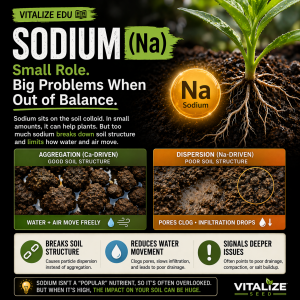
Vitalize EDU: What Sodium Is (and Isn’t) Doing in Your Soil
Sodium (Na) also sits on the soil colloid.
It plays a role in soil and plant systems, but it’s one that requires attention.
Sodium isn’t a “popular” nutrient, so it’s often overlooked.
However, it can create real issues when out of balance.
In small amounts, sodium can:
• Help maintain osmotic balance in plants
• Play a limited role in certain plant functions
But sodium behaves very differently than calcium, magnesium, and potassium.
Too much Na can:
• Disperse soil particles (opposite of aggregation)
• Break soil into fine particles that clog pore space
• Reduce water infiltration
• Create compaction-like conditions
Dispersion means soil particles repel each other instead of sticking together, leading to poor structure and reduced movement of water and air.
This often shows up as tight, crusted, or poorly draining soils.
High sodium is not always just a nutrient issue.
It is often a signal of underlying soil conditions like:
• Poor drainage
• Limited porosity
• Compaction or structural issues
Sodium can come from several sources:
• Irrigation water
• Certain fertilizers or amendments
• Manures or biosolids
• Road salt or runoff
• Natural soil minerals
It can also build up in soils with poor drainage, where water leaves but salts remain.
That’s why sodium matters beyond just the number on a soil test.
You can have a soil that looks good on paper,
but high sodium can still limit performance in the field.
In some cases, mechanical and chemical correction can help.
I’ve seen situations where ripping combined with gypsum application helped replace excess sodium on the soil colloid and improve soil function.
This is where full soil testing matters.
Having complete data, like what we get from Ward Labs, helps us understand the whole system and make better decisions.
It’s also why it’s important to understand what you are applying, where it is derived from, and how it can impact your soil long term.
Bottom line:
Sodium has a place in the system, but too much can signal deeper issues.
Understanding it helps explain why soils may struggle even when test results look good.
Sodium (Na) also sits on the soil colloid.
It plays a role in soil and plant systems, but it’s one that requires attention.
Sodium isn’t a “popular” nutrient, so it’s often overlooked.
However, it can create real issues when out of balance.
In small amounts, sodium can:
• Help maintain osmotic balance in plants
• Play a limited role in certain plant functions
But sodium behaves very differently than calcium, magnesium, and potassium.
Too much Na can:
• Disperse soil particles (opposite of aggregation)
• Break soil into fine particles that clog pore space
• Reduce water infiltration
• Create compaction-like conditions
Dispersion means soil particles repel each other instead of sticking together, leading to poor structure and reduced movement of water and air.
This often shows up as tight, crusted, or poorly draining soils.
High sodium is not always just a nutrient issue.
It is often a signal of underlying soil conditions like:
• Poor drainage
• Limited porosity
• Compaction or structural issues
Sodium can come from several sources:
• Irrigation water
• Certain fertilizers or amendments
• Manures or biosolids
• Road salt or runoff
• Natural soil minerals
It can also build up in soils with poor drainage, where water leaves but salts remain.
That’s why sodium matters beyond just the number on a soil test.
You can have a soil that looks good on paper,
but high sodium can still limit performance in the field.
In some cases, mechanical and chemical correction can help.
I’ve seen situations where ripping combined with gypsum application helped replace excess sodium on the soil colloid and improve soil function.
This is where full soil testing matters.
Having complete data, like what we get from Ward Labs, helps us understand the whole system and make better decisions.
It’s also why it’s important to understand what you are applying, where it is derived from, and how it can impact your soil long term.
Bottom line:
Sodium has a place in the system, but too much can signal deeper issues.
Understanding it helps explain why soils may struggle even when test results look good.
Buckhunter10
5 year old buck +
Vitalize EDU: What Sulfur Is (and Isn’t) Doing in Your Soil
Sulfur (S), measured as sulfate (SO₄) on soil tests, plays a key role in plant performance.
Historically, sulfur came from rainfall due to industrial emissions.
With modern regulations, that source has largely disappeared, so sulfur must now be managed intentionally.
Common sources include:
In the plant, sulfur is critical for:
Without enough sulfur, plants cannot efficiently use nitrogen.
That means
A general target is around 10:1 to 15:1 (N:S).
Even with adequate nitrogen, low sulfur can limit performance.
Organic matter is a major sulfur source.
For every 1% organic matter, soils can release roughly 2 to 5 lbs of sulfur per acre annually, or about 1 to 2.5 ppm, depending on conditions.
Soil biology drives this process, converting sulfur into sulfate, the plant-available form.
Well-drained soils support this activity.
Even if soil tests show lower sulfur levels, organic matter and biology can continue supplying sulfur throughout the season.
In the soil:
Choosing the right sulfur source matters.
Gypsum can supply both calcium and sulfur, supporting structure and plant needs.
Elemental sulfur must be microbially converted to sulfate, forming sulfuric acid.
This can help lower pH in well-drained soils, but poor drainage can create issues in the root zone.
Bottom line:
Sulfur drives nitrogen efficiency and protein formation, and its availability depends on biology, organic matter, and proper management.
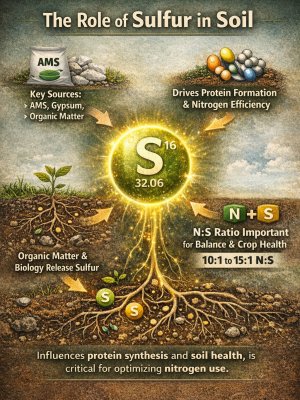
Sulfur (S), measured as sulfate (SO₄) on soil tests, plays a key role in plant performance.
Historically, sulfur came from rainfall due to industrial emissions.
With modern regulations, that source has largely disappeared, so sulfur must now be managed intentionally.
Common sources include:
- AMS
- Gypsum
- Organic matter
In the plant, sulfur is critical for:
- Protein synthesis (with nitrogen)
- Enzyme function
- Chlorophyll formation
Without enough sulfur, plants cannot efficiently use nitrogen.
That means
- Lower protein formation
- Reduced growth efficiency
A general target is around 10:1 to 15:1 (N:S).
Even with adequate nitrogen, low sulfur can limit performance.
Organic matter is a major sulfur source.
For every 1% organic matter, soils can release roughly 2 to 5 lbs of sulfur per acre annually, or about 1 to 2.5 ppm, depending on conditions.
Soil biology drives this process, converting sulfur into sulfate, the plant-available form.
Well-drained soils support this activity.
Even if soil tests show lower sulfur levels, organic matter and biology can continue supplying sulfur throughout the season.
In the soil:
- Sulfate is mobile
- It can leach, especially in lighter soils
Choosing the right sulfur source matters.
Gypsum can supply both calcium and sulfur, supporting structure and plant needs.
Elemental sulfur must be microbially converted to sulfate, forming sulfuric acid.
This can help lower pH in well-drained soils, but poor drainage can create issues in the root zone.
Bottom line:
Sulfur drives nitrogen efficiency and protein formation, and its availability depends on biology, organic matter, and proper management.
Buckhunter10
5 year old buck +
Vitalize EDU: What Zinc Is (and Isn’t) Doing in Your Soil
As you’ve likely noticed throughout this series, many nutrients have synergistic and antagonistic relationships. Much of this understanding comes from work like Albrecht’s Balancing Soils and Hands-On Agronomy by Neal Kinsey, which have helped shape how we look at soil balance.
Zinc (Zn) is a micronutrient, but it plays a major role in plant function. It is needed in small amounts, but deficiencies can have a big impact.
In the plant, zinc is critical for
Low zinc can lead to:
In the soil, zinc availability is influenced by several factors:
The phosphorus to zinc ratio is important. A general target is around 10:1 to 15:1 (P:Zn). Too much phosphorus relative to zinc can reduce zinc availability, even if total zinc levels appear adequate.
Zinc is not highly mobile in the soil, so placement and timing matter.
When applying zinc in a fertilizer form, one of the most common sources is zinc sulfate. Applying it ahead of peak demand can help improve availability as it interacts with the soil environment.
With micronutrients, we also need to be mindful of rates. These are measured in parts per million, and it does not take much to correct a deficiency. Over applications can lead to imbalances or even toxicity.
Like everything else, it comes back to:
Bottom line: Zinc plays a critical role in plant growth and development, and its effectiveness depends on balance, availability, and proper management.
As you’ve likely noticed throughout this series, many nutrients have synergistic and antagonistic relationships. Much of this understanding comes from work like Albrecht’s Balancing Soils and Hands-On Agronomy by Neal Kinsey, which have helped shape how we look at soil balance.
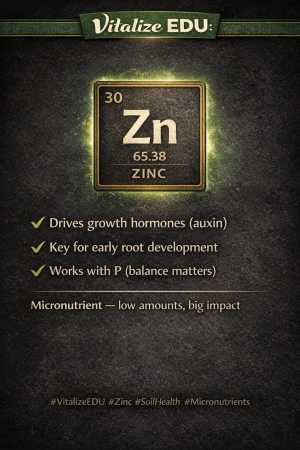
Zinc (Zn) is a micronutrient, but it plays a major role in plant function. It is needed in small amounts, but deficiencies can have a big impact.
In the plant, zinc is critical for
- Enzyme activation
- Hormone production (growth regulation)
- Early root and shoot development
Low zinc can lead to:
- Stunted growth
- Poor root development
- Reduced plant vigor
In the soil, zinc availability is influenced by several factors:
- pH (higher pH can reduce availability)
- Phosphorus levels (high P can tie up Zn)
- Organic matter and biology
The phosphorus to zinc ratio is important. A general target is around 10:1 to 15:1 (P:Zn). Too much phosphorus relative to zinc can reduce zinc availability, even if total zinc levels appear adequate.
Zinc is not highly mobile in the soil, so placement and timing matter.
When applying zinc in a fertilizer form, one of the most common sources is zinc sulfate. Applying it ahead of peak demand can help improve availability as it interacts with the soil environment.
With micronutrients, we also need to be mindful of rates. These are measured in parts per million, and it does not take much to correct a deficiency. Over applications can lead to imbalances or even toxicity.
Like everything else, it comes back to:
- Balance
- Placement
- Timing
- Understanding your system
Bottom line: Zinc plays a critical role in plant growth and development, and its effectiveness depends on balance, availability, and proper management.
Buckhunter10
5 year old buck +
Vitalize EDU: What Iron Is (and Isn’t) Doing in Your Soil
Iron (Fe) is one of the most abundant elements in most soils.
The challenge is not supply. It’s availability.
Iron is often present in large amounts, but much of it is tied up and unavailable to plants, especially in higher pH soils.
In the plant, iron is critical for:
- Chlorophyll formation (what greens the plant and allows it to capture sunlight to fuel growth)
- Energy production and transfer processes
- Enzyme function
Iron plays a key role in keeping plants green and actively growing.
Deficiency often shows up as:
- Yellowing of new growth
- While older leaves may remain green
Availability is heavily influenced by soil conditions.
Higher pH soils tend to reduce iron availability, even when total iron levels are high.
Back to balance.
Iron availability can be limited by:
- High pH (one of the biggest drivers)
- Excess phosphorus (P)
- Competition from other micronutrients like manganese (Mn) and zinc (Zn)
In excess or imbalance, iron can also contribute to competition with other micronutrients like Mn and Zn.
This is why iron issues are often about balance, not just total levels.
In certain systems, direct application can help.
For example:
In turf systems like fescue, chelated iron foliars can improve availability and uptake, leading to a quicker green response.
But in more diverse systems, biology plays a major role.
Multi-species cover crops help:
- Improve root diversity
- Increase biological activity
- Improve iron availability through root activity and biological processes.
This is where system management matters.
Instead of forcing availability, we can often improve it through:
- Biology
- Diversity
- Soil function
This is why at Vitalize Seed, we intentionally do not include iron in our micronutrient blends.
Most soils already contain ample iron, and the challenge is usually availability, not supply.
Adding more can contribute to imbalance and potential antagonisms with other micronutrients.
Bottom line:
Most soils have plenty of iron, but availability is the key. Balance, biology, and system management determine how much the plant can actually use.
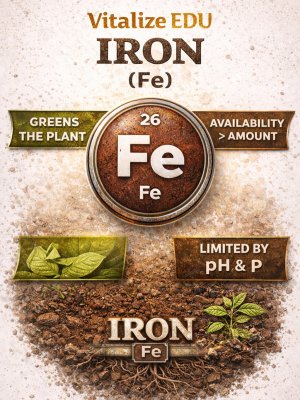
Iron (Fe) is one of the most abundant elements in most soils.
The challenge is not supply. It’s availability.
Iron is often present in large amounts, but much of it is tied up and unavailable to plants, especially in higher pH soils.
In the plant, iron is critical for:
- Chlorophyll formation (what greens the plant and allows it to capture sunlight to fuel growth)
- Energy production and transfer processes
- Enzyme function
Iron plays a key role in keeping plants green and actively growing.
Deficiency often shows up as:
- Yellowing of new growth
- While older leaves may remain green
Availability is heavily influenced by soil conditions.
Higher pH soils tend to reduce iron availability, even when total iron levels are high.
Back to balance.
Iron availability can be limited by:
- High pH (one of the biggest drivers)
- Excess phosphorus (P)
- Competition from other micronutrients like manganese (Mn) and zinc (Zn)
In excess or imbalance, iron can also contribute to competition with other micronutrients like Mn and Zn.
This is why iron issues are often about balance, not just total levels.
In certain systems, direct application can help.
For example:
In turf systems like fescue, chelated iron foliars can improve availability and uptake, leading to a quicker green response.
But in more diverse systems, biology plays a major role.
Multi-species cover crops help:
- Improve root diversity
- Increase biological activity
- Improve iron availability through root activity and biological processes.
This is where system management matters.
Instead of forcing availability, we can often improve it through:
- Biology
- Diversity
- Soil function
This is why at Vitalize Seed, we intentionally do not include iron in our micronutrient blends.
Most soils already contain ample iron, and the challenge is usually availability, not supply.
Adding more can contribute to imbalance and potential antagonisms with other micronutrients.
Bottom line:
Most soils have plenty of iron, but availability is the key. Balance, biology, and system management determine how much the plant can actually use.
Last edited:
Buckhunter10
5 year old buck +
Vitalize EDU: What Manganese Is (and Isn’t) Doing in Your Soil
Manganese (Mn) is a micronutrient that plays a key role in plant function, but like iron, availability is often the challenge.
Not to be confused with magnesium, manganese is a micronutrient.
Like many micros, it can be present in the soil but tied up without proper balance.
In the plant, manganese is critical for:
- Photosynthesis
- Enzyme activation
- Nitrogen metabolism (how the plant converts nitrogen into proteins for growth)
Deficiency often shows up as:
- Yellowing between leaf veins
- Reduced growth and vigor
Availability is driven largely by soil conditions.
Lower pH increases availability, while higher pH can limit it.
Manganese can also be impacted by:
- High pH
- Excess iron (Fe)
- Competition with other micronutrients
In excess, manganese can become toxic, especially in lower pH soils.
Many soil tests we see are low in key micronutrients like Zn, Mn, Cu, B, and Mo.
This is why at Vitalize Seed, we include manganese in our micronutrient blends.
Even though soils contain Mn, we often see levels below optimal.
Adding a small, balanced amount helps early crop performance while biology works to unlock more over time.
Like all things, the goal is to feed both the soil through the roots and the plant through foliar applications for optimal growth.
Bottom line:
Manganese plays a key role in photosynthesis and nutrient use, but availability is driven by soil conditions and balance.
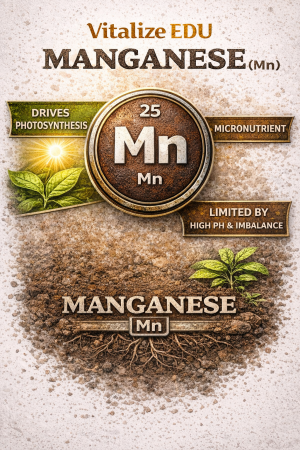
Manganese (Mn) is a micronutrient that plays a key role in plant function, but like iron, availability is often the challenge.
Not to be confused with magnesium, manganese is a micronutrient.
Like many micros, it can be present in the soil but tied up without proper balance.
In the plant, manganese is critical for:
- Photosynthesis
- Enzyme activation
- Nitrogen metabolism (how the plant converts nitrogen into proteins for growth)
Deficiency often shows up as:
- Yellowing between leaf veins
- Reduced growth and vigor
Availability is driven largely by soil conditions.
Lower pH increases availability, while higher pH can limit it.
Manganese can also be impacted by:
- High pH
- Excess iron (Fe)
- Competition with other micronutrients
In excess, manganese can become toxic, especially in lower pH soils.
Many soil tests we see are low in key micronutrients like Zn, Mn, Cu, B, and Mo.
This is why at Vitalize Seed, we include manganese in our micronutrient blends.
Even though soils contain Mn, we often see levels below optimal.
Adding a small, balanced amount helps early crop performance while biology works to unlock more over time.
Like all things, the goal is to feed both the soil through the roots and the plant through foliar applications for optimal growth.
Bottom line:
Manganese plays a key role in photosynthesis and nutrient use, but availability is driven by soil conditions and balance.
Buckhunter10
5 year old buck +
Vitalize EDU: What Copper Is (and Isn’t) Doing in Your Soil
Copper (Cu) is a micronutrient needed in small amounts, but it plays a key role in plant function.
Like many micros, it can be present in the soil but not always available.
In the plant, copper supports:
- Enzyme activity
- Reproductive growth
- Lignin formation (plant strength)
Availability is driven by soil conditions.
Higher pH and higher organic matter can limit copper availability due to strong binding in the soil.
Many soil tests we see are low in key micronutrients like Zn, Mn, Cu, B, and Mo.
This is why at Vitalize Seed, we include copper in our micronutrient blends.
We typically apply Vitalize Micros ahead of planting, often with lime when needed, into standing cover crops.
This allows time for root interaction and biological cycling before the next crop.
As always, we focus on feeding the soil first, then using foliars when needed to support the plant.
Bottom line:
Copper supports plant structure and reproduction, but availability is driven by balance within the soil system.
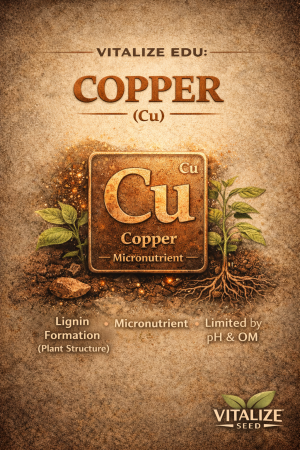
Copper (Cu) is a micronutrient needed in small amounts, but it plays a key role in plant function.
Like many micros, it can be present in the soil but not always available.
In the plant, copper supports:
- Enzyme activity
- Reproductive growth
- Lignin formation (plant strength)
Availability is driven by soil conditions.
Higher pH and higher organic matter can limit copper availability due to strong binding in the soil.
Many soil tests we see are low in key micronutrients like Zn, Mn, Cu, B, and Mo.
This is why at Vitalize Seed, we include copper in our micronutrient blends.
We typically apply Vitalize Micros ahead of planting, often with lime when needed, into standing cover crops.
This allows time for root interaction and biological cycling before the next crop.
As always, we focus on feeding the soil first, then using foliars when needed to support the plant.
Bottom line:
Copper supports plant structure and reproduction, but availability is driven by balance within the soil system.
Buckhunter10
5 year old buck +
Vitalize EDU: What Boron Is (and Isn’t) Doing in Your Soil
Boron (B) is a micronutrient needed in very small amounts, but it plays a critical role in plant development.
In the plant, boron supports:
- Reproductive growth (flowering and seed set)
- Cell wall formation
- Sugar movement within the plant (how energy made in the leaves is transported to roots, flowers, and seeds)
Boron helps move energy and sugars to where the plant needs them most.
Availability is driven by soil conditions.
Boron is highly mobile in the soil and can leach easily, especially in lighter soils.
This means levels can fluctuate, even if it was previously applied.
Due to the mobility of boron, many times it is low in soils.
Deficiency can show up as:
- Reduced vigor and growth
- Poor flowering or seed set
- Misshapen or stunted new growth
- In some cases yellowing or discoloration of leaves
These symptoms can overlap with other nutrient issues, so balance is key.
This is why at Vitalize Seed, we include boron in our micronutrient blends.
Small, balanced amounts help support early plant development and reproduction.
We apply Vitalize Micros a few weeks before planting, not months ahead, after reviewing a soil test.
Boron is mobile and will move into the root zone with moisture.
Other micronutrients are less mobile, but in diverse systems, root activity and biology help cycle them and improve access over time.
As always, we focus on feeding the soil first, then using foliars when needed to support the plant.
Like all things, the goal is to feed both the soil through the roots and the plant through foliar applications for optimal growth.
Like all things, biology, root growth, and plant health flourish when the system is in balance or moving toward it.
Bottom line:
Boron plays a key role in reproduction and nutrient movement, but availability is driven by soil conditions and balance
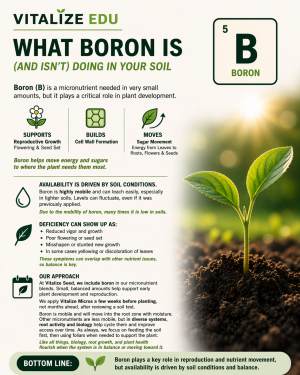
Boron (B) is a micronutrient needed in very small amounts, but it plays a critical role in plant development.
In the plant, boron supports:
- Reproductive growth (flowering and seed set)
- Cell wall formation
- Sugar movement within the plant (how energy made in the leaves is transported to roots, flowers, and seeds)
Boron helps move energy and sugars to where the plant needs them most.
Availability is driven by soil conditions.
Boron is highly mobile in the soil and can leach easily, especially in lighter soils.
This means levels can fluctuate, even if it was previously applied.
Due to the mobility of boron, many times it is low in soils.
Deficiency can show up as:
- Reduced vigor and growth
- Poor flowering or seed set
- Misshapen or stunted new growth
- In some cases yellowing or discoloration of leaves
These symptoms can overlap with other nutrient issues, so balance is key.
This is why at Vitalize Seed, we include boron in our micronutrient blends.
Small, balanced amounts help support early plant development and reproduction.
We apply Vitalize Micros a few weeks before planting, not months ahead, after reviewing a soil test.
Boron is mobile and will move into the root zone with moisture.
Other micronutrients are less mobile, but in diverse systems, root activity and biology help cycle them and improve access over time.
As always, we focus on feeding the soil first, then using foliars when needed to support the plant.
Like all things, the goal is to feed both the soil through the roots and the plant through foliar applications for optimal growth.
Like all things, biology, root growth, and plant health flourish when the system is in balance or moving toward it.
Bottom line:
Boron plays a key role in reproduction and nutrient movement, but availability is driven by soil conditions and balance
Buckhunter10
5 year old buck +
Vitalize EDU: What Molybdenum Is (and Isn’t) Doing in Your Soil
Molybdenum (Mo) is a micronutrient needed in very small amounts, but it plays a critical role in how plants use nitrogen.
In the plant, molybdenum supports:
- Nitrogen fixation (especially in legumes)
- Conversion of nitrate into usable forms (turning nitrogen into amino acids and proteins)
- Overall nitrogen efficiency
Molybdenum helps the plant take nitrogen and turn it into growth.
Availability is driven by soil conditions.
Unlike many micronutrients, molybdenum becomes more available as soil pH increases.
In lower pH soils, molybdenum availability can be limited.
Deficiency can show up as:
- Poor nitrogen use
- Yellowing similar to nitrogen deficiency
- Reduced growth, especially in legumes
Many soil tests do not account for molybdenum, but it can still play a key role in plant performance.
This is why at Vitalize Seed, we include molybdenum in our micronutrient blends.
Small, balanced amounts help support nitrogen cycling and overall plant efficiency.
As always, we focus on feeding the soil first, then using foliars when needed to support the plant.
Like all things, biology, root growth, and plant health flourish when the system is in balance or moving toward it.
This is a great example of how a soil can have everything in it, yet still not be functioning at its full potential, especially in the early stages of improving a degraded system.
Bottom line:
Molybdenum plays a key role in nitrogen use and fixation, but availability is driven by soil conditions and balance.
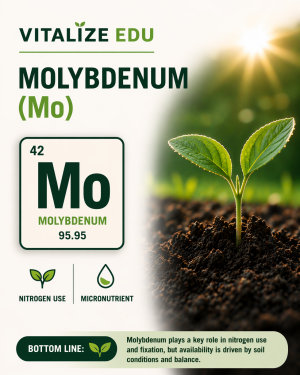
Molybdenum (Mo) is a micronutrient needed in very small amounts, but it plays a critical role in how plants use nitrogen.
In the plant, molybdenum supports:
- Nitrogen fixation (especially in legumes)
- Conversion of nitrate into usable forms (turning nitrogen into amino acids and proteins)
- Overall nitrogen efficiency
Molybdenum helps the plant take nitrogen and turn it into growth.
Availability is driven by soil conditions.
Unlike many micronutrients, molybdenum becomes more available as soil pH increases.
In lower pH soils, molybdenum availability can be limited.
Deficiency can show up as:
- Poor nitrogen use
- Yellowing similar to nitrogen deficiency
- Reduced growth, especially in legumes
Many soil tests do not account for molybdenum, but it can still play a key role in plant performance.
This is why at Vitalize Seed, we include molybdenum in our micronutrient blends.
Small, balanced amounts help support nitrogen cycling and overall plant efficiency.
As always, we focus on feeding the soil first, then using foliars when needed to support the plant.
Like all things, biology, root growth, and plant health flourish when the system is in balance or moving toward it.
This is a great example of how a soil can have everything in it, yet still not be functioning at its full potential, especially in the early stages of improving a degraded system.
Bottom line:
Molybdenum plays a key role in nitrogen use and fixation, but availability is driven by soil conditions and balance.
Buckhunter10
5 year old buck +
Vitalize EDU: What CEC Is (and Isn’t) in Your Soil
CEC (Cation Exchange Capacity) measures how much nutrient your soil can hold.
Cations are positively charged nutrients like Ca, Mg, K, and Na.
Think of CEC as your soil’s storage capacity.
CEC is driven by soil type and organic matter.
Sandy soils tend to be lower CEC.
Heavier soils tend to be higher CEC.
Don’t try to change CEC. Focus on managing it.
Lower CEC soils:
* Faster nutrient availability
* Lower holding capacity
* Benefit from smaller, more frequent inputs
Higher CEC soils:
* Greater nutrient holding capacity
* Can tie up nutrients or hold excess moisture
Both soil types require balance and structure management to function properly.
That’s where management matters.
Bottom line:
CEC tells you how much your soil can hold, but balance determines how well it functions.
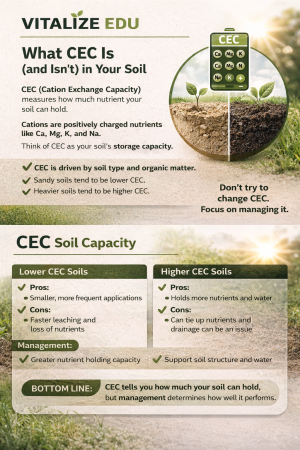
CEC (Cation Exchange Capacity) measures how much nutrient your soil can hold.
Cations are positively charged nutrients like Ca, Mg, K, and Na.
Think of CEC as your soil’s storage capacity.
CEC is driven by soil type and organic matter.
Sandy soils tend to be lower CEC.
Heavier soils tend to be higher CEC.
Don’t try to change CEC. Focus on managing it.
Lower CEC soils:
* Faster nutrient availability
* Lower holding capacity
* Benefit from smaller, more frequent inputs
Higher CEC soils:
* Greater nutrient holding capacity
* Can tie up nutrients or hold excess moisture
Both soil types require balance and structure management to function properly.
That’s where management matters.
Bottom line:
CEC tells you how much your soil can hold, but balance determines how well it functions.
Buckhunter10
5 year old buck +
Vitalize EDU: What Compaction Is (and Isn’t) Doing in Your Soil
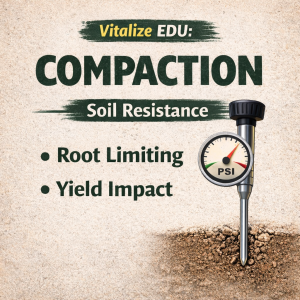
Compaction is when soil particles are pressed together, limiting air, water movement, and root growth.
It can occur at the surface from traffic or rain impact, or deeper in the soil from repeated equipment passes.
A penetrometer can help measure this by reading soil resistance in PSI.
Readings above 250 to 300 PSI, especially across multiple areas or layers, can indicate compaction that may limit root growth.
Soil moisture at the time of testing should also be considered when interpreting these readings.
This matters because roots drive everything, including water, nutrients, and biological activity.
Even if nutrient levels look good, compaction can limit performance
Compaction is not just physical.
It is influenced by soil type, base saturations, and overall balance.
Calcium helps promote aggregation and pore space, while excess magnesium or sodium can lead to tighter soils.
Soil type also plays a role.
Higher clay soils are more prone to compaction if not managed properly, while sandy soils are less prone but can still develop surface limitations.
Diverse roots and fungal networks help improve structure over time by building aggregation and porosity.
Management matters.
Surface issues can often be improved with residue, reduced disturbance, and root activity.
Deeper compaction may require deep-rooted species, time, and in some cases mechanical intervention.
Bottom line:
Compaction limits soil function, not just yield. Managing it correctly improves overall performance.
Compaction is when soil particles are pressed together, limiting air, water movement, and root growth.
It can occur at the surface from traffic or rain impact, or deeper in the soil from repeated equipment passes.
A penetrometer can help measure this by reading soil resistance in PSI.
Readings above 250 to 300 PSI, especially across multiple areas or layers, can indicate compaction that may limit root growth.
Soil moisture at the time of testing should also be considered when interpreting these readings.
This matters because roots drive everything, including water, nutrients, and biological activity.
Even if nutrient levels look good, compaction can limit performance
Compaction is not just physical.
It is influenced by soil type, base saturations, and overall balance.
Calcium helps promote aggregation and pore space, while excess magnesium or sodium can lead to tighter soils.
Soil type also plays a role.
Higher clay soils are more prone to compaction if not managed properly, while sandy soils are less prone but can still develop surface limitations.
Diverse roots and fungal networks help improve structure over time by building aggregation and porosity.
Management matters.
Surface issues can often be improved with residue, reduced disturbance, and root activity.
Deeper compaction may require deep-rooted species, time, and in some cases mechanical intervention.
Bottom line:
Compaction limits soil function, not just yield. Managing it correctly improves overall performance.
Similar threads


- Replies
- 15
- Views
- 1K
