Saw something on Utube. They have Chines Tar River knock off on Amazon that weighs 500LB. The guy said getting replacement parts was tuff. I got a good laugh.thanks so much! Absolutely slow and steady is key to any drill - imo. The biggest reason, imo, why these arms bend is because of the below. This is the gap. That metal ought to sit flush not have a gap. I forgot I also upgraded all the pins. Because of slop even some of those were warped.
Mostly. I’m just having fun trying upgrades and sharing with folks. It’s certainly custom now lol.
View attachment 91228

-
If you are posting pictures, and they aren't posting in the correct orientation, please flush your browser cache and try again.
Edge
Safari/iOS
Chrome
You are using an out of date browser. It may not display this or other websites correctly.
You should upgrade or use an alternative browser.
You should upgrade or use an alternative browser.
Ohio Farm Tours
- Thread starter Buckhunter10
- Start date

Buckhunter10
5 year old buck +
Saw something on Utube. They have Chines Tar River knock off on Amazon that weighs 500LB. The guy said getting replacement parts was tuff. I got a good laugh.
Oh geeze - ya that is a tough spot to be in for sure.
Buckhunter10
5 year old buck +
Buckhunter10
5 year old buck +
Vitalize EDU: What Potassium Is (and Isn’t) Doing in Your Soil
Potassium (K) is often abundant in soil, but not always available. Sounds similar to P doesn’t it? Let’s dive in!
Research, including work by Dr. Rick Mulvaney (University of Illinois), shows soils can hold far more K than standard tests indicate. The issue is availability, not just supply.
K can be:
• Tied up in minerals
• Held on the soil colloid
• Temporarily unavailable
pH plays a role.
In acidic soils, K availability can be reduced through interactions with iron and aluminum.
Cover crops help:
•Cycle K into plant-available forms
•Improve soil structure and porosity
•Access nutrients from areas roots couldn’t previously reach
In the plant, K supports:
•Water regulation
•Drought tolerance
•Nutrient and sugar movement
•Overall plant strength
K also plays a role in soil balance on the colloid alongside Ca and Mg.
I like placing K near or at planting to improve early uptake.
But balance matters.
Too much K can:
• Compete with Ca and Mg
• In extreme cases, interfere with other nutrients
Bottom line:
Potassium is critical, but availability and balance matter more than total levels.
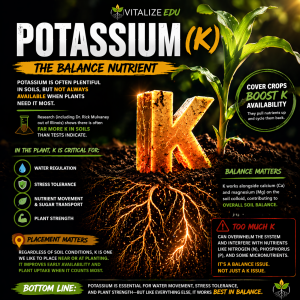
Potassium (K) is often abundant in soil, but not always available. Sounds similar to P doesn’t it? Let’s dive in!
Research, including work by Dr. Rick Mulvaney (University of Illinois), shows soils can hold far more K than standard tests indicate. The issue is availability, not just supply.
K can be:
• Tied up in minerals
• Held on the soil colloid
• Temporarily unavailable
pH plays a role.
In acidic soils, K availability can be reduced through interactions with iron and aluminum.
Cover crops help:
•Cycle K into plant-available forms
•Improve soil structure and porosity
•Access nutrients from areas roots couldn’t previously reach
In the plant, K supports:
•Water regulation
•Drought tolerance
•Nutrient and sugar movement
•Overall plant strength
K also plays a role in soil balance on the colloid alongside Ca and Mg.
I like placing K near or at planting to improve early uptake.
But balance matters.
Too much K can:
• Compete with Ca and Mg
• In extreme cases, interfere with other nutrients
Bottom line:
Potassium is critical, but availability and balance matter more than total levels.
Buckhunter10
5 year old buck +
Yea I haven’t used synthetic fertilizers in many years- many fields haven’t seen organic fertilizers either. I do lime and think it’s well worth time and money to do so.I quit worrying about lime and fertilizer input in 2016. Been using LC rotation of brassica's and oats, rye, red clover. Beans and corn gets expensive.
I do work with a lot of farmers and such so I like to write to educate if/where I can on all things soils.
In many cases - one will find the growers are often better with less (or in your case none) in the right spot that blindly applying nutrients. The antagonisms can cause more issues when folks blanket apply.
I really appreciate you following and commenting!
Have a great day!
You keep a great post going. Dr Grant has great info on organic planting using a notill method building soil in poor area. I dont plant enough acres every year to justify a notill planter.Yea I haven’t used synthetic fertilizers in many years- many fields haven’t seen organic fertilizers either. I do lime and think it’s well worth time and money to do so.
I do work with a lot of farmers and such so I like to write to educate if/where I can on all things soils.
In many cases - one will find the growers are often better with less (or in your case none) in the right spot that blindly applying nutrients. The antagonisms can cause more issues when folks blanket apply.
I really appreciate you following and commenting!
Have a great day!
Buckhunter10
5 year old buck +
Thank you much, sir. Yeah, the no-till drill game is a tough one. Honestly, I was doing 10 acres x2 a year and still didnt get a not till, until I got up to 15 acres x2 a year with plans to expand. I still do a good bit via broadcast/spray/mow/etc.You keep a great post going. Dr Grant has great info on organic planting using a notill method building soil in poor area. I dont plant enough acres every year to justify a notill planter.
Buckhunter10
5 year old buck +
Vitalize EDU: What Calcium Is (and Isn’t) Doing in Your Soil
Calcium (Ca) is one of the most important nutrients for understanding soil function.
It’s not just about how much calcium you have.
It’s about how it sits on the soil colloid.
This is where base saturation comes in.
Calcium, magnesium (Mg), and potassium (K) all compete for space on the soil colloid.
The balance between them drives how your soil behaves.
Calcium plays a major role in soil structure.
It helps:
This allows water to move more freely, which improves microbial activity and distribution.
As biology functions better, it helps drive nutrient cycling and availability, including P and K.
But more is not always better.
In some soils, excess calcium can interact with carbonates and other elements, contributing to hardening or cementation.
Too much porosity can also reduce water holding capacity in lighter soils.
In the plant, calcium is critical for:
It is primarily taken up through the roots, but foliar applications can help target specific deficiencies since calcium does not translocate well within the plant.
Back to balance.
Calcium is antagonistic with:
That’s why base saturation and ratios matter more than just total levels.
Bottom line:
Calcium supports soil structure, which drives water movement, biological function, and plant performance when in balance.
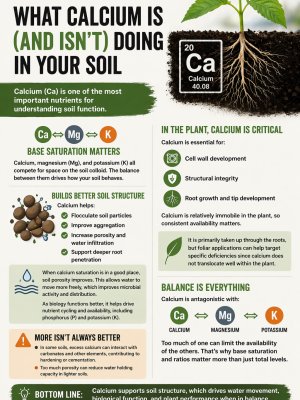
Calcium (Ca) is one of the most important nutrients for understanding soil function.
It’s not just about how much calcium you have.
It’s about how it sits on the soil colloid.
This is where base saturation comes in.
Calcium, magnesium (Mg), and potassium (K) all compete for space on the soil colloid.
The balance between them drives how your soil behaves.
Calcium plays a major role in soil structure.
It helps:
- Flocculate soil particles
- Improve aggregation
- Increase porosity and water infiltration
- Support deeper root penetration
This allows water to move more freely, which improves microbial activity and distribution.
As biology functions better, it helps drive nutrient cycling and availability, including P and K.
But more is not always better.
In some soils, excess calcium can interact with carbonates and other elements, contributing to hardening or cementation.
Too much porosity can also reduce water holding capacity in lighter soils.
In the plant, calcium is critical for:
- Cell wall development
- Structural integrity
- Root growth and tip development
It is primarily taken up through the roots, but foliar applications can help target specific deficiencies since calcium does not translocate well within the plant.
Back to balance.
Calcium is antagonistic with:
- Magnesium (Mg)
- Potassium (K)
That’s why base saturation and ratios matter more than just total levels.
Bottom line:
Calcium supports soil structure, which drives water movement, biological function, and plant performance when in balance.
Buckhunter10
5 year old buck +
Vitalize EDU: What Magnesium Is (and Isn’t) Doing in Your Soil
Magnesium (Mg) is often overlooked, but it plays a critical role in both soil and plant function.
Like calcium, magnesium sits on the soil colloid.
It’s part of base saturation alongside:
Magnesium influences soil structure, but differently than calcium.
In the plant, magnesium is essential for:
No magnesium = reduced photosynthesis and plant energy.
This is where understanding CEC matters.
CEC helps define how nutrients like Ca, Mg, and K are held and balanced on the soil colloid.
Targets should align with your goals:
Magnesium is antagonistic with:
Too much Mg can limit Ca uptake and tighten soils.
Too little Mg can limit plant function.
This even applies to foliars.
Magnesium is mobile in the plant, so foliar applications can help correct deficiencies more systemically.
Calcium is not, so consistent root uptake is critical, with foliar Ca being more situational.
That’s why we don’t chase magnesium or calcium blindly.
I often hear, “I just apply gypsum, it’s great.”
But without understanding your base saturation, you could be reducing magnesium availability and impacting photosynthesis efficiency in the plant.
We look at:
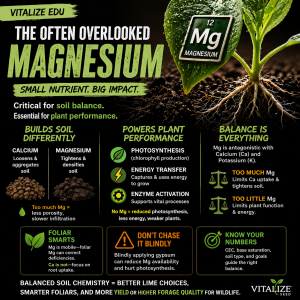
Magnesium (Mg) is often overlooked, but it plays a critical role in both soil and plant function.
Like calcium, magnesium sits on the soil colloid.
It’s part of base saturation alongside:
- Calcium (Ca)
- Potassium (K)
Magnesium influences soil structure, but differently than calcium.
- Calcium helps loosen and aggregate soil
- Magnesium tends to create denser, tighter soil structure compared to calcium
- Reduce porosity
- Slow water infiltration
- Create heavier, tighter soils
In the plant, magnesium is essential for:
- Photosynthesis (chlorophyll production)
- Energy transfer
- Enzyme activation
No magnesium = reduced photosynthesis and plant energy.
This is where understanding CEC matters.
CEC helps define how nutrients like Ca, Mg, and K are held and balanced on the soil colloid.
Targets should align with your goals:
- Tillage vs. no-till
- Irrigated vs. non-irrigated
- Soil type and structure
Magnesium is antagonistic with:
- Calcium (Ca)
- Potassium (K)
Too much Mg can limit Ca uptake and tighten soils.
Too little Mg can limit plant function.
This even applies to foliars.
Magnesium is mobile in the plant, so foliar applications can help correct deficiencies more systemically.
Calcium is not, so consistent root uptake is critical, with foliar Ca being more situational.
That’s why we don’t chase magnesium or calcium blindly.
I often hear, “I just apply gypsum, it’s great.”
But without understanding your base saturation, you could be reducing magnesium availability and impacting photosynthesis efficiency in the plant.
We look at:
- Base saturation
- CEC and soil type
- Plant response
Buckhunter10
5 year old buck +
Vitalize EDU: What Sodium Is (and Isn’t) Doing in Your Soil
Sodium (Na) also sits on the soil colloid.
It plays a role in soil and plant systems, but it’s one that requires attention.
Sodium isn’t a “popular” nutrient, so it’s often overlooked.
However, it can create real issues when out of balance.
In small amounts, sodium can:
• Help maintain osmotic balance in plants
• Play a limited role in certain plant functions
But sodium behaves very differently than calcium, magnesium, and potassium.
Too much Na can:
• Disperse soil particles (opposite of aggregation)
• Break soil into fine particles that clog pore space
• Reduce water infiltration
• Create compaction-like conditions
Dispersion means soil particles repel each other instead of sticking together, leading to poor structure and reduced movement of water and air.
This often shows up as tight, crusted, or poorly draining soils.
High sodium is not always just a nutrient issue.
It is often a signal of underlying soil conditions like:
• Poor drainage
• Limited porosity
• Compaction or structural issues
Sodium can come from several sources:
• Irrigation water
• Certain fertilizers or amendments
• Manures or biosolids
• Road salt or runoff
• Natural soil minerals
It can also build up in soils with poor drainage, where water leaves but salts remain.
That’s why sodium matters beyond just the number on a soil test.
You can have a soil that looks good on paper,
but high sodium can still limit performance in the field.
In some cases, mechanical and chemical correction can help.
I’ve seen situations where ripping combined with gypsum application helped replace excess sodium on the soil colloid and improve soil function.
This is where full soil testing matters.
Having complete data, like what we get from Ward Labs, helps us understand the whole system and make better decisions.
It’s also why it’s important to understand what you are applying, where it is derived from, and how it can impact your soil long term.
Bottom line:
Sodium has a place in the system, but too much can signal deeper issues.
Understanding it helps explain why soils may struggle even when test results look good.
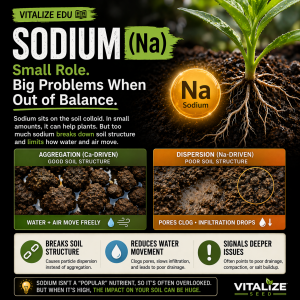
Sodium (Na) also sits on the soil colloid.
It plays a role in soil and plant systems, but it’s one that requires attention.
Sodium isn’t a “popular” nutrient, so it’s often overlooked.
However, it can create real issues when out of balance.
In small amounts, sodium can:
• Help maintain osmotic balance in plants
• Play a limited role in certain plant functions
But sodium behaves very differently than calcium, magnesium, and potassium.
Too much Na can:
• Disperse soil particles (opposite of aggregation)
• Break soil into fine particles that clog pore space
• Reduce water infiltration
• Create compaction-like conditions
Dispersion means soil particles repel each other instead of sticking together, leading to poor structure and reduced movement of water and air.
This often shows up as tight, crusted, or poorly draining soils.
High sodium is not always just a nutrient issue.
It is often a signal of underlying soil conditions like:
• Poor drainage
• Limited porosity
• Compaction or structural issues
Sodium can come from several sources:
• Irrigation water
• Certain fertilizers or amendments
• Manures or biosolids
• Road salt or runoff
• Natural soil minerals
It can also build up in soils with poor drainage, where water leaves but salts remain.
That’s why sodium matters beyond just the number on a soil test.
You can have a soil that looks good on paper,
but high sodium can still limit performance in the field.
In some cases, mechanical and chemical correction can help.
I’ve seen situations where ripping combined with gypsum application helped replace excess sodium on the soil colloid and improve soil function.
This is where full soil testing matters.
Having complete data, like what we get from Ward Labs, helps us understand the whole system and make better decisions.
It’s also why it’s important to understand what you are applying, where it is derived from, and how it can impact your soil long term.
Bottom line:
Sodium has a place in the system, but too much can signal deeper issues.
Understanding it helps explain why soils may struggle even when test results look good.
Buckhunter10
5 year old buck +
Vitalize EDU: What Sulfur Is (and Isn’t) Doing in Your Soil
Sulfur (S), measured as sulfate (SO₄) on soil tests, plays a key role in plant performance.
Historically, sulfur came from rainfall due to industrial emissions.
With modern regulations, that source has largely disappeared, so sulfur must now be managed intentionally.
Common sources include:
In the plant, sulfur is critical for:
Without enough sulfur, plants cannot efficiently use nitrogen.
That means
A general target is around 10:1 to 15:1 (N:S).
Even with adequate nitrogen, low sulfur can limit performance.
Organic matter is a major sulfur source.
For every 1% organic matter, soils can release roughly 2 to 5 lbs of sulfur per acre annually, or about 1 to 2.5 ppm, depending on conditions.
Soil biology drives this process, converting sulfur into sulfate, the plant-available form.
Well-drained soils support this activity.
Even if soil tests show lower sulfur levels, organic matter and biology can continue supplying sulfur throughout the season.
In the soil:
Choosing the right sulfur source matters.
Gypsum can supply both calcium and sulfur, supporting structure and plant needs.
Elemental sulfur must be microbially converted to sulfate, forming sulfuric acid.
This can help lower pH in well-drained soils, but poor drainage can create issues in the root zone.
Bottom line:
Sulfur drives nitrogen efficiency and protein formation, and its availability depends on biology, organic matter, and proper management.
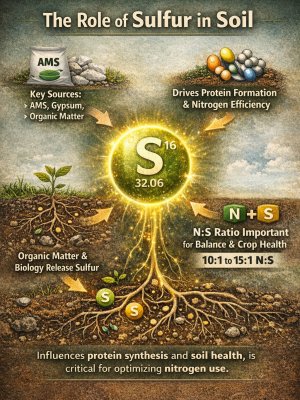
Sulfur (S), measured as sulfate (SO₄) on soil tests, plays a key role in plant performance.
Historically, sulfur came from rainfall due to industrial emissions.
With modern regulations, that source has largely disappeared, so sulfur must now be managed intentionally.
Common sources include:
- AMS
- Gypsum
- Organic matter
In the plant, sulfur is critical for:
- Protein synthesis (with nitrogen)
- Enzyme function
- Chlorophyll formation
Without enough sulfur, plants cannot efficiently use nitrogen.
That means
- Lower protein formation
- Reduced growth efficiency
A general target is around 10:1 to 15:1 (N:S).
Even with adequate nitrogen, low sulfur can limit performance.
Organic matter is a major sulfur source.
For every 1% organic matter, soils can release roughly 2 to 5 lbs of sulfur per acre annually, or about 1 to 2.5 ppm, depending on conditions.
Soil biology drives this process, converting sulfur into sulfate, the plant-available form.
Well-drained soils support this activity.
Even if soil tests show lower sulfur levels, organic matter and biology can continue supplying sulfur throughout the season.
In the soil:
- Sulfate is mobile
- It can leach, especially in lighter soils
Choosing the right sulfur source matters.
Gypsum can supply both calcium and sulfur, supporting structure and plant needs.
Elemental sulfur must be microbially converted to sulfate, forming sulfuric acid.
This can help lower pH in well-drained soils, but poor drainage can create issues in the root zone.
Bottom line:
Sulfur drives nitrogen efficiency and protein formation, and its availability depends on biology, organic matter, and proper management.
Similar threads


- Replies
- 15
- Views
- 947
