• If you are posting pictures, and they aren't posting in the correct orientation, please flush your browser cache and try again.

    Edge
    Safari/iOS
    Chrome

Rediscovered Heritage Apples

One of the above links refers to nearly all apples coming from Khaz. Are we missing things by not bringing in more genetics from M. Ioensis or the southern US equivalent?
I see very little CAR in the trees growing along our ditch banks and assume there must be some ioensis blood in them.
Sent from my iPhone using Tapatalk

Interesting point never thought about native prairie crabs as being the potential dominant pollinator for these wild trees - or there being much of that blood in them at all, but that would explain their health and endurance.
 
I spent quite a while poking through the GRIN listings a few years ago and looking up many of the various native american crab accessions. One thing I remember is how many m. ioensis were noted has highly susceptible to cedar apple rust or fireblight. It is true that many of those collected for GRIN were unusual genetics too, triploid or tetraploid instead of diploid for a normal common apple. That might be why these got collected because they were unusual specimens. Between the ploidy and disease susceptibility, I did not end up ordering anything related to ioensis or coronaria. I only got one cross with malus fusca (pacific crab).
 
A lot of the trees I got scion off of last winter where late hanging trees that I did not have much history with (saw fruit got scion) - the leaves had long dropped by the time I gathered scion but those I did have some experience with where car free during the growing seasons. So some of the trees I grafted may have had car of some sort - the new growth post grafting was pretty much free of anything so that was encouraging.
 
A lot of the trees I got scion off of last winter where late hanging trees that I did not have much history with (saw fruit got scion) - the leaves had long dropped by the time I gathered scion but those I did have some experience with where car free during the growing seasons. So some of the trees I grafted may have had car of some sort - the new growth post grafting was pretty much free of anything so that was encouraging.

Letting mother nature weed them out for ya!
 
One of the above links refers to nearly all apples coming from Khaz. Are we missing things by not bringing in more genetics from M. Ioensis or the southern US equivalent?
I see very little CAR in the trees growing along our ditch banks and assume there must be some ioensis blood in them.
Sent from my iPhone using Tapatalk

Interesting point never thought about native prairie crabs as being the potential dominant pollinator for these wild trees - or there being much of that blood in them at all, but that would explain their health and endurance.

I doubt M ioensis is now the major pollinator, but suspect it was at some places and times in the past.


Sent from my iPhone using Tapatalk
 
Very interesting article. Looking at GRIN and searching for KAZ has brought up some interesting results.
im particularly interested in some that were listed as “xerophyte” , surviving in areas with very little water.
for wild deer trees, low disease, low insect, low watering trees could be very useful.
 
A lot of the trees I got scion off of last winter where late hanging trees that I did not have much history with (saw fruit got scion) - the leaves had long dropped by the time I gathered scion but those I did have some experience with where car free during the growing seasons. So some of the trees I grafted may have had car of some sort - the new growth post grafting was pretty much free of anything so that was encouraging.

We are exposed to a heavy amount of Cedar Rust galls here and to me of course I prefer perfect dark green leaves with zero rust spots. However if the tree consistently produces lots of apples and especially late hangers then a little CAR is really irrelevant to me. CAR sign on leaves that affects the trees’ fruiting or growth habit of course is another matter.
 
My deed dates back to 1860 and the plot shows a planted apple orchard. While all these trees are now gone I believe they also planted rows around the house because I can remember the rows from 60 years ago. One of these trees still survives and even in its dilapidated old age is a prolific producer. It would be really interesting to know the heritage of this apple. Fortunately that ancient tree and that now gone apple orchard somebody planted, are the reason for the several hundred wild trees now thriving in the same spots. Albeit quite expanded. I have never found any with any special taste but the deer tell me which ones they prefer that’s for sure.
 
My deed dates back to 1860 and the plot shows a planted apple orchard. While all these trees are now gone I believe they also planted rows around the house because I can remember the rows from 60 years ago. One of these trees still survives and even in its dilapidated old age is a prolific producer. It would be really interesting to know the heritage of this apple. Fortunately that ancient tree and that now gone apple orchard somebody planted, are the reason for the several hundred wild trees now thriving in the same spots. Albeit quite expanded. I have never found any with any special taste but the deer tell me which ones they prefer that’s for sure.

Any pics of those trees?


Sent from my iPhone using Tapatalk
 
I’ll get some tomorrow. I was just out there LOL.
 
I haven't been logged in for a while, so this reply is a bit out of order by now.

The situation on the old tree I know about that is on the Central Wisconsin Apple Rediscovery Project list is that the owner cherishes being possibly the only one on the planet with that variety and wants to keep it that way. If the tree dies before the owner does, the owner simply does not care. The owner won't even consider selling scions to anyone at any price. This way of thinking is just different from mine, that's all. And for what it is worth, the elderly woman that told me the name of the variety many years ago said it was extremely sour, and that she liked it only up until better tasting varieties came along.
 
Fast forward nearly six years since I posted in this thread "When I was young, an elderly woman told me the names of the varieties of the two apple trees in the backyard of their farmhouse. Those trees are both still alive. One is on the Central Wisconsin Apple Rediscovery Project list. The current owner won't let me collect a bud from it. Hopefully the tree is still alive after the current owner is no longer the owner, and hopefully I am still alive to ask the next owner for a bud. Since I'm not one to sneak over there and collect a scion when the owner is away, there is a note in my file where I keep my Will explaining to my descendants what do to in case I'm not still around once access to the tree becomes legally possible."

Well, I have ended up outliving the owner and, as fate may have it, now own the farmhouse myself and its ancient apple trees. The tree I'm looking for is one of three in the backyard that have huge trunks. All three trunks are full of rot, but the trees are still producing on the sides where the bark is good. I closed on the purchase of the property after the apples had already fallen. The clues I have to go on next year are (1) the taste description from the elderly lady long ago who told me it tastes "sour", which could also mean "very acidic", because she loved to make apple pies and (2) a written description that it resembles Duchess but is redder, weighs around 5-6 ounces, and is a mid to late season apple. We'll see if I can perhaps crack this mystery.

 
Fast forward nearly six years since I posted in this thread "When I was young, an elderly woman told me the names of the varieties of the two apple trees in the backyard of their farmhouse. Those trees are both still alive. One is on the Central Wisconsin Apple Rediscovery Project list. The current owner won't let me collect a bud from it. Hopefully the tree is still alive after the current owner is no longer the owner, and hopefully I am still alive to ask the next owner for a bud. Since I'm not one to sneak over there and collect a scion when the owner is away, there is a note in my file where I keep my Will explaining to my descendants what do to in case I'm not still around once access to the tree becomes legally possible."

Well, I have ended up outliving the owner and, as fate may have it, now own the farmhouse myself and its ancient apple trees. The tree I'm looking for is one of three in the backyard that have huge trunks. All three trunks are full of rot, but the trees are still producing on the sides where the bark is good. I closed on the purchase of the property after the apples had already fallen. The clues I have to go on next year are (1) the taste description from the elderly lady long ago who told me it tastes "sour", which could also mean "very acidic", because she loved to make apple pies and (2) a written description that it resembles Duchess but is redder, weighs around 5-6 ounces, and is a mid to late season apple. We'll see if I can perhaps crack this mystery.
Do you remember the names?
If not, send in for DNA analysis?
 
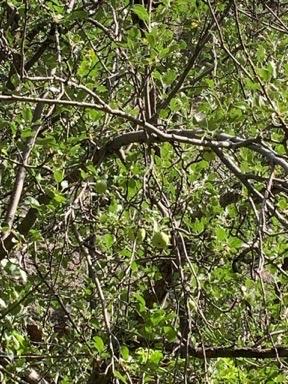
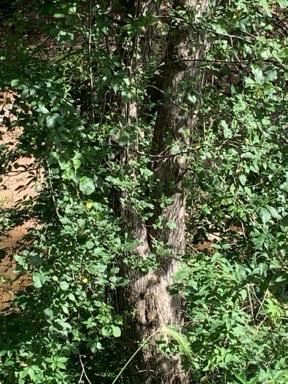
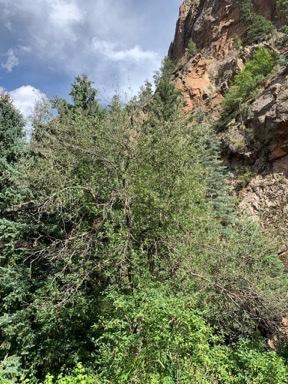
I have to wonder if this tree is one of the lost varieties. It’s very old, and it is sitting between the road and creek on the private road/path going up to the 7 falls in Colorado Springs, CO. It’s across from the restrooms that’s about half way up to the falls.

If I’m ever back there early in spring, I’ll grab a few scions off it.

c532a511a9d40ee6beccec1a2da8dd56.jpg


8d77c52019a8b2933b2a906f8131797d.jpg

9df3cc3a6b97c35f8876f4801f13f792.jpg


Sent from my iPhone using Tapatalk
 
I have to wonder if this tree is one of the lost varieties. It’s very old, and it is sitting between the road and creek on the private road/path going up to the 7 falls in Colorado Springs, CO. It’s across from the restrooms that’s about half way up to the falls.

If I’m ever back there early in spring, I’ll grab a few scions off it.

c532a511a9d40ee6beccec1a2da8dd56.jpg


8d77c52019a8b2933b2a906f8131797d.jpg

9df3cc3a6b97c35f8876f4801f13f792.jpg


Sent from my iPhone using Tapatalk
Have you heard of these folks? They're working hard searching for old apples around Colorado.
They found one of the old Arkansas varieties in an ancient orchard out there, Collins.


Sent from my SM-G990U3 using Tapatalk
 
Last edited:
Have you heard of these folks? They're working hard searching for old apples around Colorado.
They found one of the old Arkansas varieties in an old orchard out there, Collins.


Sent from my SM-G990U3 using Tapatalk

They’d be the folks to tell and do some further research on the tree.


Sent from my iPhone using Tapatalk
 
Sandbur, The elderly woman many years ago told me that she had a Bessie apple tree in the backyard. That's the one on the list of lost Central Wisconsin varieties. I'll have to try to figure out which one it is based on description, because, at least last I read, there is no known sample to compare to.

I'm trying to remember the name of another variety she told me she had in the backyard. It was many years ago.
 
To further confuse matters, apple variety names get unwittingly reused. For all I know, there could be a dozen more modern varieties bearing that name by now.
 
2am a full moon and a pair of felco's can fix that issue poorsand.

who cut scion infront of the state penn on here......
 
Back
Top