

-
If you are posting pictures, and they aren't posting in the correct orientation, please flush your browser cache and try again.
Edge
Safari/iOS
Chrome
You are using an out of date browser. It may not display this or other websites correctly.
You should upgrade or use an alternative browser.
You should upgrade or use an alternative browser.
Ohio Farm Tours
- Thread starter Buckhunter10
- Start date
Buckhunter10
5 year old buck +


Buckhunter10
5 year old buck +
When to Apply Micronutrients and Why You Don’t Need Much
Micronutrients are needed in very small amounts
Most are measured in parts per million
You are not trying to build them
You are trying to make sure they are available
This is where Liebig’s Law comes in
Think of your soil like a bucket
The lowest hole determines how much it can hold
Even when everything looks good on paper
A small micronutrient deficiency can limit the entire system
That is why micros can move the needle
Not because you need a lot
But because you are filling the lowest hole
Best timing:
Pre-plant, ahead of a rain
This helps move micros into the soil solution
And positions them in the root zone early
Foliar can also play a role
Products like Bio-Charge, built on fish emulsion with humic, fulvic, and seaweed
Help deliver micronutrients and trace elements foliarly
This is especially useful in systems where availability is limited
Vitalize Micros is designed to cover key micronutrients
Including boron, molybdenum, copper, zinc, and others
But intentionally we leave out iron
Iron is already high in many soils
And excess iron can create antagonism with nutrients like phosphorus and zinc
The goal is not more fertilizer
It is better positioning, timing, and balance
Small amounts applied correctly can drive big results
Micronutrients are needed in very small amounts
Most are measured in parts per million
You are not trying to build them
You are trying to make sure they are available
This is where Liebig’s Law comes in
Think of your soil like a bucket
The lowest hole determines how much it can hold
Even when everything looks good on paper
A small micronutrient deficiency can limit the entire system
That is why micros can move the needle
Not because you need a lot
But because you are filling the lowest hole
Best timing:
Pre-plant, ahead of a rain
This helps move micros into the soil solution
And positions them in the root zone early
Foliar can also play a role
Products like Bio-Charge, built on fish emulsion with humic, fulvic, and seaweed
Help deliver micronutrients and trace elements foliarly
This is especially useful in systems where availability is limited
Vitalize Micros is designed to cover key micronutrients
Including boron, molybdenum, copper, zinc, and others
But intentionally we leave out iron
Iron is already high in many soils
And excess iron can create antagonism with nutrients like phosphorus and zinc
The goal is not more fertilizer
It is better positioning, timing, and balance
Small amounts applied correctly can drive big results
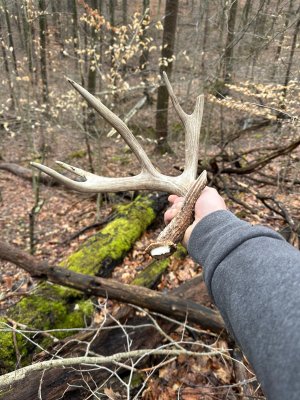
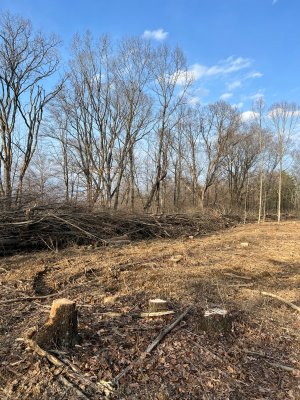
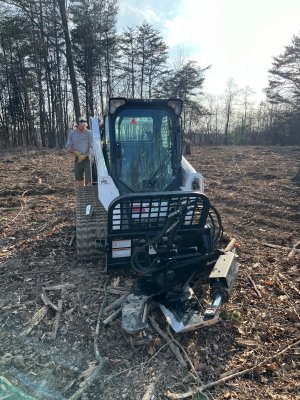
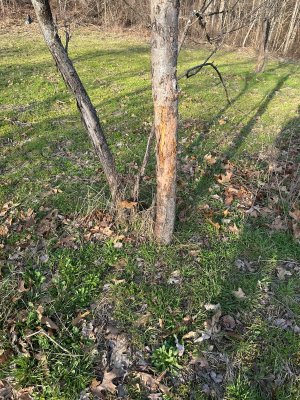
I hate stumps like that. Sooner or later I end up hitting with something.Vitalize plots were busy for us last few days. Found two target bucks, and got a new plot installed. Also planted 19 fruit trees - good few days!
This new plot will be in our Alfalfa edge and premium
View attachment 90987View attachment 90988View attachment 90989View attachment 90990
Buckhunter10
5 year old buck +
Yes my buddy is gunna bring his stump planer and we’ll get them out. Or pop them with bucket. He got others out with bucket - this wasn’t finished project yet. But close.I hate stumps like that. Sooner or later I end up hitting with something.
Buckhunter10
5 year old buck +
My good buddy expanded another plot for me. We need more food and we will get it through another 4-5 acres added so far. Excited for this!
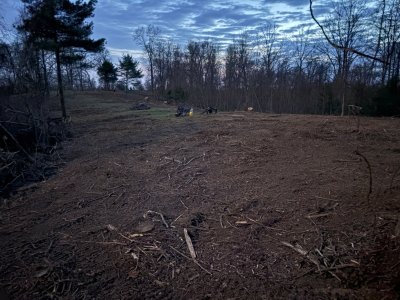
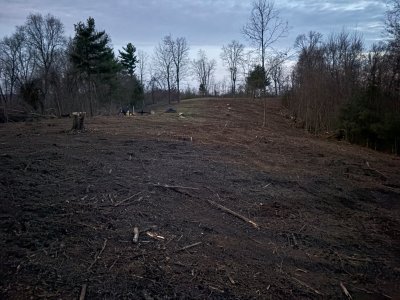
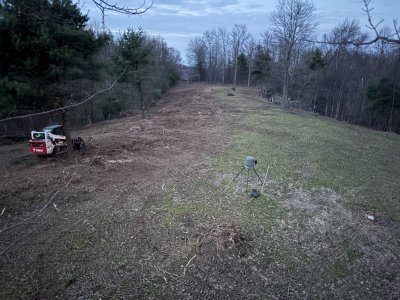
Buckhunter10
5 year old buck +
Vitalize EDU: What is OM (Organic Matter) actually doing in your soil?
OM isn’t just one thing. It exists in two forms:
• Active (labile) OM → breaks down and feeds microbes
• Stable OM → long-term carbon that supports structure and resilience
The active portion is key. It helps:
• Feed soil biology
• Improve water holding capacity
• Aid nutrient cycling
Here’s the part most miss:
Organic matter is often NOT fully accounted for in standard soil test recommendations. It acts more like a reserve that biology can unlock over time.
I like to look at OM as a byproduct of good management, not the sole goal.
In many systems, it’s a bonus.
But here’s the catch:
OM is more qualitative than quantitative.
We know it’s beneficial, but we don’t always know exactly how much nutrient it will release or when.
That depends on:
• Tillage vs. no-till
• Crop type (row crop vs. garden vs. food plot)
• Biology and microbial activity
• How well the system is cycling
If OM builds without proper cycling, it can:
• Tie nutrients up
• Slow availability
• In some cases, increase disease pressure depending on crop and conditions
Bottom line:
OM is powerful, but it’s not just about having it, it’s about managing it.
OM isn’t just one thing. It exists in two forms:
• Active (labile) OM → breaks down and feeds microbes
• Stable OM → long-term carbon that supports structure and resilience
The active portion is key. It helps:
• Feed soil biology
• Improve water holding capacity
• Aid nutrient cycling
Here’s the part most miss:
Organic matter is often NOT fully accounted for in standard soil test recommendations. It acts more like a reserve that biology can unlock over time.
I like to look at OM as a byproduct of good management, not the sole goal.
In many systems, it’s a bonus.
But here’s the catch:
OM is more qualitative than quantitative.
We know it’s beneficial, but we don’t always know exactly how much nutrient it will release or when.
That depends on:
• Tillage vs. no-till
• Crop type (row crop vs. garden vs. food plot)
• Biology and microbial activity
• How well the system is cycling
If OM builds without proper cycling, it can:
• Tie nutrients up
• Slow availability
• In some cases, increase disease pressure depending on crop and conditions
Bottom line:
OM is powerful, but it’s not just about having it, it’s about managing it.
Buckhunter10
5 year old buck +
Vitalize EDU: What Nitrate Is (and Isn’t) Doing in Your Soil
Nitrate (NO3-) is a plant-available form of nitrogen.
Here’s where people get confused:
Nitrate itself is naturally occurring, formed through the soil’s nitrogen cycle.
But colloquially, “synthetic N” refers to nitrogen that is manufactured (ex: Haber-Bosch process and salt-based fertilizers).
So:
Nitrate is:
But nitrate is NOT:
Organic nitrogen (from biomass, manure, cover crops) is different:
It’s tied to carbon compounds like amino acids (ex: glycine - NH2 - CH2 - COOH) and must be cycled by microbes before becoming available.
That’s why timing and system matter:
If you’re
Don’t overlook sulfur.
N + S work together for protein synthesis.
Bottom line:
Nitrate matters, but it’s just one piece of the system.
Nitrate (NO3-) is a plant-available form of nitrogen.
Here’s where people get confused:
Nitrate itself is naturally occurring, formed through the soil’s nitrogen cycle.
But colloquially, “synthetic N” refers to nitrogen that is manufactured (ex: Haber-Bosch process and salt-based fertilizers).
So:
- Chemically - nitrate is natural
- Colloquially - “synthetic N” = manufactured nitrogen inputs
Nitrate is:
- Rapidly available
- Immediately usable by plants
- Highly mobile
But nitrate is NOT:
- Your total nitrogen supply
- A season-long guarantee
Organic nitrogen (from biomass, manure, cover crops) is different:
It’s tied to carbon compounds like amino acids (ex: glycine - NH2 - CH2 - COOH) and must be cycled by microbes before becoming available.
That’s why timing and system matter:
- Winter tests often show lower nitrate
- Summer = more biological activity, more available N
- Legume crops can supply N, but much is tied up in biomass
If you’re
- Row cropping / gardening - nitrate matters more
- Running diverse or legume mixes - rely more on biology
Don’t overlook sulfur.
N + S work together for protein synthesis.
Bottom line:
Nitrate matters, but it’s just one piece of the system.

Buckhunter10
5 year old buck +
So my guess is yes but I’ll be pulling samples shortly. I’ll likely hammer it with lime over the next year. I’ll also use a lot of organic nutrients to speed up breakdown process of the heavy c:n residue.Maybe this was answered and I didn’t see it but will lime be needed immediately on the new cleared area? Or did I miss the point of the other info entirely!
Buckhunter10
5 year old buck +
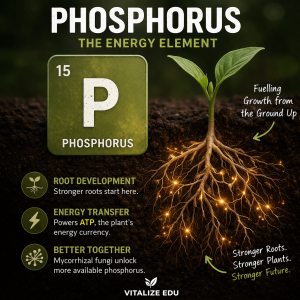
Vitalize EDU: What Phosphorus Is (and Isn’t) Doing in Your Soil
Phosphorus (P) is one of the most misunderstood nutrients in soil.
It’s highly immobile - meaning it doesn’t move much in the soil profile.
That’s why many degraded soils test low in P, even when some may be present. The issue often isn’t just supply - it’s availability.
Phosphorus is critical for:
- Root development
- Energy transfer in the plant
Specifically, P drives ATP (adenosine triphosphate), the plant’s energy currency. Simply put - phosphorus helps the plant create and move energy.
But here’s the challenge: phosphorus doesn’t move well to roots on its own.
This is where biology matters.
Mycorrhizal fungi extend the root system and help access phosphorus that would otherwise be unavailable. This is most effective in well-developed soils with high diversity, active biology, and strong fungal networks.
This is also where organic nutrient systems can shine.
I’m a big fan of placement.
Using products like:
- Seed Feed
- Spectrum+Myco
As a seed coating helps:
- Put small amounts of nutrients (including P) directly on the seed
- Jumpstart biological activity
- Improve early root interaction with fungi
Now - more is NOT better with phosphorus.
Too much P:
- Gets tied up quickly
- Builds in the soil
- Can create nutrient antagonisms
A big one is zinc.
High phosphorus can reduce zinc availability, and zinc is critical for enzyme function, hormone regulation, and overall plant development.
That’s why balance matters.
Pay attention to your P:Zn ratio. A general target is around 10:1 to 15:1 for proper balance.
Bottom line:
Phosphorus is essential, but availability is driven by placement, biology, and balance - not just how much is in the soil.
Similar threads


- Replies
- 15
- Views
- 925
