• If you are posting pictures, and they aren't posting in the correct orientation, please flush your browser cache and try again.

    Edge
    Safari/iOS
    Chrome

Ohio Farm Tours

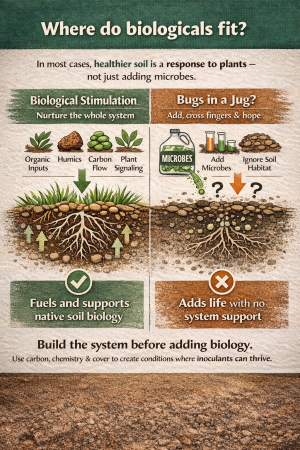
Where do biologicals fit?

Soil biology matters. Healthy soils are living systems. But biology works best when expectations are realistic.

In most cases, biological enhancement in the soil is a response to plants, not the addition of live microbes. Photosynthesis, living roots, and carbon flow are what fuel microbial activity. When plants are thriving, biology follows.

It is also important to recognize that a good response or no visible response does not always indicate whether something is working or not. Plant and soil systems are complex, and responses are influenced by weather, moisture, nutrient availability, and management. This is why we caution relying solely on anecdotal observations.

A visible response also does not always equate to improved plant health. Synthetic nitrogen is a common example. It can create rapid vegetative growth, yet that response does not always translate to better root development, reproductive growth, or long-term plant performance. The same caution applies to biological inputs.

At Vitalize, we often view biologicals as insurance policies, not the engine.

After tillage or herbicide use, fungal and bacterial networks are disrupted. These relationships will typically re-establish over time. The question is not if they return, but how long it takes. Targeted inoculation can help shorten that recovery window.

We also distinguish between biological stimulation and simply adding microbes. Supporting native biology through carbon, organic inputs, plant diversity, balanced chemistry, and reduced disturbance creates the conditions where biology can thrive.

Build the system first.

Let plants lead.

Use biology strategically.
111A7BEE-9ACC-473B-9C25-F6ED67E8863A.png
 
Tillage isn’t the villain.
But it isn’t free.

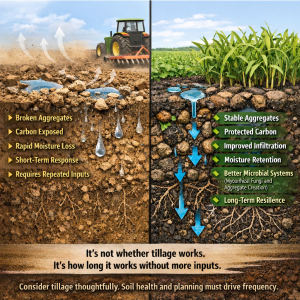
Tillage can work. It can temporarily improve seedbed conditions, loosen compacted layers, and increase early infiltration. The problem isn’t whether tillage works — it’s how long those benefits last, and how often we rely on them without a long-term plan.

Every pass disrupts soil aggregates, exposes carbon, and resets microbial systems that take time to rebuild. Over time, this leads to declining aggregate stability, reduced moisture retention, and an increasing need for additional inputs just to maintain performance.

No-till systems focus on durability. Stable aggregates, protected carbon, and functioning microbial networks — including mycorrhizal fungi — improve water infiltration, moisture holding, and nutrient cycling over time.

There are situations where tillage deserves consideration.
But frequency matters.
And planning matters more.

Soil health isn’t about absolutes.
It’s about using the right tool, at the right time, with a sound plan for what comes next.

Better structure.
Better moisture management.
Better long-term outcomes.
CBB919BF-331C-4E30-8A0D-A23D908F1878.png
 
Who does the diagrams for your posts?

They are outstanding

"There are no absolutes in soil health" warrants emphasis

bill
 
Who does the diagrams for your posts?

They are outstanding

"There are no absolutes in soil health" warrants emphasis

bill
I’ve been using some AI tools and tweaking for awhile until I get them generated how I like them. Thanks for liking them.
 
How does lime actually raise soil pH?

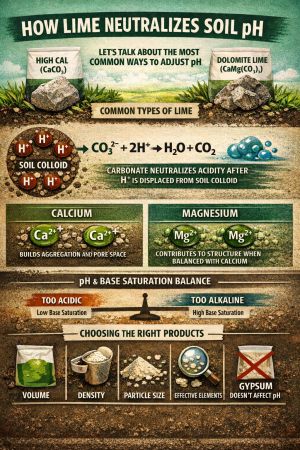
Soil acidity isn’t just a number on a soil test. It’s driven by hydrogen (H⁺) occupying exchange sites on soil colloids.

When we apply traditional ag lime, whether high-calcium lime or dolomitic lime, the pH change does not come from calcium or magnesium alone. The real work is done by the carbonate portion of the material.

Carbonate reacts with acidity in the soil:

CO₃²⁻ + 2H⁺ → H₂O + CO₂

This reaction removes hydrogen from the system, reducing acidity and shifting pH toward neutral. Calcium and magnesium then occupy those exchange sites, increasing base saturation.

Calcium helps build aggregation and pore space. Magnesium also plays a structural role, but only when it remains in balance with calcium. Too much of either can create physical and nutritional challenges, which is why pH and base saturation should always be considered together.

Understanding this chemistry helps sort through product claims. If a product does not contain carbonate (or similar neutralizing chemistry), it cannot meaningfully raise soil pH. Gypsum is a great example. It supplies calcium and sulfur and can improve structure, but it does not neutralize acidity.

It’s also worth noting that some fast-reacting lime materials can create challenges if applied aggressively or without regard to soil buffering. Rapid pH shifts can promote precipitation reactions with micronutrients like iron and aluminum, temporarily reducing availability and, in some cases, contributing to surface sealing or structural issues. Rate, particle size, and overall soil balance matter.

In certain situations, a strategic blend of faster-reacting materials with slower, traditional lime sources can make sense. This can help address short-term pH limitations while supporting longer-term stability as less reactive materials continue to work. As with all soil decisions, this approach should be guided by testing, buffering capacity, and a clear plan.

Managing soil pH isn’t about quick fixes. It’s about understanding the chemistry, respecting the system, and choosing the right material, at the right rate, for the right soil.

EFD4B57D-49C8-420E-B381-ECEFE2E07A82.png
 
Residue Management in No Till: The Carbon and Nitrogen Balance

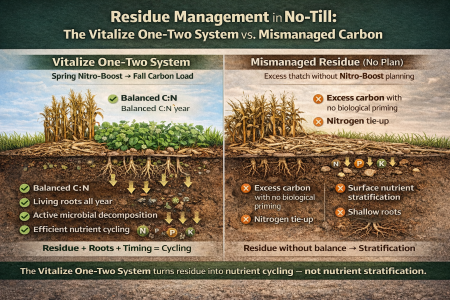
Successful no till systems are not defined by how much residue is left on the surface, but by whether residue is cycled or stratified.

The Vitalize One Two System highlights a broader rule that applies to all cropping systems.

From one crop to the next, nutrients must cycle through a balanced carbon to nitrogen relationship.

Whether you are growing:
• A monoculture cash crop like corn followed by a cover crop, or
• A cover crop following another cover crop,

the same principle applies.

If a high carbon crop is followed by another high carbon crop, residue can overwhelm biology, leading to nitrogen tie up, surface nutrient accumulation, and shallow rooting.

In those cases, nitrogen must be supplied to cycle that carbon, whether through:
• Legume nitrogen fixation
• Targeted fertility inputs
• Or a biologically active follow up crop

Residue management is not about avoiding carbon.
It is about matching carbon with the nitrogen and biology needed to process it.

When carbon and nitrogen are balanced, residue feeds the system.

When they are not, residue slows it down.

Understanding this balance is the key to effective residue management in no till systems.
C50D4C32-C9D3-4396-9E90-3F9C7DDBFCEF.png
 
Know What You’re Planting.

Online, it’s common to hear: Just get the cheapest seed.
Price matters, but it’s not the whole story.

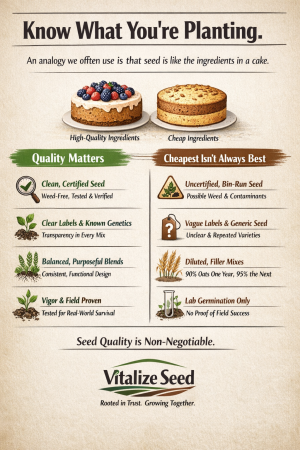
An analogy we often use is that seed is like the ingredients in a cake.

You can buy a cake made with the cheapest ingredients available and it might be fine.
Or you can bake one with high-quality ingredients and it can be exceptional and repeatable.

The same is true with seed.

Here’s what separates quality from compromise.

Clean seed vs weed seed.
Is the issue the species, or the seed quality, cleaning, and certification process behind it?
Poorly cleaned or uncertified seed, regardless of species, is one of the most common pathways for weed introduction.

Each year, we hear I can get bean seed or oat seed for cheap.
In many cases, that seed is bin-run and not properly cleaned or certified.
At Vitalize Seed, we prioritize clean, certified seed to protect long-term soil health and performance.

Transparency matters.

Many labels rely on vague terms like VNS or broad branding such as XYZ brassica. Without clarity, you may not know if you are getting distinct species, repeated genetics, or plants that actually serve different functions in the mix.

Mix design matters.

Well-designed mixes are built around rooting depth, growth rate, and functional roles. Some mixes change year to year based on which filler seed is cheapest. This leads to inconsistent performance and expectations.

Establishment matters.

A strong germination number is important, but real performance depends on seed vigor and survivability under real planting conditions. Experience with species selection and mix design matters beyond a lab test.

Quality ingredients matter. So does transparency. And so does the level of service behind the seed.

At Vitalize Seed, seed quality is non-negotiable. Every order is backed by unmatched customer service, and we appreciate the opportunity to earn your business.
.
A8289A9C-4705-41E8-8DC4-E459837F1757.png
 
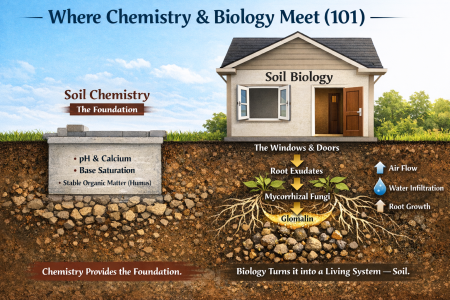
Where Soil Chemistry and Biology Meet | 101

Soil chemistry is the foundation of the house.

It gives soil strength and stability through pH, calcium, and proper balance. Without that foundation, structure is weak and inconsistent.

Soil biology is the framing, windows, and doors that make the house a functional home.

Biology takes that chemical foundation and builds aggregation. Through diverse root systems, root exudates feed microbes and mycorrhizal fungi. As these fungal networks develop, they produce compounds like glomalin, which bind soil particles together into stable aggregates.

Those aggregates create pore space, improve air and water movement, and allow roots to explore the soil profile more efficiently.
.
When both (chemistry and biology) are aligned, soils become a true home for biology to flourish, increasing plant response, resilience, and long-term soil performance.
9D23BBBE-6826-4D4A-B9BB-32E80D3DCBCB.png
 
Back
Top