• If you are posting pictures, and they aren't posting in the correct orientation, please flush your browser cache and try again.

    Edge
    Safari/iOS
    Chrome

CWD Follow-Up

356

5 year old buck +
I wanted to share a few takeaways from a recent experience that I think matters to all of us who care about deer and the future of hunting in Missouri.

As I mentioned in another thread, I was asked to serve on a Missouri Deer Management & CWD task force. Before attending, I gathered questions from members of this forum and from our local deer co‑op, and those questions helped guide my participation. I’ll be honest—at times I felt out of place as a small landowner, especially given the mix of people in the room: outdoor media personalities, large‑acreage landowners, special interest groups, and leadership from conservation organizations like RMEF, NDA, and the Conservation Federation of Missouri. Still, the discussion was open, candid, and worth sharing.

Early on, department leadership acknowledged that mistakes have been made in the past—particularly around inconsistent messaging to landowners following localized EHD outbreaks, such as "don't shoot any does" while giving an adjacent landowner 20 predation permits. They also shared that steps are being taken to improve communication between local conservation officers and landowners so those situations aren’t repeated. One of the most honest conversations we had centered on the difficulty of managing deer when different groups want very different outcomes—from agricultural interests pushing for lower numbers, to hunters who want mature bucks, verses those who simply want to see more deer.

Funding and social‑media criticism came up briefly. What was emphasized is that partnership funding has always been public and transparent, and that organizations like the NDA receive cost‑share funding for personnel and projects—no different than other conservation partners. No one is being paid to “push” CWD messaging, and the diversity of voices on the task force made it clear there’s no single organization driving the conversation behind the scenes.

Why this matters

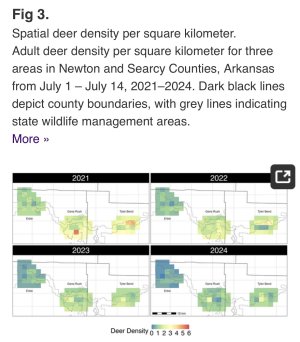
We spent a lot of time looking at what has already happened elsewhere. In northwest Arkansas, CWD reduced deer density from roughly 147 deer per square mile to about 5, with an average age of just 1.5 years. While only around 20% of infected deer die directly from clinical CWD, more than half of the herd tested positive, with mortality coming from a combination of hunting, predation (CWD‑positive deer are easier targets), vehicle collisions, and disease. Similar patterns have been documented in parts of Wisconsin.

Clinical CWD is now present in Missouri's herd. Two deer near Hannibal died from the disease, and a handful of other areas are seeing now seeing clinically ill deer. Unlike EHD (predators will not touch a EHD carcass), CWD‑positive deer that die are often quickly consumed by predators, which makes carcasses harder to find and can give the false impression that nothing is happening. One concern raised—especially by media voices in the room—was that talking openly about CWD will cost viewership. The consensus, however, was that avoiding the topic only delays honest conservation conversations.

Balancing hunters and disease management. This is where things got uncomfortable—but also where the most agreement existed.

The task force discussed:
  • Showing Missourians what clinical CWD actually looks like in the field, not to create fear, but to build understanding.
  • Sharing facts simply and clearly. The media guys had some great input for the MDC staff present.
  • Acknowledging that targeted culling works, even though it’s unpopular. The recommendation was for targeted, doe‑only culling. The greatest outcry from previous culling came from pictures of culled bucks being taken off the land out of season after being shot over a corn pile and the perception that sharpshooters killed "all the good bucks" in my area.
Other tools were discussed as well—one‑buck rules, non‑resident restrictions, and earn‑a‑buck—but all were recognized as controversial and unlikely to gain broad support. One area of strong agreement was expanding Share the Harvest. Two members committed to raising $1 million during the meeting to support expansion of the program. I agreed to meet with DHSS to explore options like using venison snack sticks for school food programs, similar to pilot programs in other states, to promote the expansion of Share the Harvest.

Key takeaways (areas of broad agreement)
  1. CWD is real, and Missouri is now seeing clinical cases. If we can keep prevalence where it is (1-5%), we buy the decades needed for a cure while maintaining our hunting culture. We know much more today than we did 20 years ago, and we know CWD does not “go away.”
  2. Without increased harvest and targeted management, CWD will continue to spread and will impact hunting opportunity within the next 4–5 years. Our window to management is short if our children and grandchildren will enjoy our whitetail hunting culture. The time to act is now.
  3. Baiting and mineral sites are the single worst behavior for disease spread. Changing that culture—and enforcing existing laws—matters.
  4. Missouri is doing a lot right. We remain a top‑tier state for age structure, deer culture, and trophy potential. Prevalence is still under 1%.
  5. Testing works. Knowledge paired with area‑specific harvest data leads to better outcomes.
  6. More hunter voices are needed. Future task‑force meetings will intentionally include more members of the hunting community.
I’m sharing this not to tell anyone what they must think or do, but because I believe honest information—and respectful discussion—is the best way to protect both our deer herd and the future of hunting in Missouri. I’m glad to answer questions or hear other perspectives.
 
“In northwest Arkansas, CWD reduced deer density from roughly 147 deer per square mile to about 5, with an average age of just 1.5 years.”

I have a hard time believing there were 147 deer per square mile to start with
 
“In northwest Arkansas, CWD reduced deer density from roughly 147 deer per square mile to about 5, with an average age of just 1.5 years.”

I have a hard time believing there were 147 deer per square mile to start with
A deer density that high might explain why the disease spread so much faster in that area than other areas.

It seems like an almost unbelievably high density though.
 
With a population that high, there would almost certainly be a die off, CWD or not. Deer populations decrease when they become overpopulated.
 
Last edited:
I wanted to share a few takeaways from a recent experience that I think matters to all of us who care about deer and the future of hunting in Missouri.

As I mentioned in another thread, I was asked to serve on a Missouri Deer Management & CWD task force. Before attending, I gathered questions from members of this forum and from our local deer co‑op, and those questions helped guide my participation. I’ll be honest—at times I felt out of place as a small landowner, especially given the mix of people in the room: outdoor media personalities, large‑acreage landowners, special interest groups, and leadership from conservation organizations like RMEF, NDA, and the Conservation Federation of Missouri. Still, the discussion was open, candid, and worth sharing.

Early on, department leadership acknowledged that mistakes have been made in the past—particularly around inconsistent messaging to landowners following localized EHD outbreaks, such as "don't shoot any does" while giving an adjacent landowner 20 predation permits. They also shared that steps are being taken to improve communication between local conservation officers and landowners so those situations aren’t repeated. One of the most honest conversations we had centered on the difficulty of managing deer when different groups want very different outcomes—from agricultural interests pushing for lower numbers, to hunters who want mature bucks, verses those who simply want to see more deer.

Funding and social‑media criticism came up briefly. What was emphasized is that partnership funding has always been public and transparent, and that organizations like the NDA receive cost‑share funding for personnel and projects—no different than other conservation partners. No one is being paid to “push” CWD messaging, and the diversity of voices on the task force made it clear there’s no single organization driving the conversation behind the scenes.

Why this matters

We spent a lot of time looking at what has already happened elsewhere. In northwest Arkansas, CWD reduced deer density from roughly 147 deer per square mile to about 5, with an average age of just 1.5 years. While only around 20% of infected deer die directly from clinical CWD, more than half of the herd tested positive, with mortality coming from a combination of hunting, predation (CWD‑positive deer are easier targets), vehicle collisions, and disease. Similar patterns have been documented in parts of Wisconsin.

Clinical CWD is now present in Missouri's herd. Two deer near Hannibal died from the disease, and a handful of other areas are seeing now seeing clinically ill deer. Unlike EHD (predators will not touch a EHD carcass), CWD‑positive deer that die are often quickly consumed by predators, which makes carcasses harder to find and can give the false impression that nothing is happening. One concern raised—especially by media voices in the room—was that talking openly about CWD will cost viewership. The consensus, however, was that avoiding the topic only delays honest conservation conversations.

Balancing hunters and disease management. This is where things got uncomfortable—but also where the most agreement existed.

The task force discussed:
  • Showing Missourians what clinical CWD actually looks like in the field, not to create fear, but to build understanding.
  • Sharing facts simply and clearly. The media guys had some great input for the MDC staff present.
  • Acknowledging that targeted culling works, even though it’s unpopular. The recommendation was for targeted, doe‑only culling. The greatest outcry from previous culling came from pictures of culled bucks being taken off the land out of season after being shot over a corn pile and the perception that sharpshooters killed "all the good bucks" in my area.
Other tools were discussed as well—one‑buck rules, non‑resident restrictions, and earn‑a‑buck—but all were recognized as controversial and unlikely to gain broad support. One area of strong agreement was expanding Share the Harvest. Two members committed to raising $1 million during the meeting to support expansion of the program. I agreed to meet with DHSS to explore options like using venison snack sticks for school food programs, similar to pilot programs in other states, to promote the expansion of Share the Harvest.

Key takeaways (areas of broad agreement)
  1. CWD is real, and Missouri is now seeing clinical cases. If we can keep prevalence where it is (1-5%), we buy the decades needed for a cure while maintaining our hunting culture. We know much more today than we did 20 years ago, and we know CWD does not “go away.”
  2. Without increased harvest and targeted management, CWD will continue to spread and will impact hunting opportunity within the next 4–5 years. Our window to management is short if our children and grandchildren will enjoy our whitetail hunting culture. The time to act is now.
  3. Baiting and mineral sites are the single worst behavior for disease spread. Changing that culture—and enforcing existing laws—matters.
  4. Missouri is doing a lot right. We remain a top‑tier state for age structure, deer culture, and trophy potential. Prevalence is still under 1%.
  5. Testing works. Knowledge paired with area‑specific harvest data leads to better outcomes.
  6. More hunter voices are needed. Future task‑force meetings will intentionally include more members of the hunting community.
I’m sharing this not to tell anyone what they must think or do, but because I believe honest information—and respectful discussion—is the best way to protect both our deer herd and the future of hunting in Missouri. I’m glad to answer questions or hear other perspectives.
Thanks for attending these meetings and taking the time to write this up.
 
Do me a favor and send Kentucky that note about baiting. Thanks in advance
 
“In northwest Arkansas, CWD reduced deer density from roughly 147 deer per square mile to about 5, with an average age of just 1.5 years.”

I have a hard time believing there were 147 deer per square mile to start with
Yeah, that seems exceptionally high. I wonder where those numbers come from. I think you already know of this SwampCat, but here is the most recent paper from NW AR. This is in the Tier 1 area that was hardest hit.


I actually lived a few years in NW AR in the early 2000's. I never hunted the area but hiked a bunch of the parks and shed hunted some private properties. I remember commenting to my family that the deer numbers seemed much higher there than at our farm in NE MO at the time.
 
IMG_6468.jpeg

According to research, numbers were not nearly that high at start of study but recognized deer density was already declining. I have hunted that area extensively during turkey season. Even before cwd, probably never saw more than 1/2 dozen deer in three days. Something is off.
 
Most of that area is public hunting area - NF and WMA’s - cant believe widespread deer density was that high
 
Thanks for taking the time to write the report and post it.
 
No way it was

Another big part of the CWD issue, many people think if the "experts" say it, it's true. There have been so many mistakes and falsehoods spread then retracted.
 
  • Showing Missourians what clinical CWD actually looks like in the field, not to create fear, but to build understanding.

Does this mean they described identifying it in the field? I'm curious if you (or others) have an opinion on a deer I shot last year.

It was a young buck, 4 points as I recall, young and scrawny. I had seen it limp by cameras and for a few days it was coming and laying down in my clover mid morning every day. I could see hip bones protruding because it was so thin.

It came by one morning when doe hunting, but stayed out a ways. I saw it only briefly before it disappeared in brush. I called the warden. Later when I gave up on seeing a doe, I went looking for it. It was 10 yards from where I last saw it, laying on the ground, in dense brush, with its head up. But because of where it was, I couldn't see it until I was less than 20 yards from it. It stayed on the ground, looking straight at me. I raised the rifle and shot it while we were staring into each others eyes at under 20 yards. It never made any any effort to move.

Ealier that morning when I called the listed number for the warden, I ended up with what sounded like a more generic state official in an office. I forget what he said he was. But he seemed confident it was EHD rather than CWD, but that was before it let me walk up on it.

I thought about trying to bury it with the tractor, but I had a lot to do that day and didn't. In hindsight I wish I did bury it. Whatever killed it, the predators ate it promptly.
 
Another big part of the CWD issue, many people think if the "experts" say it, it's true. There have been so many mistakes and falsehoods spread then retracted.
Have you got examples?
 
There are three things the theories cannot explain, and until they can be explained with some degree of credibility or demonstration, we are required to reject them.

1. There is significantly more correlation to deer populations growing in CWD areas than shrinking.

2. Culling has not reduced CWD prevalence anywhere despite decades of efforts.

3. NW Arkansas should be relatively CWD free after the herd rebounds if we are to continue with the belief herd reduction is an effective means to contain the disease. To have a 96.6% reduction in the population should quite quickly prove it so, or not.
 
There are three things the theories cannot explain, and until they can be explained with some degree of credibility or demonstration, we are required to reject them.

1. There is significantly more correlation to deer populations growing in CWD areas than shrinking.

2. Culling has not reduced CWD prevalence anywhere despite decades of efforts.

3. NW Arkansas should be relatively CWD free after the herd rebounds if we are to continue with the belief herd reduction is an effective means to contain the disease. To have a 96.6% reduction in the population should quite quickly prove it so, or not.

I can only answer to the first. I think that has a lot to do with fawn recruitment numbers. Arkansas literally has the lowest fawn recruitment of the normal whitetail range - midwest, south, NE, etc at about .4 fawns per doe. WI has fawn recruitment of .8. High Fawn recruitment in WI can keep up with all deer mortality. Low fawn recruitment in AR cant. Study recommendation was to reduce doe harvest and increase doe numbers. When have you seen a cwd management prescription that advised increasing deer numbers?
 
There are three things the theories cannot explain, and until they can be explained with some degree of credibility or demonstration, we are required to reject them.

1. There is significantly more correlation to deer populations growing in CWD areas than shrinking.

2. Culling has not reduced CWD prevalence anywhere despite decades of efforts.

3. NW Arkansas should be relatively CWD free after the herd rebounds if we are to continue with the belief herd reduction is an effective means to contain the disease. To have a 96.6% reduction in the population should quite quickly prove it so, or not.

As to #3, I have seen the herd reduction and transport bans as means to limit the spread (sound familiar?) but not as containment. The prions in the soil won't allow the herd to ever be CWD free.
 
There are three things the theories cannot explain, and until they can be explained with some degree of credibility or demonstration, we are required to reject them.

1. There is significantly more correlation to deer populations growing in CWD areas than shrinking.

2. Culling has not reduced CWD prevalence anywhere despite decades of efforts.

3. NW Arkansas should be relatively CWD free after the herd rebounds if we are to continue with the belief herd reduction is an effective means to contain the disease. To have a 96.6% reduction in the population should quite quickly prove it so, or not.
1. The SW WI area had parts that they did not allow hunting and the population declined. They did necropsy studies to confirm cause of death to confirm if it was CWD.

2. I think the culling is designed to slow the spread to other areas.
 
Let me add a few clarifying points from my notes that I didn’t include in my original post. My goal is to simply share what the research and current management experience suggest.

Transmission pathways.
The primary transmission route for CWD is nose‑to‑nose contact, although prions can be spread through other mechanisms as well. Because of that, concentrated attractants such as mineral licks or corn piles present a much higher risk for transmission than natural browse, food plots, rubs, scrapes, or licking branches. There is also evidence that infected does can pass the disease to their fawns, which typically survive long enough to complete at least one breeding cycle. Remember, proximity and duration impact the likelihood of a deer contracting CWD.

Social behavior matters.
Grooming behavior is common in deer, but it generally occurs within family groups or bachelor groups. Artificial attractants like mineral sites and bait piles unnaturally concentrate unrelated deer, especially younger bucks during dispersal, increasing the likelihood of disease spread across social groups that would not normally interact.

Reporting sick deer & testing is important.
The Missouri Department of Conservation encourages anyone who observes sick or visibly emaciated deer to report them. Unlike EHD, which typically kills deer within days and rarely results in prolonged visible illness, CWD progresses slowly, generally over 12–18 months before symptoms show. During the mid-stage, changes in the brain make healthy looking CWD deer more likely to be shot by hunters (daylighting, for example), eaten by predators or hit by cars. Those deer look healthy, and testing is the only way to know if they are infected. In later stages, infected deer show clinical signs such as abnormal behavior and significant weight loss. Of course, other diseases and conditions can produce similar symptoms, which is why reporting and testing are important.

Why road‑killed deer aren’t a simple solution.
First, many are tested, but not enough. Some hunting groups have asked why road‑killed deer can’t replace mandatory sampling. The reality is that it’s more complicated than it sounds. Roadside collection presents safety concerns, and road easements fall under MoDOT rather than MDC jurisdiction. That said, MDC is actively working through these challenges and is testing road‑killed deer in certain areas as part of its efforts to monitor both the spread and prevalence of CWD.
 
Meeting Follow-Up: The following email to task force participants came yesterday from Jason Isabelle, the Cervid Program Supervisor for the MDC. I am sharing it in its entirety.

Good morning,

I wanted to thank you all again for joining us this week to have a conversation about CWD and deer management in Missouri. Your participation and candid feedback were greatly appreciated.

Because CWD in Wisconsin came up during our discussion, I wanted to share the following article which provides results of the Wisconsin DNR’s 2025 CWD surveillance efforts. As you’ll see in the article, over 2,000 deer tested positive for CWD across the state last year, which was about 11% of the samples that were submitted.

https://www.wkow.com/news/more-than...cle_7c9b17d0-c357-401b-bfd2-99fe1a263937.html

In addition to over 10% of samples testing positive across the state, Wisconsin had several counties this past year that had over 30% of samples test positive.

If you haven’t seen it already, the link below is to an article written last year by outdoor writer, Paul Annear, whose family farm is in a county in southwest Wisconsin that has high CWD infection rates. In the article, Paul shares what it’s like to hunt in an area that is heavily impacted by the disease and how it’s impacted his motivation to hunt and his ability to provide venison for his family.

CWD is Ravaging My Family’s Land, But It’s Not Too Late for You

Thankfully, in Missouri, we’re in a very different situation with most of our CWD-positive counties having less than 1% of samples test positive. Because of this, we’re still within the window where we can continue to manage the disease to keep infection rates low and ensure the herd remains healthy. The feedback you shared during this past week’s meeting and the input we receive from other hunters and landowners will be critically important in determining how we can continue to work together to minimize the impacts of CWD on Missouri’s deer herd.

Thank you, again, for your time this past week. It was great visiting with all of you. If you have any questions or would like to have any follow-up discussion, please let me know.

Thanks,

Jason
 
Back
Top