356
5 year old buck +
I wanted to share a few takeaways from a recent experience that I think matters to all of us who care about deer and the future of hunting in Missouri.
As I mentioned in another thread, I was asked to serve on a Missouri Deer Management & CWD task force. Before attending, I gathered questions from members of this forum and from our local deer co‑op, and those questions helped guide my participation. I’ll be honest—at times I felt out of place as a small landowner, especially given the mix of people in the room: outdoor media personalities, large‑acreage landowners, special interest groups, and leadership from conservation organizations like RMEF, NDA, and the Conservation Federation of Missouri. Still, the discussion was open, candid, and worth sharing.
Early on, department leadership acknowledged that mistakes have been made in the past—particularly around inconsistent messaging to landowners following localized EHD outbreaks, such as "don't shoot any does" while giving an adjacent landowner 20 predation permits. They also shared that steps are being taken to improve communication between local conservation officers and landowners so those situations aren’t repeated. One of the most honest conversations we had centered on the difficulty of managing deer when different groups want very different outcomes—from agricultural interests pushing for lower numbers, to hunters who want mature bucks, verses those who simply want to see more deer.
Funding and social‑media criticism came up briefly. What was emphasized is that partnership funding has always been public and transparent, and that organizations like the NDA receive cost‑share funding for personnel and projects—no different than other conservation partners. No one is being paid to “push” CWD messaging, and the diversity of voices on the task force made it clear there’s no single organization driving the conversation behind the scenes.
Why this matters
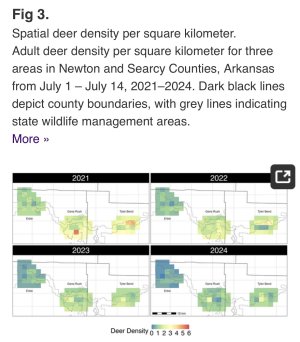
We spent a lot of time looking at what has already happened elsewhere. In northwest Arkansas, CWD reduced deer density from roughly 147 deer per square mile to about 5, with an average age of just 1.5 years. [3-9-2026 NOTE: The 147 number was an error and not the number from in the study. The correct pre-CWD population was 25-30 deer PSM]. While only around 20% of infected deer die directly from clinical CWD, more than half of the herd tested positive, with mortality coming from a combination of hunting, predation (CWD‑positive deer are easier targets), vehicle collisions, and disease. Similar patterns have been documented in parts of Wisconsin.
Clinical CWD is now present in Missouri's herd. Two deer near Hannibal died from the disease, and a handful of other areas are seeing now seeing clinically ill deer. Unlike EHD (predators will not touch a EHD carcass), CWD‑positive deer that die are often quickly consumed by predators, which makes carcasses harder to find and can give the false impression that nothing is happening. One concern raised—especially by media voices in the room—was that talking openly about CWD will cost viewership. The consensus, however, was that avoiding the topic only delays honest conservation conversations.
Balancing hunters and disease management. This is where things got uncomfortable—but also where the most agreement existed.
The task force discussed:
Key takeaways (areas of broad agreement)
As I mentioned in another thread, I was asked to serve on a Missouri Deer Management & CWD task force. Before attending, I gathered questions from members of this forum and from our local deer co‑op, and those questions helped guide my participation. I’ll be honest—at times I felt out of place as a small landowner, especially given the mix of people in the room: outdoor media personalities, large‑acreage landowners, special interest groups, and leadership from conservation organizations like RMEF, NDA, and the Conservation Federation of Missouri. Still, the discussion was open, candid, and worth sharing.
Early on, department leadership acknowledged that mistakes have been made in the past—particularly around inconsistent messaging to landowners following localized EHD outbreaks, such as "don't shoot any does" while giving an adjacent landowner 20 predation permits. They also shared that steps are being taken to improve communication between local conservation officers and landowners so those situations aren’t repeated. One of the most honest conversations we had centered on the difficulty of managing deer when different groups want very different outcomes—from agricultural interests pushing for lower numbers, to hunters who want mature bucks, verses those who simply want to see more deer.
Funding and social‑media criticism came up briefly. What was emphasized is that partnership funding has always been public and transparent, and that organizations like the NDA receive cost‑share funding for personnel and projects—no different than other conservation partners. No one is being paid to “push” CWD messaging, and the diversity of voices on the task force made it clear there’s no single organization driving the conversation behind the scenes.
Why this matters
We spent a lot of time looking at what has already happened elsewhere. In northwest Arkansas, CWD reduced deer density from roughly 147 deer per square mile to about 5, with an average age of just 1.5 years. [3-9-2026 NOTE: The 147 number was an error and not the number from in the study. The correct pre-CWD population was 25-30 deer PSM]. While only around 20% of infected deer die directly from clinical CWD, more than half of the herd tested positive, with mortality coming from a combination of hunting, predation (CWD‑positive deer are easier targets), vehicle collisions, and disease. Similar patterns have been documented in parts of Wisconsin.
Clinical CWD is now present in Missouri's herd. Two deer near Hannibal died from the disease, and a handful of other areas are seeing now seeing clinically ill deer. Unlike EHD (predators will not touch a EHD carcass), CWD‑positive deer that die are often quickly consumed by predators, which makes carcasses harder to find and can give the false impression that nothing is happening. One concern raised—especially by media voices in the room—was that talking openly about CWD will cost viewership. The consensus, however, was that avoiding the topic only delays honest conservation conversations.
Balancing hunters and disease management. This is where things got uncomfortable—but also where the most agreement existed.
The task force discussed:
- Showing Missourians what clinical CWD actually looks like in the field, not to create fear, but to build understanding.
- Sharing facts simply and clearly. The media guys had some great input for the MDC staff present.
- Acknowledging that targeted culling works, even though it’s unpopular. The recommendation was for targeted, doe‑only culling. The greatest outcry from previous culling came from pictures of culled bucks being taken off the land out of season after being shot over a corn pile and the perception that sharpshooters killed "all the good bucks" in my area.
Key takeaways (areas of broad agreement)
- CWD is real, and Missouri is now seeing clinical cases. If we can keep prevalence where it is (1-5%), we buy the decades needed for a cure while maintaining our hunting culture. We know much more today than we did 20 years ago, and we know CWD does not “go away.”
- Without increased harvest and targeted management, CWD will continue to spread and will impact hunting opportunity within the next 4–5 years. Our window to management is short if our children and grandchildren will enjoy our whitetail hunting culture. The time to act is now.
- Baiting and mineral sites are the single worst behavior for disease spread. Changing that culture—and enforcing existing laws—matters.
- Missouri is doing a lot right. We remain a top‑tier state for age structure, deer culture, and trophy potential. Prevalence is still under 1%.
- Testing works. Knowledge paired with area‑specific harvest data leads to better outcomes.
- More hunter voices are needed. Future task‑force meetings will intentionally include more members of the hunting community.
Last edited: