Not gonna catch any shade from me for that! I was actually just looking at partridge pea, milkweed, and ragweed seeds yesterday. From preliminary research I also read black eyed Susan may also be a good option. However, they’re surprisingly expensive. I’m just gonna try to nuke the stilt grass and see what the native seedbank provideth.I am probably going to catch it for admitting this but I plant a lot of native seeds including common ragweed. Great for deer and turkeys and cheap. I know i know, but allergies are not fatal and allergy medicine is over the counter. Ragweed & partridge pea are pretty cheap and i add to my clover food plots & trails.

-
If you are posting pictures, and they aren't posting in the correct orientation, please flush your browser cache and try again.
Edge
Safari/iOS
Chrome
You are using an out of date browser. It may not display this or other websites correctly.
You should upgrade or use an alternative browser.
You should upgrade or use an alternative browser.
Bulk Native Seed Dealers?
- Thread starter RGrizzzz
- Start date


Tangler
5 year old buck +
Awesomeness!My native plots are getting ragweed and partridge pea. I'm also adding tick trefoil and Jerusalem artichoke. I'll add asters and other preferred forbs over time. I would love to find giant ragweed, but so far no luck
I transplanted a bunch of pokeweed taproots already. Also planning to add jewelweed and Greenbriar, and some other shrubs as I expand the plot.
I want to give them a diverse smorgasbord of native plants. My hope is that the native stuff will establish itself and provide nutrition and a diverse ecosystem.

Turkey Creek
5 year old buck +
I put extra Common and Giant Ragweed in my plantings.

Telemark
5 year old buck +
I put extra Common and Giant Ragweed in my plantings.
Where do you get the giant ragweed seeds?
Last edited:
Telemark
5 year old buck +
Not gonna catch any shade from me for that! I was actually just looking at partridge pea, milkweed, and ragweed seeds yesterday. From preliminary research I also read black eyed Susan may also be a good option. However, they’re surprisingly expensive. I’m just gonna try to nuke the stilt grass and see what the native seedbank provideth.
In the spots where I nuked the grass, I got some black eyed susan, milkweed, goldenrod, and cone flower. I also got a crapload of cutleaf teasel, which I'm trying to kill off. If I can make a field of native forbs, hopefully it will grow dense enough to choke out the teasel rosettes.
My goal for the blow down section that I've posted here and on my land tour is constantly changing. My initial plan was isolated food plot but my latest thought is just repeated applications of cleth to hopefully establish a native meadow of forbs & supplement that with ROD plantings and a few apple/pear trees. If I can achieve that over the next couple years I'm almost certain it will be a rut hotspot, especially if I can stay out of it early seasonIn the spots where I nuked the grass, I got some black eyed susan, milkweed, goldenrod, and cone flower. I also got a crapload of cutleaf teasel, which I'm trying to kill off. If I can make a field of native forbs, hopefully it will grow dense enough to choke out the teasel rosettes.

Turkey Creek
5 year old buck +
I think I got that from Roundstone.Where do you get the giant ragweed seeds?

PatinPA
5 year old buck +
Be prepared to nuke it every year for a while. I gave up on mine. It's mostly confined to the roads so I'm just going to leave it be as long as it stays there.Not gonna catch any shade from me for that! I was actually just looking at partridge pea, milkweed, and ragweed seeds yesterday. From preliminary research I also read black eyed Susan may also be a good option. However, they’re surprisingly expensive. I’m just gonna try to nuke the stilt grass and see what the native seedbank provideth.
Telemark
5 year old buck +
I think I got that from Roundstone.
They don't seem to have it anymore, even in their mixes. Bummer. I've been looking everywhere for it.
Yes, I'm aware its going to be a battle. I did overcome another area of it on another section of my property. Just knocking it back a couple times over about 2 years allowed some of the native forbs to get up and above it which did wonders. There is still stilt grass around it, but not getting into that area with the shade/competition of the natives. My plan here is the same, hit it with cleth early after the first flush comes up and then circle back again in July and hit it again before it goes to seed. It should allow the native seed bed of non-grass to get a jump on it, especially if my timing is correct and I repeat next year. That's a big reason why I intend to plant some trees and shrubs in this area too, it will die off if you can get some shade on it. I can tolerate some of it in areas, I'm never going to eradicate it completely, but if I can beat it back so it's not a monoculture of invasives & offer deer some cover and soft + woody browse in that area I will consider it a success.Be prepared to nuke it every year for a while. I gave up on mine. It's mostly confined to the roads so I'm just going to leave it be as long as it stays there.
PatinPA
5 year old buck +
Ya I thought about putting clover over all my roads but I'm not sure if that would be enough to outcompete it or not.Yes, I'm aware its going to be a battle. I did overcome another area of it on another section of my property. Just knocking it back a couple times over about 2 years allowed some of the native forbs to get up and above it which did wonders. There is still stilt grass around it, but not getting into that area with the shade/competition of the natives. My plan here is the same, hit it with cleth early after the first flush comes up and then circle back again in July and hit it again before it goes to seed. It should allow the native seed bed of non-grass to get a jump on it, especially if my timing is correct and I repeat next year. That's a big reason why I intend to plant some trees and shrubs in this area too, it will die off if you can get some shade on it. I can tolerate some of it in areas, I'm never going to eradicate it completely, but if I can beat it back so it's not a monoculture of invasives & offer deer some cover and soft + woody browse in that area I will consider it a success.
I could be wrong, but my thinking is by planting or managing the grass with cleth will give the native forbs a chance to shine again. I don't think wiping the area clean with gly is going to work, the grass will re-germinate faster than the natives. So by selective herbicide use, whatever good is in there it can continue its growing while the stilt grass is knocked back. Supplementing it with some shrubs and tree plantings should expedite the process some too. At first, I wanted it an isolated groomed food plot, but my thinking has changed on this. 1.) It is going to be much harder to achieve, and 2.) I think a native brushy meadow with some hard and soft mast paired with woody browse is likely to serve the wildlife better, and likely will draw mature deer far better than a manicured lawn of clover. Who knows, I could be wrong & may change things up again later, but as of now I'm pretty convinced this is what is best.Ya I thought about putting clover over all my roads but I'm not sure if that would be enough to outcompete it or not.
Telemark
5 year old buck +
I could be wrong, but my thinking is by planting or managing the grass with cleth will give the native forbs a chance to shine again. I don't think wiping the area clean with gly is going to work, the grass will re-germinate faster than the natives. So by selective herbicide use, whatever good is in there it can continue its growing while the stilt grass is knocked back. Supplementing it with some shrubs and tree plantings should expedite the process some too. At first, I wanted it an isolated groomed food plot, but my thinking has changed on this. 1.) It is going to be much harder to achieve, and 2.) I think a native brushy meadow with some hard and soft mast paired with woody browse is likely to serve the wildlife better, and likely will draw mature deer far better than a manicured lawn of clover. Who knows, I could be wrong & may change things up again later, but as of now I'm pretty convinced this is what is best.
Manicured, cover-free plots require expensive equipment and constant maintenance, and it's not what deer prefer. I'm going for plots I can plant and then ignore for a few years. Then when I come back to them, I can either spot spray, or nuke the whole thing and start over. I want good cover, and maximum diversity. I'm hoping my native plots will cruise for at least 5 years without any significant work, though I might have to spot spray grasses and invasives. The other plots will be focused on perennials, with a lot of diverse annuals the first year, and overseeding thin spots with annuals in the following years. I will have very limited annual-only plots, and that will be only in Canada where the deer density is low an the risk of them wiping the plot out is minimal. All the plots will get a relatively dense border screen of native shrubs, with a good deal of native shrubs planted throughout to add cover and diversity. The non-native plots will also get fruit trees.
Telemark
5 year old buck +
My goal for the blow down section that I've posted here and on my land tour is constantly changing. My initial plan was isolated food plot but my latest thought is just repeated applications of cleth to hopefully establish a native meadow of forbs & supplement that with ROD plantings and a few apple/pear trees. If I can achieve that over the next couple years I'm almost certain it will be a rut hotspot, especially if I can stay out of it early season
If I had a whole field that was a blank canvas, and the equipment to start from zero, I would nuke the whole thing until it was completely dead. Then I would sow the most diverse mix of forbs I could manage to put together, along with 2lbs per acre of switchgrass, and I would plant native shrubs throughout. I would plant 5-8 oaks in the white oak family. This would give you good cover with plentiful food, and should be ideal for deer most days of the year. I would use this spot as a staging area between bedding and small annual plots with fruit trees. I would have a tower blind overlooking this area for rifle and muzzleloader season, and I would try to keep the area about 200 yards edge to edge. A 200x200 yard square is about 8.5 acres.
In the small annual plots, I would plant either a brassica/annual clover mix or soybean/sunflower/sorghum mix and rotate between the two, with every fifth year or so being a soil-building blend. It keeps the continual effort and cost to a minimum, while providing an incredible amount of nutrition and cover for the deer and other wildlife. The plots would be about 60 yards in diameter, with a beech tree bang in the center for a communal scrape. This would give me a 30 yard bow shot from anywhere around the edge of the plot, and I would have several stands for various wind conditions. A 60 yard diameter circle is about 0.6 acres. Three of these would be under two acres total, which would be relatively easy and cheap to manage.
For bedding, I would nuke the field and plant 2lbs per acre of switchgrass, with a few other grasses like bluestem, and rings of spruce with white pine in the center. Eventually, the spruce and pine would give them pockets of overhead and horizontal cover, with the more open areas allowing them to sun themselves while still in good cover. I'd plant some nice hardwoods in there, too, to give them summer shade. This area can be unlimited in size, and should ideally have some hardwood forest nearby, preferably with some arborvitae, red oaks, and honey locust for winter survival food.
That's my vision for a northern whitetail paradise.
Telemark
5 year old buck +
For a native food plot in Ohio, I would start with giant ragweed and native sunflowers as an edible high-protein screen. It would be planted relatively sparse, but wide. I want the deer to feel secure but not trapped, and I want to cover my approach and exit. Wherever I have a stand, I would plant a strip denser and wider to discourage travel within 20 yards of the tree I'm hunting from.
Inside the plot, I would plant partridge pea, oldfield aster, Jerusalem artichoke, coreopsis, evening primrose, ragweed, goldenrod, pokeweed, tick trefoil, bluebell, wingstem, coneflower, purple poppy mallow, milkweeds, and wild lettuce.
For shrubs, I would plant native plums, hazelnut, sumac, dogwoods, willows, and viburnum, at a rate of about 10-20 shrubs per acre.
This should be a good mix of food and cover, all native, for the deer, insects, and other wildlife. I would only enter once in the summer to manage invasives. We have a problem with cutleaf teasel, Asian honeysuckles, Callery pear, and buckthorn. We also have black medick and nodding thistle, but they don't seem to be a problem, so I wouldn't spend time focusing on them.
Ideally I could spend one day a year on this plot. I would take loppers and a bottle of dyed herbicide with a sponge attached to the top to kill buckthorn, Callery, and honeysuckle. And I would have a sprayer to hit the teasel after lopping off the seed heads. I think I could manage up to about 3 acres a day this way, depending on how persistent the invasives were.
Inside the plot, I would plant partridge pea, oldfield aster, Jerusalem artichoke, coreopsis, evening primrose, ragweed, goldenrod, pokeweed, tick trefoil, bluebell, wingstem, coneflower, purple poppy mallow, milkweeds, and wild lettuce.
For shrubs, I would plant native plums, hazelnut, sumac, dogwoods, willows, and viburnum, at a rate of about 10-20 shrubs per acre.
This should be a good mix of food and cover, all native, for the deer, insects, and other wildlife. I would only enter once in the summer to manage invasives. We have a problem with cutleaf teasel, Asian honeysuckles, Callery pear, and buckthorn. We also have black medick and nodding thistle, but they don't seem to be a problem, so I wouldn't spend time focusing on them.
Ideally I could spend one day a year on this plot. I would take loppers and a bottle of dyed herbicide with a sponge attached to the top to kill buckthorn, Callery, and honeysuckle. And I would have a sprayer to hit the teasel after lopping off the seed heads. I think I could manage up to about 3 acres a day this way, depending on how persistent the invasives were.
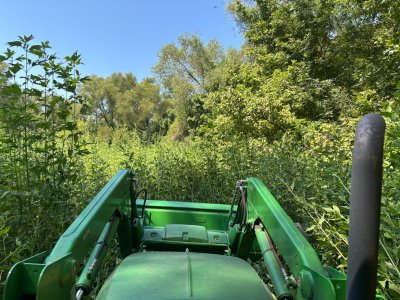
It is always interesting to see plant preference by us habitat folks. I cant imagine anyone wanting to plant giant ragweed. This is an annual food plot planted with wheat in Oct. This is what it looks like every Aug when I bush hog it. Some of that ragweed is 12 ft tall. I see very little usage - either browsing or bedding. Come get some seed.
Tangler
5 year old buck +
has round stone changed? I once ordered several native seeds (common ragweed, Partridge pea,I think I got that from Roundstone.
Yes, They did sell common ragweed but not any longer, or at least not now. I bought common ragweed + some native legumes (partridge pea, etc) from roundstone a year ago. This year I bought partridge pea & common ragweed from Ernst Conservation Seeds inc. I cannot find giant ragweed for sale anywhere. I would like to plant that in some wet areas. Anyone seen giant ragweed online currently?They don't seem to have it anymore, even in their mixes. Bummer. I've been looking everywhere for it.
Telemark
5 year old buck +
View attachment 90625
It is always interesting to see plant preference by us habitat folks. I cant imagine anyone wanting to plant giant ragweed. This is an annual food plot planted with wheat in Oct. This is what it looks like every Aug when I bush hog it. Some of that ragweed is 12 ft tall. I see very little usage - either browsing or bedding. Come get some seed.
Jeez, your place is overwhelmed with it.
I have patches of marestail (Erigeron canadensis) like that. I don't even bother with those areas. It's native, and I'm taking SD's approach in assuming there is something wrong with the soil that.needs fixed. If it persists, I'll make a plan to deal with it.
Is there a protocol for dealing with ragweed infestation? I have plenty of common ragweed. I haven't seen much use, and it's showing no sign of becoming aggressive, but I'm keeping an eye on it.
Similar threads


- Replies
- 15
- Views
- 1K


