
g squared 23
5 year old buck +
My brother left 8 acres of standing beans and found 2 sheds. The glory days are WELL behind and gone forever
Sent from my iPhone using Tapatalk
Sent from my iPhone using Tapatalk


I set my Garmin watch yesterday, I walked 4.5 miles, nevermind the almost 70 acres of fields I drove. I found one dead head.My brother left 8 acres of standing beans and found 2 sheds. The glory days are WELL behind and gone forever
Sent from my iPhone using Tapatalk
You got any gobblin turkeys?I set my Garmin watch yesterday, I walked 4.5 miles, nevermind the almost 70 acres of fields I drove. I found one dead head.
I'm sure Ive had a zero shed year sometime in the past, but I sure dont remember it. Don't look as much as I used to.


You know, I was hoping to mow 8 acres of switch grass. Odds are likely of finding 1 the wrong way.I have found a few in a tractor tire

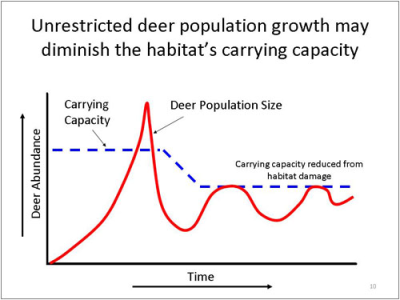
To me it seems like if it was that quick of a response for buck quality to decline, there would be more dramatic increases and decreases in buck quality even within small geographic areas that are managed differently (even accounting for fawn dispersal). This figure works for showing deer populations over time, but did they talk how this is related to buck quality?This chart from the MSU Deer Lab is a pretty good look at how we can have less and less quality bucks as the years go by. I think back on that study where it took 2 generations of optimum nutrition for bucks to reach their genetic potential. So, with that same reasoning, it can take 2 generations or more for buck quality to decline after nutrition goes down. Those 5.5 yo top quality bucks are the results of the nutritional plane wherever they dispersed from where their grandmothers were born. What looked like a great herd with lots of deer and great buck quality was the rise before the fall.
View attachment 90291
It would definitely be a gradual decrease in quality. With the study, they were showing it would take 2 generations for improving quality in a very controlled environment. In the wild you wouldn't see it that fast. That's why I was saying you're looking at 2 or more generations of does living at a suboptimal level then you would notice the bucks they produce 5 years after that wouldn't be as good. So, probably a decade or more. That's what I think of when people say we used to have lots of deer and big deer 10 or so years ago, but we don't anymore. The habitat prior to those glory days was probably going downhill already.To me it seems like if it was that quick of a response for buck quality to decline, there would be more dramatic increases and decreases in buck quality even within small geographic areas that are managed differently (even accounting for fawn dispersal). This figure works for showing deer populations over time, but did they talk how this is related to buck quality?


It’s funny you say that, but on the contrary a County Park had a buckthorn eradication event with follow up . This 80 acre park was full of buckthorn. It was also full of deer.Invasive species are taking their toll on the landscape and only getting worse with each passing year.
One can spend dozens or hundreds of hours a year in eradication efforts (not to mention $$$) only for your buck fawns born in your premium habitat to disperse 3 to 10 miles away.
What a cruel return on investment mother nature serves up
Yep, invasives thrive in mature over story hardwoods. They get the jump in early spring and hold on an extra couple weeks in the fall.It’s funny you say that, but on the contrary a County Park had a buckthorn eradication event with follow up . This 80 acre park was full of buckthorn. It was also full of deer.
They cut all the invasive outs and there are literally no deer in that Park anymore . It’s so wide open and the walking trails are busy . They all moved .
A buddy has 5 acres that borders it and it was a great rut spot before as the bucks came out of the park … he’s pissed now !
I don’t blame them for treating it, but not sure if it will hold much for wildlife anymore.
That’s what it appears to be. Looks to be very effective.So it's a heavy lawn jart that drops it in their head?

It all depends on the soil and location. It might end up as all grassland, or oak savanna, or if there is a local seed source, more buckthorn.Yep, invasives thrive in mature over story hardwoods. They get the jump in early spring and hold on an extra couple weeks in the fall.
If your park did a timber harvest, the deer would readily return because there would be side cover and food instead of just side cover from the invasives.


