• If you are posting pictures, and they aren't posting in the correct orientation, please flush your browser cache and try again.

    Edge
    Safari/iOS
    Chrome

Wisconsin CWD?

SwampCat

5 year old buck +
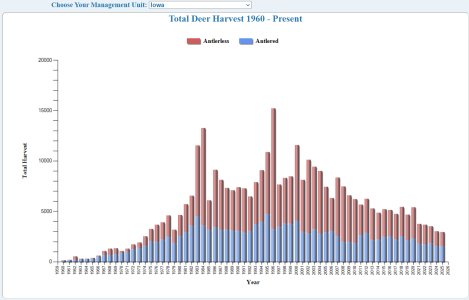
I noticed in the WI CWD data, Iowa Co - a county with one of the highest number of cwd detections - the average number of deer submitted for testing over the past three years was around 750. In past years - there were many, many years of 1500 submissions for testing - or more.

Is the drop in deer submitted a result of hunter indifference over time, fewer deer, fewer deer hunters in those zones - a combination - or something different?
 
I would guess hunter indifference.

I'm two counties away and there hasn't been a difference in deer numbers or hunters.
 
I agree with Brian. Hunter indifference.

I'm also two counties away and have noticed no difference with deer numbers or hunters.

Personally, I hear more about CWD in Wisconsin on these threads than I do in real life.
 
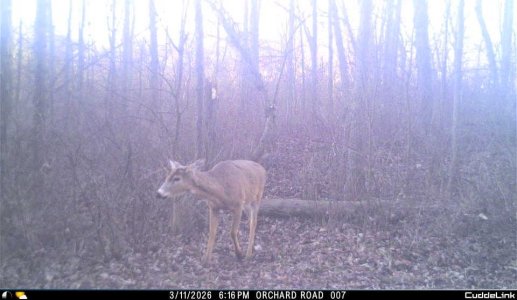
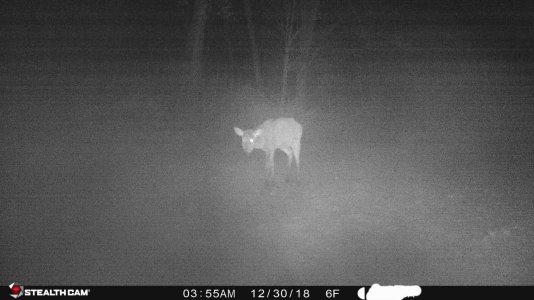
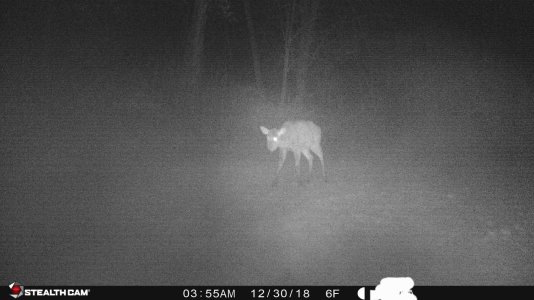
We are in Sauk County and our population is high but mature buck numbers are getting lower. Here is a photo we just got yesterday and id bet a 100 dollar bill that deer will be dead within a month. CWD is an issue in our area.Snapchat-433665292.jpg
 
So, back when cwd was first detected they were killing 8000 to 10,000 deer a year in Iowa county and now killing about 2500 - a 75% drop in harvest. Yet folks say there are just as many deer now and just as many hunters.

Are hunter electing not to shoot them? You would actually think folks would be killing more deer now - if I understand the tagging procedure. If you kill a deer and check it and submit if for cwd and it tests positive for cwd - do you then get a replacement tag and can go out and kill another deer - which would then add to the harvest total?
 
Less deer. I'll quote myself from something I posted last year...

"My land in Wisconsin is in a county with a very high CWD infection rate. The township I'm in has an infection rate of about 29%. Despite the harvest dropping the last four years the deer population is not growing in my county. GPS collar studies are showing the decline is because of CWD, not EHD or predators. Once infection rates reach a certain level you can no longer stockpile deer."

CWD is a very big issue where I hunt.
 
The harvest numbers for the counties around Iowa don't show the same decline. FWIW.

There is certainly nuance to the conversation.
 
Less deer. I'll quote myself from something I posted last year...

"My land in Wisconsin is in a county with a very high CWD infection rate. The township I'm in has an infection rate of about 29%. Despite the harvest dropping the last four years the deer population is not growing in my county. GPS collar studies are showing the decline is because of CWD, not EHD or predators. Once infection rates reach a certain level you can no longer stockpile deer."

CWD is a very big issue where I hunt.
It’s hard to like a post like this, but thank you for sharing your first hand experience. Here is Missouri we are struggling to get hunters to accept that CWD is a very big issue that will causes changes to hunter behavior, but does not have to eliminate hunting.
 
Is it possible the value of land there has changed harvest? I’m not overly familiar with those counties, but the ones right along the MN border can fetch $10,000+ an acre. That to me doesn’t seem like freezer filling prices anymore. That’s trophy ground prices.


Sent from my iPhone using Tapatalk
 
Is it possible the value of land there has changed harvest? I’m not overly familiar with those counties, but the ones right along the MN border can fetch $10,000+ an acre. That to me doesn’t seem like freezer filling prices anymore. That’s trophy ground prices.

Do you think someone would really pay that kind of money mainly to deer hunt in a county with a very high cwd infection rate?

Sent from my iPhone using Tapatalk
 
I'm pretty in tune with land prices on both the MN and WI side of the river. Buffalo, Pierce, and Pepin counties in WI fetch close to $10k/acre but their CWD rate is mostly non-existent.

You get down towards Vernon, Crawford, Grant and the CWD rates get higher and the land has always lagged behind in cost. $7-9k an acre currently in those areas. Move "inland" off the river and you're still $6-8k/ac in Richland, Monroe counties. Those are primarily all hunting tract numbers. Prices can fluctuate regionally near La Crosse or as you get closer to Madison.

Farmland is $1-2k/ac more almost everywhere. Not a hard and fast rule. But generally MN land prices are ~$1k/acre cheaper than their WI counterpart. So far in the counties I'm familiar with (full disclosure, not familiar with Iowa county) the real estate price pressure hasn't seen a downward reflection from CWD, IMO.
 
Less deer. I'll quote myself from something I posted last year...

"My land in Wisconsin is in a county with a very high CWD infection rate. The township I'm in has an infection rate of about 29%. Despite the harvest dropping the last four years the deer population is not growing in my county. GPS collar studies are showing the decline is because of CWD, not EHD or predators. Once infection rates reach a certain level you can no longer stockpile deer."

CWD is a very big issue where I hunt.
My property is in a township with similar infection rates. Our deer population is spotty and from what I have gathered noticeably lower than years past. Now whether it is the disease directly or whether our area was shot up more during the CWD tags eras or ??? I dont know. Its just odd that from my place we have low deer numbers and high cwd prevalence and yet 10-15 miles away from me cwd prevalence is much lower and the populations are through the roof.
 
It'd be interesting to see what would happen to CWD rates if a management zone in mixed country (crop/timber/hay) quit spraying and plowing the farm fields for 4 years. It would test the theory of prions living in the soil and reinfecting deer as they eat off soils with no humic or fulvic acid where prions are believed to build up. The feds would need to pay to not crop those fields, but we've spent money on worse ideas. We could also make some glyphosate free honey too.
 
We are in Sauk County and our population is high but mature buck numbers are getting lower. Here is a photo we just got yesterday and id bet a 100 dollar bill that deer will be dead within a month. CWD is an issue in our area.View attachment 90360
I’m missing something, what’s wrong with this deer? Looks like every deer I see this time of year
 
I’m missing something, what’s wrong with this deer? Looks like every deer I see this time of year
That deer is looking skinny compared to other 3.5+ yr old bucks we have around. We left 6 acres of standing beans and brassicas. Other photos we have of him he always has his head down when standing. Doesn't seem to alert of his surroundings.
 
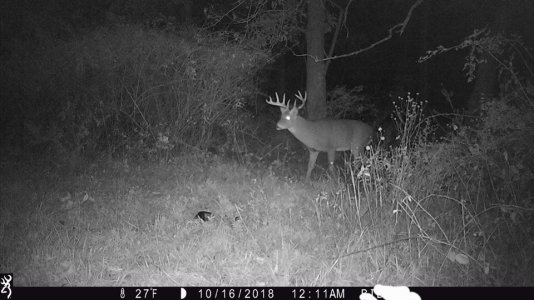
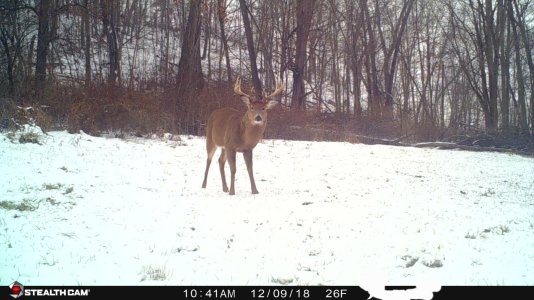
Here is another example, deer looked perfectly healthy all fall. By early December, we questioned if something was wrong and by end of December you could clearly see he was sick. Found him dead early January and we had him tested and it was confirmed CWD.44247797_10156601856566380_5051667192693653504_n.jpg47573303_10156717017551380_7936282930811240448_o-1.jpg49645492_10156780050041380_733591327668699136_o.jpg49381658_10156780050831380_8041420813934526464_o.jpg
 
Here is another example, deer looked perfectly healthy all fall. By early December, we questioned if something was wrong and by end of December you could clearly see he was sick. Found him dead early January and we had him tested and it was confirmed CWD.View attachment 90471View attachment 90472View attachment 90473View attachment 90474
Dang that’s sad. I see what you mean about that perma-head down look. Ugh
 
It'd be interesting to see what would happen to CWD rates if a management zone in mixed country (crop/timber/hay) quit spraying and plowing the farm fields for 4 years. It would test the theory of prions living in the soil and reinfecting deer as they eat off soils with no humic or fulvic acid where prions are believed to build up. The feds would need to pay to not crop those fields, but we've spent money on worse ideas. We could also make some glyphosate free honey too.

The cwd area in AR where the deer herd basically died out between hunting and cwd deaths is almost 100% mixed pine/hardwood forest.
 
The cwd area in AR where the deer herd basically died out between hunting and cwd deaths is almost 100% mixed pine/hardwood forest.

Back in 2012, we almost bought a cabin/hunting property in Newton County, AK. There is a lot of logging in the area, which made for good successional habitat on the larger scale, but made it challenging for small property landowners.

As for the prions, while the misfiled proteins do stay in the soil for decades, the "intensity and frequency" of exposure as a factor in spreading the disease is still being researched. What is known is that high concentration areas (mineral sites & bait areas where CWD positive deer are present and plants growing were a CWD positive carcass decomposed) are generally going to spread the disease to 100% of the deer using those sites or eating that browse. Decontamination of these small areas is possible using Sodium Hydroxide or with enzymes such as Prionzyme. However, in the wild decontamination is not practical.
It'd be interesting to see what would happen to CWD rates if a management zone in mixed country (crop/timber/hay) quit spraying and plowing the farm fields for 4 years. It would test the theory of prions living in the soil and reinfecting deer as they eat off soils with no humic or fulvic acid where prions are believed to build up. The feds would need to pay to not crop those fields, but we've spent money on worse ideas. We could also make some glyphosate free honey too.

While soil/plant uptake is not the primary transmission source Here is a breakdown of soil types and characteristics that hold CWD prions best, based on research from the National Academy of Sciences (note: the stuff below is "cut and paste")
  • Clay-Rich Soils: Soils containing high levels of smectite clays, such as montmorillonite, show the highest affinity for binding CWD prions. These soils are common in many CWD-endemic regions of North America.
  • Soil Type Examples: Prairie Chernozems (clay-loamy soils) are particularly effective at binding and keeping prions on the surface, preventing them from leaching deep into the ground.
  • Key Soil Characteristics:
    • High Clay Content: Clay particles have a large surface area that binds to the prions.
    • Higher pH: Soils with a pH greater than 6.6 are more likely to have a persistent presence of CWD.
    • Lower Humic Acid: While clay binds prions, some studies indicate that highly organic soils containing high levels of humic acid may actually degrade CWD prions and reduce their infectivity.
  • Soils That Do Not Hold Prions Well:
    • Sandy Soils: Quartz sand or sandy loam soils do not bind prions as tightly, allowing them to potentially wash away or leach deeper into the soil profile.
    • Illite Clay: Unlike montmorillonite, illite (common in northern boreal/tundra soils) does not bind prions as strongly.
While I would love to see a reduction in herbicide use, the primary advantage of good soil is not that it reduces CWD update (it does not), but rather that in areas with great quality browse, deer do to have to put their mouths on the ground (where feces and urine are present) and can be more selective in what they eat, which will likely reduce potential exposure.
 
Back
Top