• If you are posting pictures, and they aren't posting in the correct orientation, please flush your browser cache and try again.

    Edge
    Safari/iOS
    Chrome

C2 Ranch Controlled Burn

356

5 year old buck +
Here is the link to the original Land Tours post: https://habitat-talk.com/threads/c2-ranch.17932/post-406635
* * * * * * * * * * * * *
Got a call from our forestry company during family dinner on Saturday saying they were running ahead of schedule, and they'd be burning Sunday morning. That's today, the high temp is 80F a few days before new year, and I've got one more week of deer season left to hunt... You burn when they're ready to burn though, so I got up at o-dark-thirty and drove up.

We had planned to burn 65 acres, but the crew decided to add a fire break across a gulley I hadn't even considered trying to navigate, so it ended up being 70 acres instead. Couldn't get started due to the 90% humidity until about noon, but we had a great burn and got most of what I wanted burned -- for some reason big thickets of greenbriar and that half acre of invasives I spent all the time spraying and killing just hold a lot of humidity and won't burn. *shrug* next time.

Everything was either fairly open pines (think 50-70 DBH per acre), meadow, or thick mixed species bottomlands. We burned during the growing season 18 months ago and each time seems to get more effective.

20251228_131321.jpg


20251228_125044.jpg


20251228_145841.jpg


20251228_125819.jpg


20251228_131544.jpg


20251228_123827.jpg


20251228_152439.jpg
 
Thanks 356!

A couple of notes about our strategy and the process for us:

In East Texas, in the heart of timber and pine country -- we get a lot of rain in the winter and spring, with very warm temps, so we see a lot of growth throughout the year. For that reason, we're doing an 18-month cycle on burns, alternating the season each cycle. I believe that dormant burns help to reduce fuel and promote the growth of forbs, while growing season burns promote grasses more heavily and more significantly impact the growth of unwanted hardwoods. I'm not an expert, but my research leans me in that direction.

We still have a lot of thick growth that neither winter or spring burns can kill. This includes excessive volunteer pines in some areas. For this reason, I've been manually thinning the volunteer pines, or occasionally including them in a spray session. When wanting to kill pines along with the hardwoods, I mix gly in with triclopyr 4 - at a rate of about 4% gly and 1.5% tri-4. However, I can only cover so much ground with a 25-gallon sprayer and September is hot here, real hot. This coming year we'll be bringing in the forestry company with the skidder and spraying about 20 acres to help us better control a few areas that I can no longer easily manage. Then, this'll get picked up in the next growing season burn.

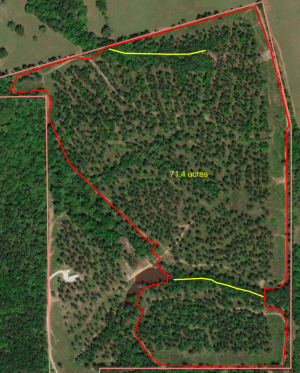
Here's our burn area - the two yellow lines include gulleys that had never been burned before. This means they had a lot of scrap and slash that had been pushed in the gulleys that caught fire. These log piles had to be put out at the end of the burn, or they would've kept burning for weeks. The crew sprayed them down before heading out for the day.

Screenshot 2025-12-29 103251.png

The crew consisted of five guys, one bulldozer, one fire truck, and one side-by-side with water sprayer. That wasn't enough people to keep on all of the fire lines, so myself and a friend monitored the fire lines on the north and east while they focused on the south and west. Wind was at about 16 mph out of the SW at the beginning of the burn, ending up at no wind at the end of the burn.

The fire breaks are mostly long-established trails around the perimeter, typically 16'-20' wide. For growing season burns, I simply mow them close - but for the dormant season, they're scraped with the dozer. We used a bridge and its path in/out as a new fire break this year, and that worked very well.

All backburns were done to 100+ feet before the head fires were set, and each head fire was limited to about 30 yards in depth to avoid starting out of control infernos. This is different than our growing season fires, where the head fires may be 50-100 yards deep.

We hired a forestry company, as Texas law really inclines you that way. You are encouraged, and allowed to burn your property, but you carry the liability. If you hire a certified burn manager, and they are onsite during the burn (plus a few other requirements), then you as the landowner, by law, carry no liability - the burn manager does.

The price is about 1.5x my annual insurance policy, but less than a fraction of what that policy would be if I had a burn claim. (If I could even get a new policy!) So, I find that to be cheap insurance on a burn this size.
 
Back
Top